
Frequency inverter
Braking energy return
Regenerative drives. The new generation of ABB frequency inverters feeds braking energy from electric motors back into the grid as almost harmonic-free current.
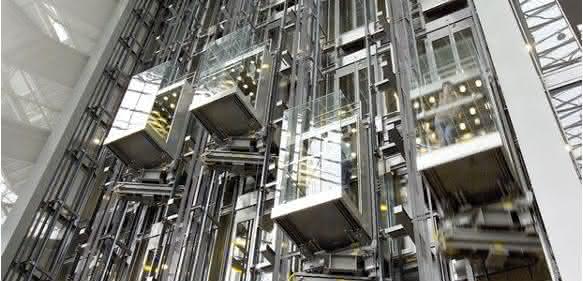
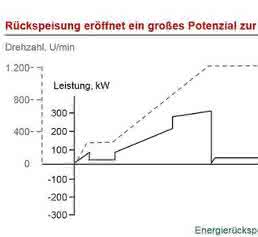
In industry, electric motors are often used in applications with numerous braking processes. A brake chopper and external electrical resistors dissipate braking energy in the form of heat. This then dissipates ineffectively or even has to be cooled with additional energy. Regenerative speed-controlled drives, on the other hand, can feed this braking energy back into the grid. This significantly improves energy efficiency.
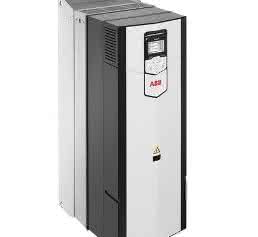
The regenerative frequency inverters ABB Industrial Drives ACS880 cover a power range from four to 3,200 kilowatts. They can significantly reduce energy consumption, reduce space requirements by up to 85 percent thanks to their compact design and thus also reduce investment costs by up to 30 percent, ABB calculates. In addition, the lower heat dissipation means that less expensive air conditioning is required in the electrical room. Recovered energy is "clean" and of high quality. It can be used by other consumers, which increases system efficiency. The new generation of ABB Industrial Drives can regulate the cosine phi of the fundamental oscillation to unity under all load conditions, so that reactive power and energy consumption are optimized.
An example shows how much energy such solutions save: for a crane for waste disposal with a 55-kilowatt hoist motor, a nine-kilowatt crane travel motor and a 4.5-kilowatt trolley travel motor and a regenerative frequency converter, the savings per year amount to an estimated 15.6 megawatt hours of energy - or the equivalent of around 2,300 euros. This 32 percent reduction corresponds to the average annual energy consumption of four German households.
Removing interfering harmonics
Non-linear electrical loads, including speed-controlled drives, cause harmonics that lead to undesirable distortions of the voltage and current in the grids. The harmonics lead to unreliable operation and can overheat other loads such as motors, transformers and other electrical equipment. This requires additional cooling, causes energy losses and, in the worst case, can lead to premature failures. Although additional electrical filters can dampen these harmonics, it is better to prevent them from occurring in the first place. This is exactly what the new generation of regenerative ABB frequency inverters does, preventing harmonics before they occur.
Less downtime thanks to greater reliability
The ACS880 regenerative frequency inverters are characterized by high immunity to mains interference and can keep the motor voltage stable or even increase it even when the supply voltage is unstable. This ensures reliable operation even if the feed-in voltage drops below the normal value.
By eliminating external brake components, ABB's regenerative frequency inverters can be built more compactly than conventional solutions. The resulting reduction in engineering and material costs and the smaller space requirement in the electrical room mean potential savings in cabinet construction costs. The ACS880-11 wall-mounted units, the ACS880-14 built-in modules and the ACS880-17 enclosure units have all the necessary components integrated in a ready-to-connect housing. This makes cabinet installation even easier and quicker, as there is no need for subsequent wiring of various components.
The ACS880 ensures full motor voltage under all conditions. The frequency inverters are equipped with DTC torque control and offer precise and dynamic speed and torque control for maximum motor performance and efficiency.
This means that these ABB solutions can meet even the highest demands, such as those required for applications on test benches. An ABB Industrial Drive ensures not only the necessary precision but also significant cost savings on the all-wheel drive test bench of a leading agricultural machinery manufacturer. Up to 90 percent of the braking energy that was previously converted into ineffective heat during the tests can now be recovered thanks to the ABB frequency inverter. Similar effects can also be achieved in other typical applications such as centrifuges, balancing stands, winders or turbines.
Digitalization and connectivity
The ACS880 also serves as a multiple sensor that reads out important information such as motor speed, motor torque, motor currents, various temperatures and many other parameters. This data is then available for diagnostics, remote monitoring and process optimization via ABB Ability - the bundling of all products, services and solutions in ABB's digital offering, including cloud connection. pb
Hall 11, Stand A35


You might also be interested in
ESTIA aims to strengthen Europe's cloud
New tech alliance for EU sovereignty
Twelve companies, including Dassault Systèmes, are founding the European Sovereign Tech Industry Alliance (ESTIA). The initiative aims to strengthen Europe's technological independence and define requirements for sovereign cloud services. The start...
 read more...
Deutsche Telekom and Nvidia launch one of Europe's largest AI factories
With the Industrial AI Cloud in Munich, Deutsche Telekom and NVIDIA are creating one of the largest AI factories in Europe. Companies can train AI models, carry out simulations and access 10,000 GPUs.
read more...Leveraging data potential with AI and streaming
Huge data treasures are still lying dormant in many manufacturing companies. And yet it is high time that these treasures were unlocked. There is often a lack of resources and capacity to make data usable in real time. Streaming production data can...
read more...More awareness of noise
Dematic offers solutions that are tailored to different cloud environments and reduce environmental impact through reduced material consumption and improved energy efficiency.
read more...Generative AI in the automation environment
The mechanical engineering and automation industry is undergoing profound change. This transformation is being driven by more volatile global trade, geopolitical crises and increasing market pressure, which demands greater agility, technological...
read more...Rigid data structures have had their day
The traditional data center is no longer the center of data. A hybrid cloud storage approach enables manufacturing companies to both meet the current requirements of data-intensive processes and future-proof their infrastructure.
read more...Software as a service in three stages
CIM Database Cloud is a new out-of-the-box solution from Contact for end-to-end digital product development.
read more...How production can benefit from AI
Together with AI technology, IIoT networking makes it possible to better control machine parameters and optimize quality with predictive quality. Downtimes and set-up times can also be further minimized. Cloud platforms also make these technologies...
read more...More expertise for digital engineering
Altair, a computational science and artificial intelligence (AI) company, has acquired OmniV, a technology from Michigan, USA-based software company XLDyn.
read more...