

Energy efficiency
Energy from storage
To increase energy efficiency, fittings manufacturer Hawle uses energy storage in a power and energy management solution for the new high-bay warehouse, which reduces the power requirements of the storage and retrieval machines by a factor of 7 to 10.

Pioneering spirit has always been a hallmark of the Hawle Austria Group. This began back in 1948 when company founder Engelbert Hawle invented the economy flange. He went on to revolutionize connection technology in water pipe construction with numerous other innovations. Today, Hawle is known all over the world for its wide range of pipe connections, fittings, shut-off, distribution and control valves.
"Our bestsellers include gate valves and hydrants," explains Andreas Bamberger, Energy Manager at E. Hawle Armaturenwerke. He is keeping an eye on the implementation of an energy management system in accordance with DIN EN ISO 50001 at the company headquarters in Vöcklabruck and at the production site in Frankenmarkt. "We are trying to improve the eco-balance and reduce energy consumption with a wide range of measures such as heating with sustainable raw materials, a consistent switch to LED lighting, increased use of frequency converters in motors or targeted heat recovery in compressors, refrigeration and ventilation systems," says the graduate eco-energy engineer, summarizing several projects that have already been implemented. This has resulted in savings of between 10,000 and 100,000 kWh per year. However, the Upper Austrians have achieved their greatest success to date in terms of energy efficiency with the use of an innovative power and energy management solution for industrial drives with power caps as energy storage units.
Greatly reduced peak power requirement
"It is part of our company philosophy to always be open to new technologies," says Johannes Kräutner. As a systems engineer, the long-time employee of the fittings manufacturer immediately pricked up his ears when Hörmann Logistik reported on a promising method for reducing the peak power requirement of storage and retrieval machines from 70 to 7 to 10 kW. In the end, this suggestion even decided the contract as general contractor for the construction of the new logistics hall. "At the time, we didn't choose the cheapest provider, but the most favorable one for our requirements," recalls the industrial engineer and explains: "We take a very close look at what is installed in our plants, and the intralogistics specialist Hörmann scored points with conveyor technology from Klatt, stacker cranes from Mias and a promising power and energy solution from SEW-Eurodrive."
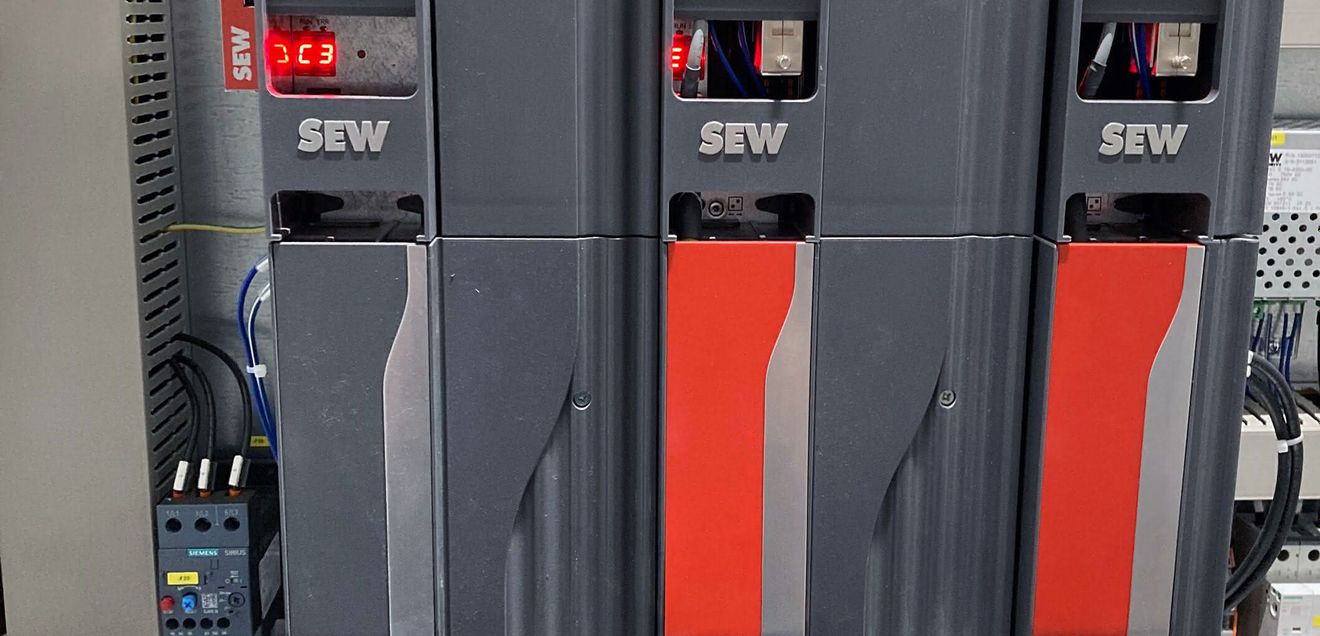
The way in which SEW-Eurodrive recovers energy in industrial drive systems, stores it temporarily and makes it available to cover peak loads or bridge power failures was awarded the Baden-Württemberg Environmental Technology Prize in the "Energy Efficiency" category in 2019. Powercaps form the heart of the system. In Hawle's control units, these electrical storage units buffer excess braking energy to release it for subsequent acceleration or start-up activities. This reduces power peaks and overall consumption. "According to our calculations, we save around 230,000 kWh per year with this state-of-the-art technology. That is roughly equivalent to the electricity consumption of 52 average households," says Energy Manager Andreas Bamberger.
Powercaps on board
A total of five aisle-bound single-mast SRMs with telescopic forks for double-deep pallet storage are in operation in the Hawle Austria Group's new 29 m high logistics hall. Each one of them weighs around 25 tons without load capacity and requires a corresponding amount of energy to be moved into the desired storage or retrieval position. "Normally, we would have had to plan for a peak power requirement of 60 to 70 kW per storage and retrieval machine on the grid side. Thanks to the Movi-C Power and Energy Solution from SEW-Eurodrive, however, this was reduced to a fraction of that," says Bernd Nebel, specialist project manager for automation technology at Hörmann Logistik. This not only has a positive effect on the customer's electricity bill, but also on the design of the infrastructure: The supply lines, fuses, cable cross-sections, the transformer and other components could be dimensioned smaller. The control cabinets for the storage and retrieval machines, in which the Powercap modules are also installed, are an impressive 1.8 m in size. Up to 3,300 recovered kWh are waiting to be used in these power storage units.
"The basic idea is to store the energy that has been fed into the system close to the application so that it can be called up as required. We can use the collected reserves to absorb peak loads, ensure grid stability or bring systems into a defined safe state in the event of a power failure," says Stephan Nick, sales engineer at SEW-Eurodrive in Munich. Hawle is already considering another Powercap application. According to Hermann Pichler, automation and control technician at the Frankenmarkt production site, the blast wheel blasting system, for example, is a good example. "Here, cast parts are blasted with steel shot in a rapidly rotating unit in order to achieve clean, uniformly homogeneous surfaces as the end result," he explains.
Green success project
At the Hawle Austria Group, ecological considerations have always been important. However, all investments in new technologies or systems must also pay for themselves within a reasonable period of time. "With every new acquisition, we think very carefully about how to operate it as efficiently as possible. The decision in favor of the Powercaps cost around 25,000 euros more per lane, but according to our calculations, it pays for itself from the fifth year onwards," says Andreas Bamberger, pleased with another "green success project". As a graduate in green energy technology, he immediately recognized the potential of this technology, which stores energy from regenerative operating states and then supplies it to the lift, travel or fork drives of the storage and retrieval machines. "It's like a photovoltaic system: you have to spend money once to purchase the appropriate infrastructure and then benefit for decades," says Bamberger.
Long-standing innovation partnership
A total of 195 drives from SEW-Eurodrive were installed in the high-bay warehouse of the Hawle Austria Group, 175 for the conveyor technology and 20 for the stacker cranes. "If one of our customers preferred another manufacturer, they would have to force us to change," says Bernd Nebel, specialist project manager for automation technology at Hörmann Logistik, referring to the close and trusting cooperation with SEW-Eurodrive. If required, commissioning support is also provided over several days. This was the case with Hawle, for example, as this project was a first for all involved. Even SEW-Eurodrive had not yet realized a comparable powercap project at that time. "SEW and Hörmann have a long-standing innovation partnership. With our combined expertise, we have already made several major leaps forward, which have brought many advantages for our customers," emphasizes Bernd Nebel.
After the weekend, Hawle was able to hit the ground running with all five storage and retrieval machines. "Normally, we would start them up one after the other and with reduced initial power to keep the power requirement in the power grid within limits," explains the Hörmann employee. Together with SEW-Eurodrive, a lot of tinkering, calculations and simulations were carried out in advance. How much energy flows into the power caps when the hoist moves from the top to the bottom, for which movements is a fully or half-charged energy storage unit sufficient, for which scenarios is additional power from the grid required? These and other questions had to be answered in terms of control technology. "In some cases, our feed-in power is even below the forecasts," says Johannes Kräutner, who was primarily responsible for the logistics hall project at Hawle.


You might also be interested in
When heat slows down production
Cooling concept for industrial halls with significantly reduced energy requirements
Infranorm is developing a cooling concept for industrial halls based on two-stage adiabatic cooling. According to the company, energy consumption can be reduced by up to 95 percent.
 read more...
Networked energy and automation solutions
Schneider Electric presents solutions for Industry 4.0 at Hannover Messe 2026: networked energy and automation technologies, AI-supported processes, modern control systems and strategies to combat skills shortages, safety risks and energy...
read more...Peak load management in forklift trucks
Intelligent energy management prevents expensive power peaks
Targeted and efficient energy management is becoming increasingly important for customers in the logistics sector: a large number of devices, different charging cycles and high electricity volumes mean that electricity is a critical cost factor for...
read more...AI is shaping logistics worldwide, supply chains are being restructured
The Agility Emerging Markets Logistics Index 2026 shows that artificial intelligence is being used almost everywhere in the logistics industry. At the same time, geopolitical uncertainties, tariffs and production relocations continue to drive the...
read more...New life for old machines
"When we talk about retrofitting, for us it's about giving a machine tool a second life that lasts just as long as the first," emphasizes Ralf Glatzeder, Head of the Reman department at Liebherr-Verzahntechnik in Kempten.
read more...Sustainability along the robot life cycle
Automation through the use of robots offers numerous advantages. One is often overlooked: Robots can make a valuable contribution to sustainability, for example by helping to reduce emissions. However, this requires the entire robot life cycle to be...
read more...Encoders increase the efficiency of servo...
Same performance with less energy
Electric motors in industrial applications are responsible for more than 40 percent of global electricity consumption. With encoders from Hengstler, the efficiency of drives can be significantly increased, resulting in a significant reduction in...
read more...Sustainable industry starts with efficiency
Electrification and digitalization are key levers for improving efficiency in industry. Optimizing efficiency requires an intelligent and flexible approach that makes full use of the available technical possibilities.
read more...Energy-efficient use of extraction and filter systems
How manufacturing companies can sustainably reduce their energy costs through clever and forward-looking system design.
read more...