
Drive technology in wine cellars
Great class from the oak barrel
Nord Drivesystems supplies the French wine pump manufacturer Cazaux Rotorflex with decentralized drive systems consisting of geared motors and frequency converters. Its new rotary lobe pumps are also equipped with drives from Nord and are in demand from winemakers and cellar masters all over the world - including in the world's largest growing region for high-quality wines, the Bordelais.
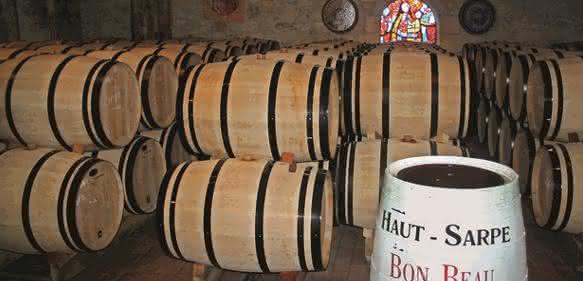
The Bordelais, the region around Bordeaux, is the largest contiguous growing area for AOC/AOP-certified wines. Over 3,000 vineyards line the landscape. The quality of a Bordeaux wine depends not only on the grape variety, soil conditions and location, but also on further vinification in the wine cellar, known as ageing. Despite all the tradition, producers today are supported by modern technology.
Château Haut-Sarpe is located not far from the town of St. Émilion. The vineyard has been run by the Janoueix family since 1934. The grapes from which the Château Haut-Sarpe, Saint-Émilion Grand Cru Classé is made after 15 months of refinement grow on the clay and limestone terroir. "A wine like this must express the complex character of its terroir," explains the oenologist in charge, Didier Beillon.
In the wine cellar, the hand-picked, sorted and destemmed grapes are first pressed in a press drum to open up the skins and bring the juice into contact with the yeast. This promotes alcoholic fermentation and releases the tannins, colorants, vitamins, enzymes and minerals contained in the skins. The mash is then pumped into concrete tanks, which are less susceptible to temperature fluctuations, for fermentation and maceration. During the conversion of the fruit sugar into alcohol, the resulting carbon dioxide drives the pomace to the surface.
The grape juice is pumped into barrique barrels made from French oak to mature into Grand Cru Classé. The barrique ensures that the wine absorbs the tannins from the oak, which give it a spicy accent. In the barrel, the remaining suspended matter refines the character of the wine and gradually settles to the bottom of the barrel. The wine must therefore be racked at regular intervals and transferred to new barrels before it is finally ready for bottling after around 15 months.
Decanting the wine using a pump
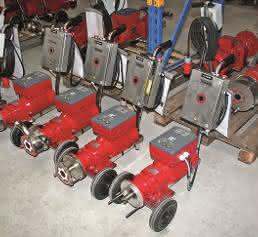
From the filling of the fermentation tanks to the repeated clarification of the wine, there are numerous pumping processes in which the medium has different consistencies. While the mash is viscous and interspersed with solids, the grape juice becomes increasingly liquid after fermentation and during the clarification process. The winery has purchased a new rotary lobe pump from Cazaux in order to be able to carry out all pumping processes with one machine. The LOB 300 can be used from the destemmed grapes to bottling and ensures a high, consistent flow rate. The LOB rotary lobe pumps are the latest development from Cazaux, which offers a wide range of pump technology for vinification. Across all series, the company relies on robust, slimline drive systems from Nord, which can be connected directly to the pump system. The decentralized integrated units with frequency converters mounted on the geared motor are very compact and lightweight.
Cazaux Managing Director Yves Le Guillou says: "Nord's drive technology allows us to offer different options for pump operation, whether with a potentiometer, radio remote control or a touchscreen on which the flow rate, pressure and speed can be set. This simplifies the work, especially with the cuvées of several grape varieties, because the cellar master can set the exact mixing ratio and the pump switches off automatically once the corresponding volume has been reached."
The pump manufacturer has been working with Nord Drivesystems for electrical drive technology since 2009. "We turned to the French Nord agency back then because the products from the previous supplier were not reliable enough for us," says Le Guillou. Today, Cazaux purchases almost 400 products from Nord every year. In addition to the high level of reliability, the pump manufacturer was won over by the compact design, low-noise operation and versatile range of functions. "Drive technology for wine pumps was still new territory for us at the beginning," says the Nord sales manager for south-west France. "However, it quickly became clear that the decentralized drive units in our Nordac Flex series also meet all the requirements for wine pumps."
High control quality
The frequency inverters in the Nordac Flex series are characterized by their high control quality. The drive regulation, which extends into low speed ranges, prevents strong turbulence. The drive systems ensure sensitive adjustment of the flow rate. In addition, the inverter ensures smooth starting and stopping, enables self-regulating speeds that adapt to specified pressure ranges and offers effective dry-running protection.
Oenologist Didier Beillon summarizes what is important for wine pumps: "Because wine is a sensitive product, the pumping processes must be gentle. At the same time, high and consistent flow rates are required so that further processing does not come to a standstill." This is ensured by the operating principle of the rotary lobe pump. The powerful drive allows pumping distances of up to 80 m and fills a barrique in two to three minutes. am


You might also be interested in
Plagiarius 2024 negative prize
On January 26, 2024, the Plagiarius campaign awarded its dreaded "Plagiarius" negative prize for the 48th time to manufacturers and retailers of particularly brazen counterfeits and fakes.
 read more...
Ivalua honors winners of the Generative AI...
AI-supported "add-ons" for buyers within 48 hours
Ivalua, provider of cloud-based spend management solutions, announced the winners and innovations of the first Generative AI Innovation Cup. The competition took place in December 2023. It was open to all Ivalua partners and employees - more than...
read more...Efaflex celebrates 50 years of high-speed...
The emphasis is on "fast"
Since day one, Efaflex has wanted to use new technologies as early as possible and drive progress in the industry. This year, the family business is celebrating its 50th anniversary under the motto "Fast Forward".
read more...Security of supply even during power outages
In the winter of 2022, Germany was worried about energy shortages. The drugstore retailer dm did not paint any horror scenarios, but nevertheless saw the possibility of controlled, temporary, regional power cuts (brownouts).
read more...Safety technology in mechanical engineering
Modules with new functions
Euchner's product highlights at EMO 2023 include the communication-capable solenoid interlocks.
read more...Transforming the paper industry towards climate neutrality
Together with partners from industry and research, Voith is developing a project for the optimization of energy and material flows in paper production. The aim of the research project is to develop a digital framework that enables effective process...
read more...Up to 95 percent less flue gas thanks to direct extraction
The requirements for occupational safety measures and safety technology are also constantly increasing in welding technology. The Technical Rules for Hazardous Substances (TRGS) stipulate that welding fumes and harmful substances must be extracted...
read more...Competitive advantages with large machines
Whether 3D-printed components for machines and systems, prototypes or aids for design: additive manufacturing is almost indispensable for modern companies in mechanical and plant engineering and automation if they want to play in the premier league.
read more...Transport technology from the modular system
Many transport tasks can be realized with the help of linear technology. Pre-configured solutions are available to simplify the interaction between the linear unit, motor, gearbox and controller. This minimizes the effort required for research and...
read more...