

Drive technology
The inverter becomes a signpost
ABB has integrated position control into the frequency inverter. Fred Donabauer talks to handling editor Annina Schopen about the advantages of this and where the Industry 4.0 journey can still take us.
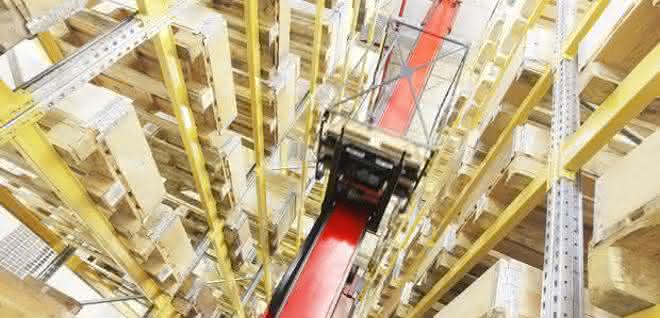
ABB has integrated position control into the ACS880 frequency inverters, what are the advantages of this?
Donabauer: Different devices are often used for position control and for speed and torque control. In this case, a higher-level motion controller takes over the position control and the inverter only the speed and torque control. This naturally requires an additional hardware component for position control, specific tools, user interfaces and programming languages. Servo controllers are also used in such applications, but the upper performance range is limited here.
If the position control is now relocated to the inverter, this has the advantage that the additional hardware component can be dispensed with. It simplifies installation, but also engineering. The inverter has several pre-programmed functions such as homing modes, absolute and relative positioning, positioning profiles, axis synchronization and fast reference position detection. These functions are already preconfigured and only need to be set by parameterization.
How does parameterization work?
It's very simple. The ABB standard commissioning tool, our Drive Composer, is connected to the inverter. This can be done either via Ethernet or a USB interface. This tool can be used to display and set the drive parameters or to monitor and tune the drive train. The extension to position control is ultimately an option for the frequency inverter. When ordering, the customer can decide whether the software should be implemented in the inverter.
In otherwords, you can use the software on all product variants of the ACS880?
We install the software on the industrial inverters as an option. This allows us to cover the power range from 0.55 to 5,600 kilowatts at a voltage of 230 to 690 volts - the complete bandwidth in all versions.

And we use the different hardware variants. This can be a wall-mounted device, then we have built-in modules especially for the control cabinet, but we can also supply complete cabinet devices. We also supply the inverters with a high degree of protection, up to IP55, which means that a device can also be installed decentrally close to the process. In this case, we do not need a switchgear house with clean air; somewhat harsher ambient conditions are no problem.
What applications is the ACS880 frequency inverter suitable for?
A typical application can be found, for example, in rack conveyor vehicles in high-bay warehouses. However, it is also generally suitable for applications involving the transportation of goods. It is also used in sheet metal presses, in sorting and packaging lines, for rotary tables, which also have to move to a certain position, or for cutting systems. They can even be used in mixers. One customer has tested this: To clean the mixer, the tool has to be moved to a certain position, using the inverter with position control, and without encoder feedback.
Saving energy: The ACS880 also enables regenerative solutions.
The regenerative inverter is often used for position control. To prevent the braking energy from being wasted as heat via a braking resistor during frequent acceleration and deceleration, it is fed back into the mains via the frequency inverter. In multi-axis systems, where several motors accelerate and brake in different cycles, our Multidrive system is often worthwhile. Not all frequency inverters need to be connected to the grid for feedback. Instead, the one that is braking feeds its energy back to the one that is accelerating and currently needs energy.
What safety functions does the inverter have?
There are quite a few. We have the Safe Torque Off (STO) function as standard in every inverter, optionally Safe Stop 1 (SS1), Safely Limited Speed (SLS), Safe Maximum Speed (SMS), Safe Brake Control (SBC), Safe Direction of Rotation (SDI), Prevention of Unexpected Start (POUS) to ensure that the machine does not start up on its own. This is often used for paper machines.
Safe Speed Monitoring (SSM) monitors whether the drive is running within a certain speed range, and of course there is Safe Emergency Stop (SSE) and Safe Motor Temperature (STM), because in hazardous areas it is particularly important that the motor temperature is safely monitored. We achieve performance level e (PLe, SIL3). And what makes us unique is that we can do this without encoder feedback. This saves one component and therefore the cabling, the probability of failure is lower and it reduces maintenance.
Let's move on to Industry 4.0, digitalization and big data: frequency inverters are also suitable for collecting motor data. What is possible with the ACS880?
We are very active in this area. We now monitor the entire drivetrain with sensors, and the inverter itself already has built-in intelligence thanks to the electronics that collect data such as air intake temperature, semiconductor temperature, torque, speed and power.
We do the same with the motor. We have a smart sensor that we place on the motor and that collects data. The sensor sends this data to an ABB cloud via a Bluetooth interface with the help of a smartphone or a gateway. Information on parameters such as vibration, temperature or speed is passed on so that it is easy to see how the motor is doing. This means that the user is informed early on whether damage is imminent and can schedule a preventive maintenance appointment. The inverter also has an interface to the cloud and provides information on this. We have dashboards on which we use a traffic light system to show how the components are doing and the customer can set a level at which they would like to be warned.
What other innovations do you have planned?
We are working most on digitalization. Integration into the cloud and displaying the entire drivetrain on one platform are developments that are already at an advanced stage. But there is still more to come.
We are also active in the field of virtual commissioning. In the past, there was already a tool for parameterizing the inverters, but whether everything worked as desired only became visible during commissioning. We now have a solution in which the inverter firmware is embedded in the tool as an add-on. This allows the load, motor and inverter to be defined virtually and the system to be tested. It behaves almost like in reality. This allows the customer to set parameters, run the device, see the current and torque and also simulate commissioning. The data can then be downloaded to the real machine and only a few fine adjustments need to be made.
But we don't stop at the motor shaft, we don't just simulate the inverter and the motor, we can also virtually represent complex systems, for example a complete crane. We can drive the crane virtually and see how it will behave under different operating conditions.
Mr. Donabauer, thank you very much for the interview.


You might also be interested in
ESTIA aims to strengthen Europe's cloud
New tech alliance for EU sovereignty
Twelve companies, including Dassault Systèmes, are founding the European Sovereign Tech Industry Alliance (ESTIA). The initiative aims to strengthen Europe's technological independence and define requirements for sovereign cloud services. The start...
 read more...
Deutsche Telekom and Nvidia launch one of Europe's largest AI factories
With the Industrial AI Cloud in Munich, Deutsche Telekom and NVIDIA are creating one of the largest AI factories in Europe. Companies can train AI models, carry out simulations and access 10,000 GPUs.
read more...Leveraging data potential with AI and streaming
Huge data treasures are still lying dormant in many manufacturing companies. And yet it is high time that these treasures were unlocked. There is often a lack of resources and capacity to make data usable in real time. Streaming production data can...
read more...More awareness of noise
Dematic offers solutions that are tailored to different cloud environments and reduce environmental impact through reduced material consumption and improved energy efficiency.
read more...Generative AI in the automation environment
The mechanical engineering and automation industry is undergoing profound change. This transformation is being driven by more volatile global trade, geopolitical crises and increasing market pressure, which demands greater agility, technological...
read more...Rigid data structures have had their day
The traditional data center is no longer the center of data. A hybrid cloud storage approach enables manufacturing companies to both meet the current requirements of data-intensive processes and future-proof their infrastructure.
read more...Software as a service in three stages
CIM Database Cloud is a new out-of-the-box solution from Contact for end-to-end digital product development.
read more...How production can benefit from AI
Together with AI technology, IIoT networking makes it possible to better control machine parameters and optimize quality with predictive quality. Downtimes and set-up times can also be further minimized. Cloud platforms also make these technologies...
read more...More expertise for digital engineering
Altair, a computational science and artificial intelligence (AI) company, has acquired OmniV, a technology from Michigan, USA-based software company XLDyn.
read more...