
Motors with and without brushes
DC or BLDC motors?
Brushed and brushless DC motors both have their advantages and disadvantages. But which type is better suited to the respective application? The most important properties of the different types determine their use. Here is an overview.
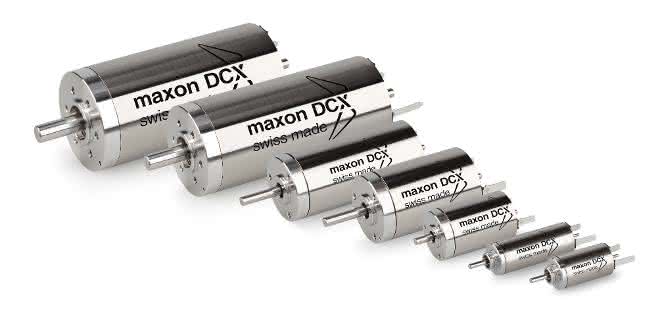
Anyone who relies on compact direct current motors in drive technology must first make a choice - between brushed (DC) and brushless (BLDC) motors. At Maxon, the latter are also known as EC motors (electronically commutated). The following text serves as a guide for selecting the right motor type for a specific application.
The commutation system with brushes limits the service life of the DC motor. Normally, several thousand hours can be achieved, in the best case perhaps 10,000 hours. However, the service life can also be over after less than 100 hours. An exact prediction is hardly possible as there are no reliable calculations. Much depends on the load. High current, high speed, reverse operation and high vibrations reduce the service life. A comparison with a similar application is therefore often necessary.
In brushless DC motors, the ball bearings limit the service life of the motor, which can be estimated fairly precisely. Typically, the bearings are designed for several 10,000 hours. However, the following still applies: For many applications, an operating time of a few 1,000 hours is easily sufficient.
Speed and torque
As a starting point, we consider a brushed DC motor of a given size. These designs are only trends. The speeds and torques that are possible depend specifically on the motor type in question. A brushed DC motor can reach speeds up to a maximum of 20,000 rpm . In most cases, however, the limit speed is below 10,000 rpm. At higher speeds, the service life of the motor decreases dramatically due to increasing electrical and mechanical wear.
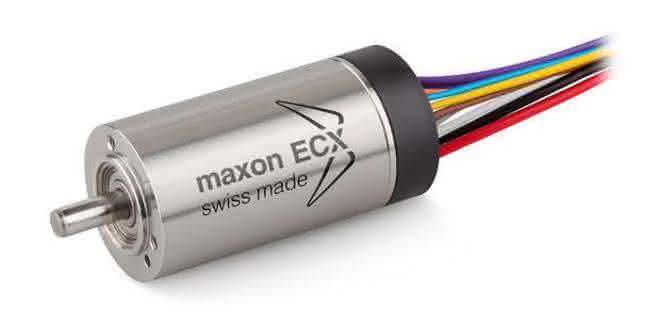
A brushless DC motor comparable in size and magnetic design can be operated at much higher speeds, in some cases over 100,000 rpm. Such drives are therefore perfect for applications that require a lot of speed, such as industrial cutters, milling cutters and certain fans. It is interesting to note that brushless motors are often designed with multiple poles. This increases the torque, but at the expense of speed. This is because many applications do not require the extremely high speeds, but a little more torque is very welcome. And yet: one of the main advantages of brushless motors is the higher speeds.
Special ambient conditions
The brush system of DC motors can lead to complications in special applications:
- Brush fires cause electromagnetic interference that may need to be attenuated. In explosive gases, the sparks are not exactly welcome. However, even a brushless motor requires modifications in order to be explosion-proof.
- Graphite brushes generate graphite dust, which can contaminate clean rooms, vacuum or optical applications.
- Graphite brushes also need a certain amount of moisture and some oxygen in the atmosphere to work well.
- Precious metal brushes need to be lubricated. As a result, neither brush system is suitable for high vacuum applications.
For these reasons, most motors for special ambient conditions are brushless. This applies, for example, to applications in ultra-high vacuum, in deep drilling or in sterile devices for medical technology.
Control and operation
When it comes to operation, there is no motor that is as easy to operate as the DC motor with brushes. One voltage at the two connections is enough to get the motor turning. In contrast, brushless motors require additional commutation electronics. The wiring is more complex, as there are up to eight connections.
However, the situation changes with controlled drives: In most cases, the controllers for speed, position or torque can be used with both motor types (DC and BLDC). In these cases, the costs for the electronics and the feedback sensor as well as the cabling are very similar.
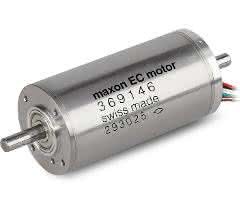
Various criteria play a role in the decision for a brushed or brushless motor. Whether a brushed or brushless DC motor makes sense depends on various criteria:
- required speed - with advantages for brushless motors at high speeds.
- Service life - again with advantages for brushless.
- Ambient conditions - adaptations are usually easier with brushless motors.
- Cabling and operating costs - with advantages for simple drives on the brushed side.
Whether the decision is made in favor of DC or BLDC motors ultimately depends on technical considerations. However, environmental conditions, service life aspects and economic considerations also play a role. If the user takes all aspects of the application into account, they will find the right solution. If help is needed in selecting a drive, the experts at Maxon will be happy to help.
Urs Kafader, Head of Technical Training at Maxon / am


You might also be interested in
Plagiarius 2024 negative prize
On January 26, 2024, the Plagiarius campaign awarded its dreaded "Plagiarius" negative prize for the 48th time to manufacturers and retailers of particularly brazen counterfeits and fakes.
 read more...
Ivalua honors winners of the Generative AI...
AI-supported "add-ons" for buyers within 48 hours
Ivalua, provider of cloud-based spend management solutions, announced the winners and innovations of the first Generative AI Innovation Cup. The competition took place in December 2023. It was open to all Ivalua partners and employees - more than...
read more...Efaflex celebrates 50 years of high-speed...
The emphasis is on "fast"
Since day one, Efaflex has wanted to use new technologies as early as possible and drive progress in the industry. This year, the family business is celebrating its 50th anniversary under the motto "Fast Forward".
read more...Security of supply even during power outages
In the winter of 2022, Germany was worried about energy shortages. The drugstore retailer dm did not paint any horror scenarios, but nevertheless saw the possibility of controlled, temporary, regional power cuts (brownouts).
read more...Safety technology in mechanical engineering
Modules with new functions
Euchner's product highlights at EMO 2023 include the communication-capable solenoid interlocks.
read more...Transforming the paper industry towards climate neutrality
Together with partners from industry and research, Voith is developing a project for the optimization of energy and material flows in paper production. The aim of the research project is to develop a digital framework that enables effective process...
read more...Up to 95 percent less flue gas thanks to direct extraction
The requirements for occupational safety measures and safety technology are also constantly increasing in welding technology. The Technical Rules for Hazardous Substances (TRGS) stipulate that welding fumes and harmful substances must be extracted...
read more...Competitive advantages with large machines
Whether 3D-printed components for machines and systems, prototypes or aids for design: additive manufacturing is almost indispensable for modern companies in mechanical and plant engineering and automation if they want to play in the premier league.
read more...Transport technology from the modular system
Many transport tasks can be realized with the help of linear technology. Pre-configured solutions are available to simplify the interaction between the linear unit, motor, gearbox and controller. This minimizes the effort required for research and...
read more...