

Logistics solution of the future
Continental supports Hyperloop technology
The technology company Continental is driving forward the future of logistics and is involved in Hyperloop development.
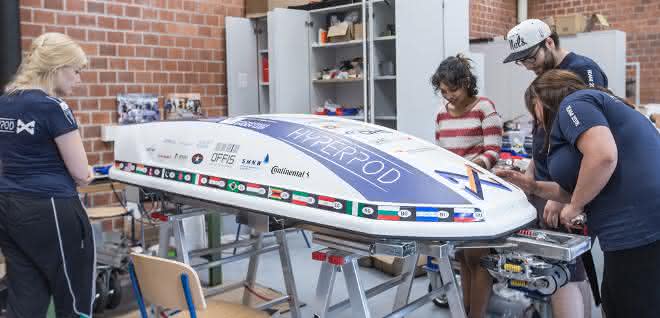
Most recently, the company supported the research work of young talents: for the "HyperPodX" project, students from the cooperative Engineering Physics course at Emden/Leer University of Applied Sciences and the University of Oldenburg developed a Hyperloop as part of a competition organized by the American company SpaceX. The drive is provided by a high-performance belt from Continental.
"The mobility of the future will also travel by rail. Safe, reliable and, above all, fast transportation is crucial for the logistics of the future. Increasing flows of goods will hardly be covered by today's existing infrastructure. The industry needs new, efficient alternatives," explains Hans-Jürgen Duensing, member of the Continental Executive Board. "We therefore see new rail transport solutions such as the Hyperloop as a promising technology for the future and are passing on our expertise from over 90 years of industry knowledge to the engineers of tomorrow."
Low air resistance ensures extreme speed
The Hyperloop system would make it possible to transport people and goods at speeds of more than 1,000 km/h - similar to airplanes. The advantage over air transportation is that the Hyperloop is much more environmentally friendly and could be used at the same speed as a subway. The technological concept is based on the idea of reducing the usual resistance of regular trains in tunnel-like tubes in order to achieve much higher speeds with the vehicles. Above all, air resistance is reduced to almost zero. The air pressure in the tubes is only one percent of the usual air pressure in the atmosphere. In addition, the Hyperloop does not need wheels, so there is no friction here either. Instead, the capsule-shaped vehicles use magnetic levitation technology or air cushions for locomotion.
Concrete Hyperloop projects conceivable in the near future
A distance of 1,000 kilometers in one hour? For the logistics industry, the idea of using such a means of transportation between global production sites opens up numerous new opportunities in logistics. "It will be around three to five years before the first Hyperloop is actually used to transport goods," predicts Prof. Dr. Walter Neu, Hyperloop expert from Emden/Leer University of Applied Sciences. "Various test routes are currently under construction, for example in France and the United Arab Emirates, and the Vienna-Prague route is also under discussion."
If the Hyperloop technology proves itself there and specific projects are realized, companies will not only benefit from the much faster transport of goods compared to current rail vehicles or trucks. Thanks to its low resistance, the Hyperloop requires only a fraction of the energy and is therefore both a cost-effective and sustainable solution. The system also relieves the burden on the road and rail network. In the long term, the Hyperloop will also be used for passenger transportation.
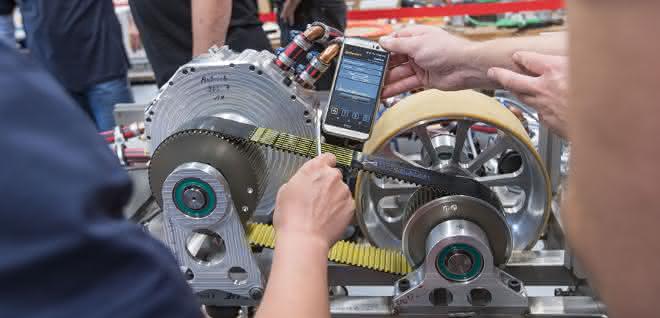
Drive belt from Continental meets Hyperloop requirements
Continental recognized the potential of the technology early on and is working with young talents in development work. For example, in a current project with students from the Emden/Leer University of Applied Sciences and the University of Oldenburg. Under the guidance of Professors Walter Neu and Thomas Schüning, they have spent the past nine months thinking about how high speeds can be achieved safely and reliably. Their specific task for the SpaceX competition was to develop a prototype for a Hyperloop with a drive that achieves high acceleration in a vacuum, can brake and has its own power supply.
The students met this challenge with an electric motor with 170 kilowatts of power. This propels the 250 kg prototype to a top speed of up to 500 km/h. "We needed a high torque and a very powerful belt for our drive. Continental initially advised us and ultimately provided us with a suitable special belt which, thanks to its material properties, can reliably cope with the high acceleration forces of the Hyperloop and use in a vacuum," says Neu, summarizing the requirements.
Alexander Behmann, application engineer at Continental, adds: "With its carbon cord and polyurethane construction, the belt is both extremely energy-efficient and very narrow, making it extremely light. It is also very reliable without maintenance. And it is precisely these aspects - power, reliability and low weight - that are important for a Hyperpod." The belt has already successfully passed its first test: The rides on the SpaceX test track in Los Angeles went well and the team of mechanical and electrical engineering students from Emden/Leer University of Applied Sciences placed in the top 10 of the competition.


You might also be interested in
BS Rollen Strengthens Its Presence in North Rhine-Westphalia
With the groundbreaking ceremony, BS Rollen is launching the construction of a new company facility in Hückeswagen. The new building will house administrative offices, an assembly line, and a high-bay warehouse, and is intended to facilitate further...
 read more...
Micro motors as the driving force behind intralogistics
Suitable transport structures in intralogistics are a prerequisite in all industries in order to withstand competitive pressure in the future. The basis for this is comprehensive automation, which would be inconceivable without an armada of powerful...
read more...E-scooter with customizable damping
The startup Scuddy has significantly improved the flexibility, performance, customizability and ergonomics of its second-generation foldable e-scooter of the same name - thanks in part to damping technology from ACE.
read more...Electric multidirectional counterbalanced...
360-degree steering on three wheels
Hubtex has given its FluX electric multidirectional counterbalanced truck an update: The new generation for the three-ton capacity class.
read more...New FLUX: 360-degree steering on 3 wheels
HUBTEX presents the new generation of the FLUX 30 electric multidirectional counterbalanced truck (load capacity 3 t). The innovative 2-in-1 stacker is both a front and sideloader. With its patented 360-degree HX steering, it transports both long...
read more...Norelem supports VDI Racing Camp
Mastering the challenges of e-mobility
Promoting young talent has been a priority at Norelem for many years: the company supports young talents with components and the necessary know-how and provides schools with illustrative material.
read more...igus:bike honored with German Design Award 2023
A wide, angular frame made of plastic, black wheels with Y-spokes: The futuristic look of the bicycle designed by Dutch bicycle developer mtrl with motion plastics from Igus can look forward to the prestigious German Design Award 2023.
read more...Floating garbage trap cleans up the Rhine
Every day, a ton of garbage flows down the Rhine. To catch some of it, the Cologne-based Krake association has now inaugurated a floating garbage trap. One of the sponsors of the so-called Rhine octopus is the plastics specialist Igus.
read more...Torwegge presents FlexO rollers
Visitors to the FMB - Supplier Fair for Mechanical Engineering can once again look forward to a new product at the Torwegge stand this year: the FlexO rollers.
read more...