

Ball screws
Product development according to customer requirements
August Steinmeyer specializes in the development and manufacture of high-precision ball screws and offers a wide range of solutions for various industries and applications.
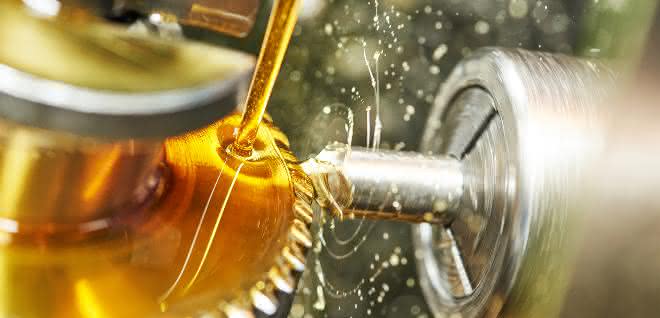
August Steinmeyer has been manufacturing ball screws in Albstadt for more than 50 years. Thanks to many years of experience, the processing of high-quality materials and state-of-the-art production technologies, the company can offer a wide range of products of the highest quality: from heavy-duty ball screws, which are used in injection molding machines or presses, for example, to miniature ball screws for the optical industry and precision ball screws for machine tool construction.
"Machine tool and special machine construction is our key industry," says Jens-Uwe Gühring, Sales Manager at Steinmeyer. "Our ball screws are used in machining centers, lathes, milling machines and grinding machines, among other things." The company offers precision ball screws in sizes ranging from less than 20 to over 100 mm in diameter for positioning and feed tasks. They guarantee a backlash-free and dynamic conversion of rotary movements into longitudinal movements and at the same time meet high requirements in terms of rigidity and service life.
In order to minimize machine downtime and repair and maintenance costs, the requirements placed on the installed components in terms of reliability and load capacity are particularly high. In addition, they must meet individual requirements depending on the application. For example, some applications require particularly high quality and precision, while others require robustness, tight installation spaces or the particular cost-effectiveness of the components.
Positioning and transport ball screws
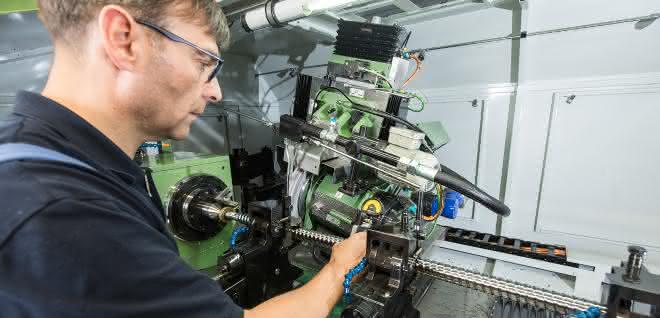
Steinmeyer offers two different types of ball screws for tool and special machine construction: On the one hand, positioning ball screws, which are usually used for positioning tasks or applications with increased demands on running properties, for example in machine tools. These are usually designed with a ground spindle thread.
The company also manufactures transport ball screws, which are typically used in handling axes or feed systems and are designed with a rolled or whirled spindle thread. Thanks to their efficient manufacturing process, they are particularly impressive due to their favorable price-performance ratio combined with high precision. According to DIN, the tolerance classes for positioning ball screws are designated P (1-5), while transport ball screws are designated T (7-10).
Drawing and feasibility check
During product development, Steinmeyer's specialists discuss with the customer which criteria must be met for the respective application. The company supplies ball screws for mechanical engineering mainly with a spindle shaft according to customer drawings. This is required in order to prepare a detailed quotation. A sketch is usually also sufficient for a price and delivery time information. "We need a drawing or sketch so that we can check the feasibility of the respective inquiry," explains Gühring. "We look at the geometric data and load capacity specifications for the application and use the drawing to check whether it complies with the generally applicable standards, whether it can be implemented in terms of production technology or whether there is still a need for optimization in the design, for example through a different nut preload or improved sealing, in order to save costs and effort."
Steinmeyer has a complete modular system with components that can be combined as required for the composition of the ball screws. This includes various nut types for precision ball screws with nominal spindle diameters of 16 to 125 mm in tolerance classes P1 to P5 with connection dimensions in accordance with DIN 69051 or ISO 3408. The customer can select different load capacities for all sizes due to different load ratings based on the different number of revolutions.
The selection of nut, ball diameter, deflection, wiper and lubrication is the responsibility of the manufacturer, whereby individual requirements regarding quality, service life, load capacity and reliability must be met. "For factors such as pitch, nominal diameter, spindle length, bearing, installation position and journal design, we are guided by customer specifications," reports Gühring. "To ensure the highest possible quality of our ball screws, we also check the nut stiffness and required load ratings."
Different nuts for different requirements
For precision ball screws, Steinmeyer offers ball screw nuts as single nuts with 4-point contact, double nuts with 2-point contact or in ETA+ design.
Single nut with 4-point contact
Single nuts are one-piece nuts that have no pitch jump or offset of their internal thread. They are only preloaded via ball interference. The ball kinematics are also influenced by the four contact points, so that the single nut with preload always has a slightly poorer efficiency than a nut with two-point contact. Single nuts also react somewhat more strongly to manufacturing tolerances, so that very long spindles are not normally fitted with preloaded single nuts. The advantages are compactness, economy and the fact that no balls are relieved during force peaks. Single nuts are mainly used for applications with a small installation space and less stringent quality requirements, such as simple feed axes.
Double nut with 2-point contact
At Steinmeyer, the two-piece double nut is not preloaded with the usual intermediate ring, but with the patented Unilock connection. This design is frequently used in grinding machines, for example, making it practically as compact and rigid as a one-piece nut. In addition, the Unilock connection also ensures a stable connection between the two nut halves and makes the double nut very robust. The connection between the two nut halves is also liquid-tight, so that no lubricant is lost. Other advantages are the good efficiency and high rigidity due to the two-point contact, the comparatively simpler production, especially for very long nuts or with a large pitch angle, and the easy, infinitely variable adjustment of the preload without changing the ball. Compared to the single nut, however, the design is larger and the costs are somewhat higher.
The top class ETA+
If particularly high quality and reliability are required, Steinmeyer recommends the ETA+ nut technology. This nut design was developed by Steinmeyer several years ago and is still unique today. It is characterized by significantly improved efficiency, reduced friction and noise development as well as increased rigidity. An ETA+ ball screw drive thus achieves significantly better dynamics compared to conventional double nuts and the positioning accuracy of a feed axis can also be increased. ETA+ technology therefore contributes to a significantly longer service life of a ball screw. This design is frequently used in highly dynamic machining centers, for example.
Nut preload
Ball screw nuts are preloaded in order to achieve higher positioning accuracy, better rigidity and higher travel speeds for feed axes. This is the only way to achieve machining operations on machine tools that achieve the required accuracies, cutting depths etc. with minimum non-productive times (e.g. for HSC machining). The type of preload varies depending on the application. Preloads are possible via ball interference, unilock connection, spring preload, pitch offset and pitch offset in combination with ball interference.
Steinmeyer manufactures three different types of deflection. For many sizes, the deflection cannot be selected as it is determined by the design conditions. For certain sizes, the type of deflection can be determined depending on the application. For smaller pitches, for example in positioning axes, the internal ball recirculation system is recommended, so that the best running properties can be achieved even with oscillating motion. Wear and variation of the friction torque are significantly reduced. For large inclines, Steinmeyer recommends the external recirculation of the balls - i.e. the recirculation of the balls over the entire length of the nut: this achieves maximum travel speeds with minimum heating. The deflectors, which are individually designed for each size, guide the balls smoothly into the return channel. Their geometry is precisely designed to minimize friction.
Lubrication and wipers
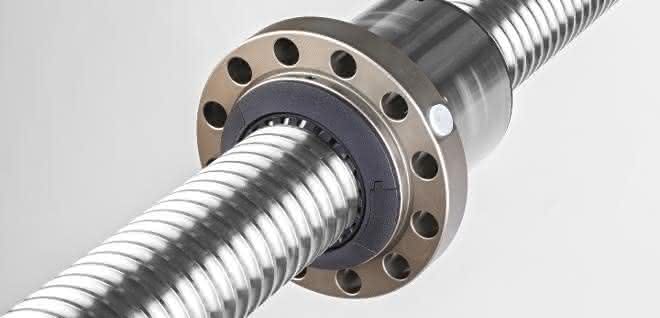
At Steinmeyer, the ball screw drives are pre-lubricated at the factory. Mineral oils or rolling bearing greases with wear-reducing additives are used for this purpose. To calculate the lubrication, the degree of contamination is defined by the ambient media - from the clean room to ceramic processing - and the dynamics of the application and the type of wiper are taken into account. For example, highly dynamic drives require more oil with a lower viscosity, standard applications require less, but more viscous oil. When using double wipers, the oil quantity is reduced to around half the specified value. For machine tools, the manufacturer recommends special wipers or so-called double wipers, which reliably remove both coarse dirt particles such as chips and prevent dust from entering the nut.
The service life of a ball screw can be calculated using data on the loads, speeds, machining forces and travel speeds of a machine. The calculation of the service life of a ball screw described in ISO3408 is based on the assumption that material fatigue is the decisive criterion. Strictly speaking, however, this calculation is only part of the service life. For many ball screws, wear is much more relevant than material fatigue. Therefore, both the preload as a permanent load - especially with high rapid traverse rates - and external influences such as lubrication, contamination, temperature range, installation tolerances to be observed and running accuracy must be taken into account. The original theory was therefore expanded based on the specifications of DIN 69051 / ISO3408.
"We recommend adhering to certain positional tolerances when installing ball screws," says Gühring. The parallelism between the guide and the ball screw axis as well as the perpendicularity of the nut fastening ensure that the drive unit is not distorted and a longer service life is achieved. Misalignment can lead to premature failure of the ball screw. After installation, ensure that the ball screw can be moved smoothly in all positions depending on the preload. If the nut is located at the outermost point of the spindle or as close as possible to the bearing, any tension can be best detected.
Service is a top priority
Steinmeyer is known for its high-quality products and excellent service. Industrial companies and machine builders from all over the world rely on the products from the manufacturer with the "Made in Germany" seal. "We respond individually to the wishes of our customers and attach great importance to comprehensive and personal advice. In addition, we are always there for our customers, on the phone or on site through our sales representatives," concludes Gühring. "Our ball screws are not only characterized by the highest precision and best quality, they are also constantly being further developed - this makes us unique on the market."


You might also be interested in
Protection against electrostatic discharge
StoFloor ESD KU 614 from StoCretec: dissipative flooring with the latest technology meets all ESD standards, is economical, extremely durable, mechanically and chemically resistant. The surface can be adjusted to be slip-resistant. The system is...
 read more...
Cables and wires from Helukabel
Food cultivation on a new level
Vertical farming - cultivation in multi-storey greenhouses - is considered one of the most exciting trends in food production. One of the pioneers in this field is the Romanian start-up Ultragreens. The company relies on solutions from Helukabel to...
read more...Further training for specialists to become security experts
With the "CESA - Certified Expert for Security in Automation" qualification, automation expert Pilz offers a two-day expert course designed to provide participants with compact security knowledge in line with the latest standards.
read more...Meaningful data on the service life of the seal
Seals prevent substances from penetrating or entering technical components. The intelligent seals from Freudenberg Sealing Technologies can significantly expand this core task in the future: the seal itself is also a sensor and becomes a "smart...
read more...Online stud configurator according to drawing
For standard bolts, with head, thread or hole
For standard bolts, with head, thread, bore or as a version with recess, mbo Osswald configurators map the standard specifications, are very easy to use, take a lot of work off the user's hands and save a lot of time.
read more...Safe palletizing with the Cobot
Verla-Pharm's medicinal products and food supplements have been available for decades. Ever-increasing throughputs result in ever-increasing logistics costs, whereby optimum utilization of the available production space is necessary.
read more...The tiger among processors
Since the move towards the Industrial Internet of Things (IIoT) and Industry 4.0 has picked up speed, processor boards and modules must be able to process exponentially growing amounts of data.
read more...VDWF publishes "Sustainability Compendium"
Nowadays, nobody can avoid "sustainability": In addition to a far-reaching presence in the media, it is also becoming increasingly important for companies in the tool and mold making industry to develop and implement appropriate concepts.
read more...More transparency and synergies with QM software
Weber, manufacturer of wood and metal sanding machines and extruders, has reorganized its quality management with ConSense IMS Professional. The software solution enables transparent documentation and more efficient processes.
read more...