
Articulated couplings
Every millimeter counts
Misalignment on the drive or output train of machines can stress the shaft bearings and impair production quality. Articulated couplings can compensate for high radial and angular misalignment.
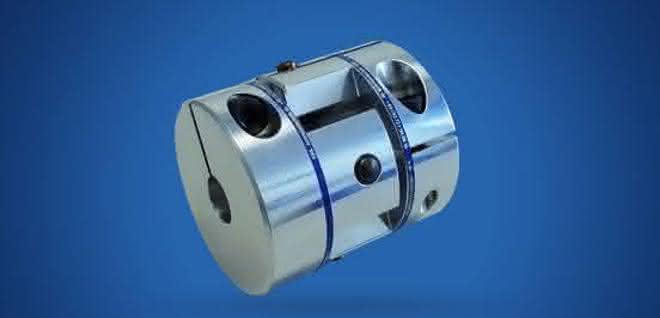
Medical devices, test benches or machine tools: All of these applications must be connected to the drive train with as little play as possible in order to fulfill their function. If the radial or angular misalignment is too large, reliable operation is no longer guaranteed. Minor deviations can be compensated for with standard couplings. If the radial or angular misalignment exceeds a certain level, the forces acting on the shaft bearings when the drive elements are rigidly connected will be so great that they will wear heavily under continuous load. This also affects the seals and the couplings themselves. To prevent these components from being subjected to excessive stress, the shaft misalignment should be compensated for as far as possible.
KBK Antriebstechnik has developed the KBGK and KBGK-T articulated couplings to meet these requirements. The KBGK compensates for high radial and angular misalignment and has extremely low restoring forces, further reducing the bearing load. Just like the KBGK, the KBGK-T is designed to be fatigue-resistant, rigid and virtually backlash-free thanks to special bushes and guides. Both clutch types are manufactured to a high standard and are made of aluminum (hub, inner ring) and steel (pins). Both elements are torsionally rigid couplings - they are torsionally rigid in the circumferential direction and flexible in the radial and axial directions.
The high compensation capacity of the articulated couplings is also suitable for applications in which the shaft misalignment that occurs cannot be precisely estimated in advance. Metal bellows and elastomer couplings are unsuitable for these applications as they would wear out quickly due to the high load.
The KBGK was specially developed for the precise fastening and positioning of linear motors, for example in welding, cutting and bending systems, in the textile industry or in machine tools. Depending on the size, the KBGK can absorb axial forces of between 200 and 13,000 newtons and is manufactured with external diameters of 18 to 100 millimetres. The KBGK can also be used as a transmission coupling to connect two shafts with minimal backlash.
The type KBGK-T is suitable for use in servo and stepper motors and transmits torques between two and 580 newton meters with absolute precision, reliably compensates for even large angular and radial misalignments and can firmly connect two shafts together. pb


You might also be interested in
Plagiarius 2024 negative prize
On January 26, 2024, the Plagiarius campaign awarded its dreaded "Plagiarius" negative prize for the 48th time to manufacturers and retailers of particularly brazen counterfeits and fakes.
 read more...
Ivalua honors winners of the Generative AI...
AI-supported "add-ons" for buyers within 48 hours
Ivalua, provider of cloud-based spend management solutions, announced the winners and innovations of the first Generative AI Innovation Cup. The competition took place in December 2023. It was open to all Ivalua partners and employees - more than...
read more...Efaflex celebrates 50 years of high-speed...
The emphasis is on "fast"
Since day one, Efaflex has wanted to use new technologies as early as possible and drive progress in the industry. This year, the family business is celebrating its 50th anniversary under the motto "Fast Forward".
read more...Security of supply even during power outages
In the winter of 2022, Germany was worried about energy shortages. The drugstore retailer dm did not paint any horror scenarios, but nevertheless saw the possibility of controlled, temporary, regional power cuts (brownouts).
read more...Safety technology in mechanical engineering
Modules with new functions
Euchner's product highlights at EMO 2023 include the communication-capable solenoid interlocks.
read more...Transforming the paper industry towards climate neutrality
Together with partners from industry and research, Voith is developing a project for the optimization of energy and material flows in paper production. The aim of the research project is to develop a digital framework that enables effective process...
read more...Up to 95 percent less flue gas thanks to direct extraction
The requirements for occupational safety measures and safety technology are also constantly increasing in welding technology. The Technical Rules for Hazardous Substances (TRGS) stipulate that welding fumes and harmful substances must be extracted...
read more...Competitive advantages with large machines
Whether 3D-printed components for machines and systems, prototypes or aids for design: additive manufacturing is almost indispensable for modern companies in mechanical and plant engineering and automation if they want to play in the premier league.
read more...Transport technology from the modular system
Many transport tasks can be realized with the help of linear technology. Pre-configured solutions are available to simplify the interaction between the linear unit, motor, gearbox and controller. This minimizes the effort required for research and...
read more...