
Air motors
Always correctly bolted with LZB air motors
LZB air motors from Atlas Copco Tools screw together steel drums and plastic containers in Feige Filling's filling systems. What sounds like a simple task actually requires high-tech in order to fill the drums correctly and seal them reliably.
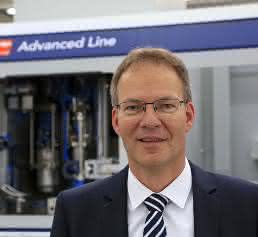
"First and foremost, our customer wants a securely bolted drum," says Mathias Mente. He is Technical Manager at Feige Filling in Bad Oldesloe and knows what his customers want. These include food processors and the mineral oil industry, as well as chemical manufacturers who cannot afford leaking containers under any circumstances. "Imagine if the seal on a container with highly toxic contents were to leak during overseas transportation. That could contaminate an entire cargo ship." To prevent this from happening, Feige Filling develops and produces filling solutions that eliminate such risks as far as humanly possible.
"Of course we are feeling the current price pressure in the bottling industry," admits Mente. However, the company offers customers individual solutions in terms of safety and efficiency. With over 100 systems delivered and commissioned worldwide every year, the company is one of the market leaders in Europe. Closures, seals, materials and manufacturing tolerances - everything varies with almost every batch of containers. The range of containers is becoming more and more colourful, Mente comments on globalization. Depending on the market, different specifications, guidelines and production qualities have to be adhered to. "This constantly confronts us with new challenges, which we are sure to overcome."
Problems due to incorrect savings
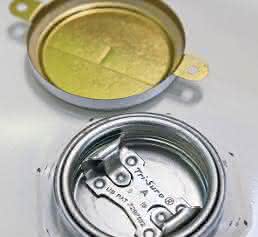
Using the example of a supposedly simple 200-liter steel drum, Mathias Mente explains why it is not so easy to screw these containers together correctly: "Some customers use a polyethylene sealing ring for the threaded plugs instead of an elastomer seal, partly for cost reasons. However, many users do not consider the fact that this other material begins to flow under the force of an applied torque and that the closure system then has a completely different setting behavior." And if that alone were not enough, some of his customers' factory standards specify torques of 25 Nm for one and the same closure, while others specify torques of up to 60 Nm.
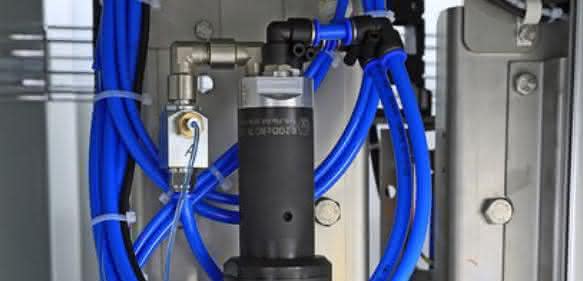
Feige Filling strives to meet all market requirements. To this end, the company works closely with its suppliers. Feige uses a special high-torque motor with an LZB33 planetary gearbox in its Advanced Line systems. Atlas Copco Tools developed this specially two years ago. "We install two in each of our filling systems," says Mente. Due to the limited space available, Atlas Copco designed the sealing cap for the output shaft so that the motor can be integrated directly into the screwing mechanism - without an additional connecting flange. In addition to the space-saving design, Mathias Mente emphasizes that the LZB-33 motors are very flexible in terms of torque and speed and always screw the plugs in correctly.
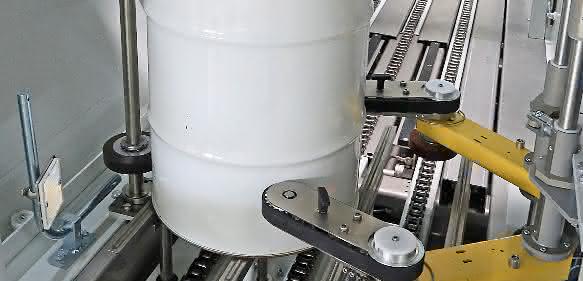
"The first LZB 33 unscrews the stopper from the empty drum. While the open drum is cycled into the filling station, a small belt conveyor transports the unscrewed metal plug to the capping station," explains the technical manager. There, the incoming freshly filled drum is centered again. The second LZB then screws the closure into the bunghole with the exact torque required.
What does "exactly" mean?
The customer can decide exactly how "precise" they want it to be. Feige Filling offers three options for torque control: "We can end the actual screwdriving process via a mechanical cut-off using a spring or back-pressurized pneumatic cylinder," says Mente, describing the more classic options. Although this already meets the requirements of the relevant guidelines, "we recommend the use of load cells as a third variant, in which a lever mechanism defines the torque more precisely and enables electronic monitoring and documentation of the screw-in results". The LZB high-torque motors, which can also be operated with oil-free compressed air, are exactly the right choice for this application. This is because their robust planetary gears can absorb higher stall torques without being damaged.
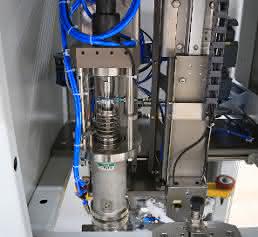
According to Atlas Copco, the low-speed LZB-33 high-torque models with idle speeds between 14 and 210 rpm cover nominal torques of 36 to 300 Nm. Under load, they consume only 7.9 to 8.1 l/s of compressed air according to factory specifications. This is now another criterion for many customers, says Mente: "Compressed air used to be seen as an energy source that was available per se," he recalls. "Today, however, the demand values of the air consumers are increasingly being included in our customers' profitability calculations." And he emphasizes another aspect of economic efficiency that is at least as important - durability: the internal sealing towards the gearbox is better solved with the Atlas Copco motor than with a model from another manufacturer that was previously installed. "It was possible for residual moisture from the expanding compressed air to condense in the gearbox," explains Mente. "This caused the drive to wear out prematurely and, in the worst case, could cause production downtime for customers." This problem does not exist with the LZB-33 models now in use. "Since we switched to the Atlas Copco motors over a year ago, we haven't had a single complaint." cs


You might also be interested in
Motors, gearboxes and encoders: Faulhaber expands Ø 16 mm portfolio
Faulhaber is expanding its portfolio with new DC motors from the SXR and GXR family, a 16 mm planetary gearbox and the IEX3 magnetic encoder for compact drive solutions.
 read more...
New drive solutions for industrial automation and robotics
Faulhaber presents drive solutions with the new GXR and SXR motor family, which offer high efficiency and flexibility in combination with powerful gearboxes and encoders. These optimized components open up new possibilities for applications in...
read more...Marco Altherr becomes new Chief Financial Officer
The Supervisory Board of Ziehl-Abegg has appointed Marco Altherr as the company's new Chief Financial Officer (CFO). Altherr will take up his post in May 2025.
read more...Hydrogen storage in metal hydride
With its focus on storage systems for green hydrogen in solid form (metal hydride), GKN Hydrogen presents itself as a pioneer in safety and efficiency for the industry. GKN Hydrogen offers safe storage systems for green hydrogen and focuses on two...
read more...INDUSTRIAL Production Products of the year...
2nd place, Robotics category: EGS Automation
The SUMO automation systems from EGS Automation - economical standard solutions for automating a wide range of processes in plastics and metalworking - took second place in the robotics category in the competition for Product of the Year 2024.
read more...More productivity with Drive Intelligence
The trends in automation are productivity, sustainability and connectivity. Baumüller is launching new products on the market that address these trends, including new tools for smart energy monitoring, condition monitoring in the drive and new...
read more...Intelligence in Motion
At SPS, Koco Motion will be showcasing its expertise in customized drive solutions based on DC and BLDC motors, stepper motors, servo motors, linear drives and controllers.
read more...Nomination Products of the Year 2024
EGS Automation: SUMO automation systems
The SUMO automation systems from EGS Automation, economical standard solutions for automating a wide range of processes in plastics and metalworking, have been nominated in the Robotics category in the competition for Product of the Year 2024.
read more...Transport technology from the modular system
Many transport tasks can be realized with the help of linear technology. Pre-configured solutions are available to simplify the interaction between the linear unit, motor, gearbox and controller. This minimizes the effort required for research and...
read more...