
Automation
5 facts about networkable hydraulics
Drive physics makes the difference in many cases. Whenever high forces and robustness are required, hydraulics come into play - a rather unfamiliar technology for many younger design engineers. Why working with modern, networkable hydraulics is easier and more economical than many people think.
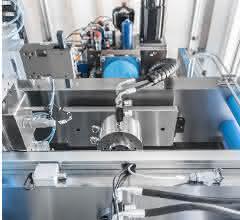
Ready-to-install functions instead of components
In-depth knowledge of fluid mechanics and fluid technology, a large number of individual components - no longer an issue for design engineers today. Increasingly, they are using plug & produce modules such as servo-hydraulic axes with their own decentralized fluid circuit and a variable-speed pump drive. They only need to supply such ready-to-install modules with power and connect them to the guide communication. Why this makes sense: For forces over 400 kilonewtons, there is no more efficient, compact and robust drive technology than hydraulics.
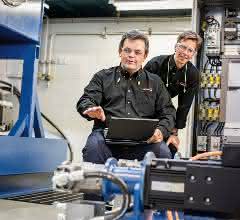
Commissioning with familiar engineering tools
Intelligent, networkable hydraulics are commissioned using the same engineering tools as electric drives and control systems - at least at Rexroth. Functions that were previously performed hydromechanically have long since been transferred to the drive software. What's more, software wizards guide technicians logically through the commissioning process and even suggest suitable parameters. What counts are the required forces - the rest is the same.

Hydraulics is energy efficient
Until a decade ago, energy consumption played a subordinate role in mechanical and plant engineering. Hydraulic units were constantly driven and provided maximum power at all times, even when it was not needed. The preconception that hydraulics were more energy-intensive than other technologies dates back to this time. That has changed. Variable-speed pump drives generate the flow rate as required and reduce the speed accordingly at partial load. Compared to constantly driven pumps, they reduce energy consumption by up to 80 percent - to a level that corresponds to that of electric drives of the same size.
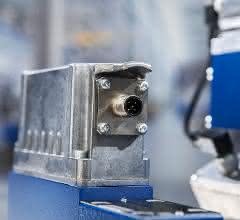
Connected hydraulics are part of the IoT
Intelligent, networkable hydraulics, Connected Hydraulics, is extremely capable of communication. It maps the various stages in a finely scaled manner: Analog valves become digitally visible very economically with IO-Link and exchange data with the controller. Intelligent valves with their own control electronics and fieldbus connection offer the same convenience as electric actuators. They are commissioned, operated and diagnosed using software. Plug & Produce modules with their own controller also come with an OPC UA client/server for communication with higher-level IT systems. This means that Connected Hydraulics is already part of the IoT in production today.
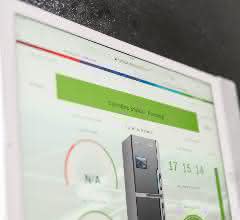
Hydraulics are easy to maintain and diagnose
What is the difference between electricity and hydraulic oil: one can only be measured, the other can be measured, felt and seen. This is an advantage when it comes to determining operating conditions and deducing wear and further service life. With a few sensor data such as pressure difference, oil temperature, visually measured contamination or pressure increase over time, software can very accurately assess the condition of the system. Rexroth supplies such evaluation logic directly with the latest generation of hydraulic power units. as


You might also be interested in
Further simplify assembly processes
In addition to the proven racks with a length of one meter, Wittenstein alpha now offers optional two-meter racks for linear systems. They are particularly suitable for use in short axes, for example, in order to simplify assembly even further.
 read more...
Hiwin manufactures its own shaft gearboxes
Have you ever waited several months for an urgently needed corrugated gearbox? Hiwin has too. That's why the Offenburg-based drive specialist has decided to produce its own space and weight-saving reduction talent.
read more...Human-robot interaction at the trade fair
Sumitomo Drive Technologies is presenting its drive solutions for automation and robotics at Automatica 2023 together with the Lafert Group. The company will be showcasing two different applications of the Tuaka drive system for robot applications...
read more...Partial automation with robots
At Automatica, Promess will be showcasing its modular individual workstations and how these can be partially automated with robot support. The servo press manufacturer will also be providing information about the latest features of its Revolution X...
read more...A new benchmark for collaborative robots
At this year's Automatica, Denso Robotics will be showcasing its innovations in the field of robotics. The collaborative Cobotta Pro product family will be the focus of the presentations. Visitors to the trade fair can see all variants in various...
read more...Clamping system for a new milling machine
Investments in machinery often lead to further purchases - as is the case at Joma-Maschinenbau, whose modern production facility has recently been supplemented by a 5-axis milling machine.
read more...Schunk wants to simplify processes in automated production
The declared aim of automation specialist Schunk is to make its customers' processes comprehensible, simple and efficient. Data transparency plays an important role in this. It enables reliable processes and provides the basis for resource-saving...
read more...Festo and Hahn Automation develop battery tester for greater safety
The success and reputation of electric vehicle manufacturers depend on the safe and flawless functioning of batteries. Hahn Automation has therefore developed a battery tester that performs a fully automated 100% test of mobile energy storage...
read more...SPN Schwaben Präzision presents gearbox solutions for automation and industrial robotics
Short cycle times, robust technology, wear-free surfaces and compact designs have always been relevant for automation and robotics solutions. This year's Automatica trend topics include "Sustainable production" and "Digitalization and AI". SPN aims...
read more...