

System technology
Welding with the laser cutting system
One of Loka Metallverarbeitung 's core competencies is welding processes. An unexpectedly intensively used solution at Loka comes from the start-up WSoptics: the use of a laser cutting system as an automatic welding machine.
In its more than 25-year history, the company from Hüttenberg in central Hesse has developed into a specialist in the processing of stainless steel, steel, aluminum and a wide variety of sheet metal into highly functional assemblies. If you add the company LK-Mechanik und Blechverarbeitung, which was acquired in 2017, the company has 40 years of experience in demanding contract work. Customers come from industries such as mechanical engineering, air conditioning, packaging and aviation, food, pharmaceutical and medical technology. The performance
The range of services includes development and design, sheet metal processing, welding technology, steel and plant construction as well as surface processing and finishing. The process- and material flow-optimized machinery also includes a Trumpf L3030 2D laser cutting machine with a 3.2 kW CO2 laser. A machine that offers a special option at Loka.
Retrofittable laser welding solution
WSoptics, a company from Altenstadt in Upper Bavaria that specializes in control software for mechanical engineering, has invented WSweld, a retrofittable laser welding solution. WSoptics received the Euroblech Award in 2016 for its innovative idea of converting Trumpf laser cutting machines into automatic welding machines with the help of a processing head, a processing table and control software.
Tomas Loh, founder and Managing Director of Loka Metallverarbeitung, learned about this idea at Euroblech 2018 and liked it straight away. "A laser welding system is a huge investment, involves a lot of training and requires large quantities of workpieces to be utilized. In contrast, we mainly deal with small batch sizes and individual orders. Despite good growth, a laser welding system is not worthwhile for us in the near future," explains Tomas Loh and continues: "Of course, we know the advantages of joining technology from manual laser welding. WSweld is therefore the perfect intermediate step before we can move into automated laser welding."
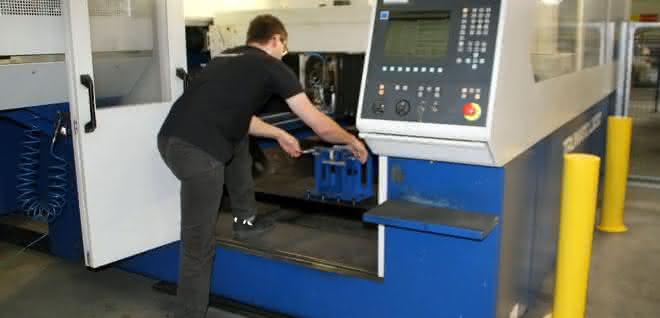
Tomas Loh and Florian Sepp, Managing Director of WSoptics, got started shortly after Euroblech 2018. The inventors mounted the TC08 laser welding head on the L3030 cutting system, trained the employees for the WSweld 3D programming software and supplied their modular processing table, for which Loka designed its own fixture system. An initial project was set up and evaluated together: square tubes made from two U-profiles welded together. The result was convincing. "We tried it out and stuck with it - we've been using the welding head on the cutting machine regularly ever since," says Loh.
Quick tool change
The TC08 WSweld laser welding head replaces the cutting head of a Trumpf flatbed machine in just a few minutes. It combines deep penetration and heat conduction welding in one optic, has active cooling of all optical elements, a coaxial welding gas supply and active collision detection. A cross-jet prevents contamination of the optics. The employees at Loka confirm that the WSweld software leads intuitively from the 3D model to the finished component. The 3D programming software performs an automatic installation space check by simulation and generates the finished machine program directly. As the laser cutting machine at Loka does not have a conveyor belt, there is space for two of the processing tables so that components up to 2,000 mm long and 800 mm high can be processed. The contract manufacturer has devised a lifting device for the processing tables to facilitate setup. If required, a welding job can be started here in less than half an hour where sheet metal was previously cut.
Reproducible quality
"If you offer the manufacture of products in small batch sizes, you always have to calculate the effort required to achieve the required quality," says Tomas Loh. "The extent to which reworking is necessary also plays a role. We use laser welding automation primarily in the stainless steel sector and have been able to gain additional customers thanks to the reproducible high technical and visual quality of the weld seams." A young company in the field of medical technology was awarded the contract for a project partly because Loka provided it with perfect, cleanroom-compatible housings through advice on design and high-quality processing with laser welding seams.
The benefits that WSweld users derive from their easy entry into CNC-controlled laser welding lie primarily in the ability to root weld in hard-to-reach areas and the high reproducible quality of the machine weld seams. Other well-known advantages of laser welding, such as freedom from distortion, also enable Loka to offer additional services and thus achieve growth.
Use for complex assemblies
Florian Sepp, one of the founders of WSoptics, was impressed by the use of the converted Trumpf machine during his last visit to the Hessian metalworking company: "We 'only' add a Z-axis to a 2D machine with the welding head. It is all the more impressive to see the complex assemblies Loka puts together with it. It's fun to see how the extensive possibilities of the solution are exploited via fixtures and repositioning." Where automation is used for cost-effective series production, you want to avoid repositioning a workpiece in the machine as far as possible - but here it's all about the processing quality of small batch sizes and individual orders. The effort required to achieve the same results with a different welding process and reworking would be greater or the corresponding properties could not be achieved at all.
"On average, we use the laser cutting system for welding five days a month, usually two or three days at a time," says Tomas Loh. If sheet metal has to be cut during this time, two combination machines can be used. "We have learned how to design workpieces for laser welding and can produce very complex assemblies using the appropriate fixtures, despite only 2.5D degrees of freedom. The Trumpf machine retrofitted with WSweld has proven to be a simple and at the same time rewarding entry into automated laser welding for us. The solution is very popular with us in-house."


You might also be interested in
Housing and inserts for plenty of power
Lapp presented the expansion of its Epic Power series at SPS 2023: four new M23 circular connector inserts and three new M23 housings. The special feature: all housings can be combined with any of the four inserts.
 read more...
News and product updates from Smartgas
Portable gas analyzers for outdoor use
Smartgas is starting the second half of the year with a series of updates to existing products and a number of new products. Portable analyzers expand the range of applications, while new accessories such as protective housings and heating modules...
read more...Everything accurate in switch cabinet construction
To ensure smooth work processes, tools for processing enclosures and housings must function flawlessly and reliably. Häwa rounds off its punching range with the Multi-Press 500.
read more...Shafts and conversion parts
The Rodriguez range includes ball bushings including matching housings, shaft brackets, crossbars and supports.
read more...Cooling and temperature control units
Hygienic packaging sells safely
In few industries are the requirements for hygiene in the production process as strict as in the food sector - the health of consumers has top priority. This results in enormous challenges for all machines and components involved, especially in...
read more...Simple tool change in seconds
With the CMS, Schunk is launching a user-friendly, manual change system for quick component replacement. In addition to its simple and convenient operation, the CMS also stands out with its extensive range of optional modules and complementary end...
read more...Motion controller for small drives
Medium power range covered
Faulhaber has another housing-less and compact motion controller in its range, which is particularly suitable for integration in device construction and medical technology applications.
read more...Welding solutions in the name of resource efficiency
At the Welding & Cutting trade fair in Essen (September 11-15), Fronius will be focusing on the major drivers in welding technology. Quality requirements are increasing in all industries, but the required welding specialists are scarce. In...
read more...Safe solutions for cable installations
From thick power cables to thin sensor lines, cables and lines must be routed safely through systems and machines. A challenge that should not be underestimated, explains Jörg Sokat, Head of Product Management at Pflitsch.
read more...