

Welding technology
Hurdles on the road to success
Welding is one of the most complicated processes in the manufacturing process, and it is becoming increasingly difficult to find suitable personnel. Can this problem be solved by automating processes? Can or should the robot colleague replace the experienced welder? The automation of manual welding is a complex, multi-stage process.
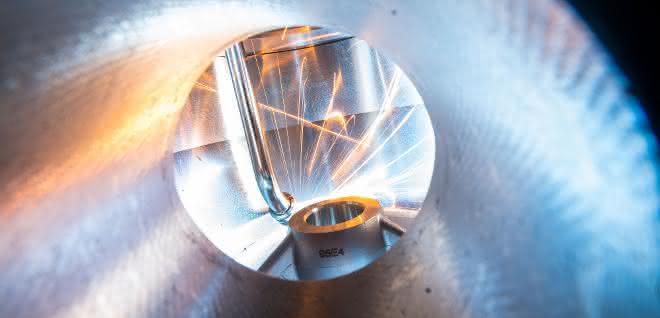
Welding and joining technology companies are struggling to find suitable skilled workers. Many companies find themselves in a dilemma: on the one hand, the shortage of welding specialists and rising wage costs, on the other hand, increasing demands on the quality, flexibility and efficiency of welding processes. This is why companies are increasingly focusing on the automation of processes and the use of robots. What has mainly been common practice in the automotive industry and large-scale production in recent decades is also becoming increasingly important in medium-sized and small companies from a wide range of industries. This is because automated welding processes can now be operated economically not only in large corporations. The benefits of automation include absolute repeat accuracy with consistent weld seam quality, process reliability and increased productivity due to reduced set-up and non-productive times.
Basic requirements for the automated process
If welding processes are to be automated, it is not only necessary to clarify in advance which components are to be manufactured and which geometries need to be taken into account. It is also important to specify the batch size, tolerances and the desired welding processes. "Often, an understanding of the process has to be created first. The robot cannot compensate for changes in position, but the welder can," says Max Lautenbach, Deputy Head of Application Technology/Automation at EWM. "So the welding fixture has to be exactly right - and this usually involves more effort." This is because automation changes the entire process. The processes upstream and downstream of the welding cell also have to be adapted; for example, a sufficient number of components from prefabrication must be available so that the system is optimally utilized. In addition, there is a high demand on the accuracy of the components. The welded parts must then be removed and stored in good time to avoid a process backlog. The personnel available on site must also be taken into account. "Completely unskilled workers cannot operate a robot system," says Andreas Euen, Managing Director of EWM-Euen. "Although robotics reduces overall personnel requirements, in order to automate processes, you need employees on site who can program a welding cell."
Collaborating robots are in vogue, also in welding technology. The great advantage lies in the uncomplicated operation of the systems. The cobot can simply be trained on site and then repeats the processes shown to it. No complex programming is required, but the so-called "teaching" should be carried out by specialist personnel.
Cobot versus welding cell
Cobots offer good value for money and are therefore also suitable for use in smaller businesses. The safety aspect should not be overlooked. After all, the welding process involves many hazards - from possible welding sparks and the generation of hazardous radiation to electrical hazards and the formation of harmful substances. It is therefore virtually impossible to work hand-in-hand with the cobot while the arc is burning. Compact welding cells, which are also cost-efficient, are more suitable for smaller companies. For example, the XQbot welding cells from EWM are a suitable introduction to automation. At the heart of the cells is the CRX robot from Fanuc, which is comparable to an industrial robot in terms of precision, repeat accuracy and stability. Small and very small series can thus be produced without a great deal of programming effort, with maximum protection for the operator.
With imprecise components or unstable fixtures, additional measuring runs are often necessary to achieve exact positioning. This quickly makes the entire process inefficient. In the manual process, on the other hand, the welder can react immediately to changes and notices, for example, if the sheet moves during welding. In this case, the robot would simply weld a few millimetres away from the desired position. The weld seam is then in the wrong place and the component cannot be used. For this reason, the welding process should be carefully analyzed in advance. Does it even make sense to switch to automated production? Do too many changes have to be made, so that the project is not economically viable?
Concept and feasibility analysis
Suppliers must support potential users with expert advice on the planning, installation and commissioning of welding cells. This includes a detailed initial consultation, concept development and a feasibility analysis. The component to be welded must be examined and evaluated in detail. An initial sample weld should also be carried out on the provider's robot welding systems before the ready-to-use installation on site. The customer receives a comprehensive introduction to the programming and can check the welding process and the welding result. As soon as the right system has been selected, the customer receives comprehensive training on how to operate it and continues to receive expert support even after the system has been installed. "The decisive aspect is not the robotics, but the welding technology. To achieve the best possible results, suppliers must have the necessary expertise in this area," says Wolfgang Kumpf, Head of Internal Sales at EWM.
Automation in chassis production
EWM-Euen implemented an automation solution with a welding robot for a manufacturer of truck trailers and semi-trailers. All sled and external roller trailers are manufactured from the same assemblies. A new clamping device was to make the welders' work easier. EWM-Euen implemented a gantry system with nine axes. A Phoenix puls from EWM is used as the welding machine. The production of carriage trailers and external roller trailers takes place in two separate work areas. While the robot is welding in one section, the other can be loaded. Welders insert the long beams and welded assemblies, tack them and weld particularly short seams directly.
Once the robot has finished welding in one booth, it moves to the second booth and continues welding there. The finished chassis is removed and the cell is reassembled. As the entire welding process is based on taught curves, there must be no major deviations in the individual components - a major challenge for the parts preparation. The thermal expansion of components also had to be taken into account. It therefore took several passes until the welders had programmed the components perfectly and the weld seam was optimally achieved at all times. By automating chassis production, the manufacturer was able to almost double its production - with fewer personnel required. It now produces 300 weld seams in 90 minutes. Thanks to the high weld seam quality and low weld spatter, rework was reduced by 30%.
When automating welding processes, it is necessary to take a holistic view of the system. The focus should be on welding, not on the movement of the robot. Although the robot cannot replace trained specialists, it can relieve them of monotonous and strenuous work. This makes them available for more value-adding activities. As a result, a successful switch to automated welding processes can be a sensible solution in times of a shortage of skilled workers and measurably increase productivity and competitiveness.
Intec, Hall 2, Stand G27


You might also be interested in
E-scooter with customizable damping
The startup Scuddy has significantly improved the flexibility, performance, customizability and ergonomics of its second-generation foldable e-scooter of the same name - thanks in part to damping technology from ACE.
 read more...
New plug-and-play solutions for the warehouse
Exotec announces a new Skypath conveyor system, the optimized Skypicker picking robot and Deepsky, another proprietary storage software. All three products can be seamlessly integrated into the manufacturer's Skypod system.
read more...Production automation
At Motek, Weiss will be presenting solutions for the linear and rotary movement of workpieces that can be easily integrated into the overall system of hardware and software.
read more...Solutions for surface hardening
Many industrially used components require a combination of a tough core and a hard surface layer so that they can better withstand the stresses of use. Hardening is achieved by rapidly heating the surface and then cooling it quickly.
read more...Wheel bearings and wheel bearing sets
Low-friction rolling behavior
Hecht Kugellager offers a wide range of bearing technology for use in the automotive industry, commercial vehicles and mobile machinery.
read more...Simulation in product development
The Munich-based start-up Spyra significantly shortens the development time of its production by using Solidworks simulation solutions.
read more...Doubling production capacity by 2026
Nabtesco is investing in a third production site, doubling its production capacity to two million precision gearboxes per year by 2026.
read more...Counterbalance trucks with lithium-ion technology
Clark has relaunched the GEX and GTX series.
read more...Intelligent sensor detects leaks
Fraunhofer IPA is working with Sick to develop an additional leakage service for an intelligent flow sensor. Self-learning algorithms evaluate the measurement data and detect leaks.
read more...