
Welding electrical contacts
Cable assembly to perfection
Flexible stranded cables are used wherever there is a higher risk of conductor breakage due to frequent movement. In order to be able to connect all individual wires safely, especially with larger cross-sections, it is better to weld them to the contacts instead of clamping them.
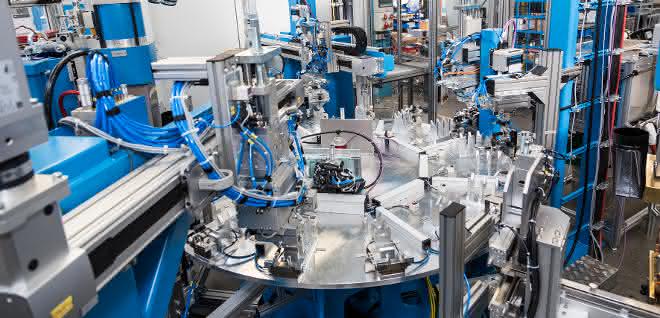
Frötek-Kunststofftechnik uses Dalex welding machine technology for the production of stranded wire cables with wire end contacts and produces a wide range of variants in large quantities fully automatically within a very short time.
The expertise of Frötek-Kunststofftechnik with its main plant in Osterode am Harz ranges from injection molding of high-performance thermoplastics and multi-component injection molding to system developments such as Moldflow, resistance, ultrasonic and rotation welding, the creation of prototypes and the construction of small systems and tools as well as the assembly of components. Another important pillar is battery technology. Whether flexible or rigid, sleeve or welding technology, Frötek is internationally active in the production of a wide variety of connector cables. One of the secrets of the company's success lies in its production technology: a fully automatic welding system from Dalex is used to assemble a wide variety of stranded cables with wire end contacts.
One system for countless variants
"Frötek wanted to optimize its stranded cable production and combine several work steps. The company was looking for a system solution that could perform all tasks fully automatically, from feeding the cable to measuring, cutting and stripping processes, feeding the wire end contacts, welding the contacts on both sides and ejecting the finished products. The main challenge was the large number of variants. Welding tube connectors with cross-sections of 16, 25, 35, 50, 70 and 95 mm2 and lengths of 75 to 300 mm in 1 mm increments had to be produced reliably, repeatably and productively in the shortest possible time and in large quantities. The result is a 16-station rotary transfer assembly machine that is precisely tailored to the requirements," says Marcel Groß, Group Head of Mechanical Design at Dalex.
The stranded cable is fed into the system from the coil/coiler unit using dancer control. The cable is measured, stripped and cut to length to convert the various diameters and lengths. The conveyor belt then transports the corresponding cable section to the removal station on the turntable. A sensor automatically detects the cable. The cable is then removed from the conveyor belt, inserted at the turntable and tensioned.
Double welding shortens times
"The system is equipped with two welding stations. They each fit one end of the cable with the end contacts. As they work simultaneously, there are always two cables in the system and the quantities can be completed much faster," says Groß. The processes around the two welding machines are identical: a spring-mounted handling unit checks the cable, balances the lengths and brushes the copper wires to remove oxidation residues for optimum welding. It is then inserted into the welding station.
The copper end contact lugs also enter the station automatically. During the projection welding process, the system monitors the welding current, voltage and welding path in order to achieve optimum results. Between the two welding stations, a servomotor-driven handling unit removes the cable, turns it, moves it into position and inserts it into the component holder of the welding machine.
Automatic final inspection
Marcel Groß: "After welding, the system automatically checks the welded cables. If the parts are OK, a needle embosser marks the contacts. They are then ejected from the system on a conveyor belt. If the parts are faulty, they are automatically separated before marking. In the final station, a light barrier checks whether the component holder is empty after removal."
The advantages of the 16-station rotary transfer assembly machine are clear to see: Thanks to the combination of the previously separate work steps, the production of stranded cables is more efficient and therefore more productive. The many different variants can be covered with a single system. And the parallel welds significantly reduce production times. "Since purchasing the Dalex systems, we have already completed a remarkable 200 million welds - with outstanding quality. The combination of our own stringent rope monitoring techniques and our cable extrusion systems with the Dalex technology ensures that we have had very few welded part failures to date," says Sebastian Mathes, Director Electrical Engineering / New Markets at Frötek. The company already has three of these systems in use.


You might also be interested in
The AKIMI Research Project at WZL
Agent-Based AI Aims to Simplify Robotics for Small and Medium-Sized Businesses
The AKIMI research project is developing an agent-based AI designed to significantly simplify the setup, programming, and reconfiguration of robotic systems for small and medium-sized enterprises. The goal is to make robotics more flexible and...
 read more...
BS Rollen Strengthens Its Presence in North Rhine-Westphalia
With the groundbreaking ceremony, BS Rollen is launching the construction of a new company facility in Hückeswagen. The new building will house administrative offices, an assembly line, and a high-bay warehouse, and is intended to facilitate further...
read more...Intelligent brownfield networking
Many industrial companies are struggling with established plant structures and proprietary interfaces. Stefan Klaus' presentation will show in a practical way how brownfield environments can be efficiently networked with open technologies and made...
read more...Factory-X in practice
How can set-up processes in highly variant production be automated efficiently? Markus Benndorff from soffico shows how Factory-X, industrial data rooms and modular architectures create new possibilities for flexible production concepts.
read more...Mechanical engineering | Case study
Cordless in brush production
The machine manufacturer Wöhler Bohemia is integrating wireless HMI panels from Keba into its brush production systems. The background to this is the need for flexibility, robotics integration and new market strategies.
read more...International product approvals as a strategic competitive advantage in the global market
Which certificates are valid worldwide? Christian Latte, Head of Technical Compliance and Approval Officer at Hummel AG, explains this in an interview. He provides insights into product approvals and explains why early approval strategies shorten...
read more...Foundry modernizes plant park with continuous wire belt shot blasting system
The Spanish foundry Funosa is modernizing its equipment fleet with an RDGE 1250 wire belt continuous shot blasting machine from Rösler. Focus: sand removal from heavy iron castings, energy efficiency, ease of maintenance and ESG strategy.
read more...How bridging steps, stairs and catwalks are changing processes in production and logistics
At Logimat 2026, Munk Günzburger Steigtechnik will be showcasing modular bridging steps, stairs, platform and walkway systems for production, warehousing and logistics. With online configurators, distances can be efficiently shortened, processes...
read more...Drilling cycles optimized
A new replaceable head drill from Walter can reduce machining time in series production thanks to its patented interface and screwless design.
read more...