

Servopneumatic welding guns
Reduce downtimes by 25 percent
A leading car manufacturer relies on the precision and efficiency of Festo's servo-pneumatic welding guns.
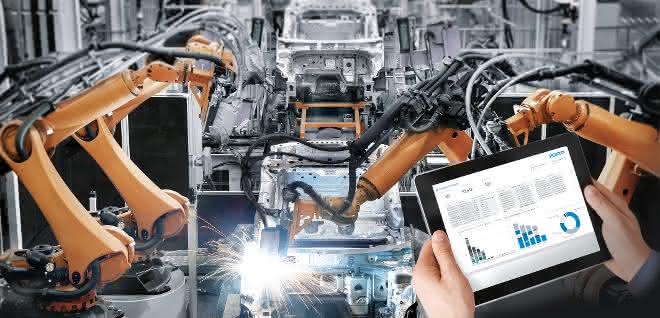
As a result, more than 2,500 welding gun robots with this technology are now installed in the manufacturer's body shop worldwide. Now the car manufacturer has also succeeded in reducing downtimes by 25 percent - thanks to a predictive maintenance system from Festo that is ready for the use of artificial intelligence.
Festo implements in automotive factories what other automation specialists only talk about. In numerous applications in the automotive and supplier industry, metal processing and the food industry, Festo implements projects in which predictive maintenance - in future with artificial intelligence - ensures that process deviations are detected in good time, maintenance is optimized and energy is saved.
Generate value-added solutions
Customer-specific solutions with knowledge of the application enable agile, innovative approaches. Experience has shown that there is potential to multiply such solutions for standard business. The challenge here is to use the data from the devices, the data from the application environment and the knowledge of the processes to deliver real added value for the end customer.
The advantages are obvious: car manufacturers can shift tong repairs to non-production times and thus increase the availability of their systems. The status of the pliers can be mapped in the control system. This makes it easy to generate automated repair orders and even "CVs" of clamps. Filter functions enable comparisons. The early detection of leaks leads to energy savings, as energy and maintenance costs play a major role in the body shop.
Predictive maintenance
During resistance spot welding in mechatronic system products, a lot of data is already processed and pre-compacted into diagnostics that can be used for maintenance. However, it is not enough to simply provide and display data. Compared to traditional condition monitoring approaches, predictive maintenance based on artificial intelligence will open up new possibilities in the future: Data from the devices will be merged with process data and evaluated using analytics models and cloud-based solutions.
Festo's system specialists have added software to the robot cell's existing system PCs that collects the welding gun's diagnostic data and sends it to a cloud input point. A maintenance application is operated in the cloud which, in addition to displaying the data in the browser (maintenance dashboards), also evaluates the data with regard to the expected service life.
The challenge of data transport
"The challenge here was to transport the data from the welding gun from production to the cloud in the first place. Topics such as network utilization, processor loads and data security were uncharted territory for both parties at the time," explains Dr. Jan Bredau, Head of the Application Software for System Solutions department at Festo.
Festo developed the hardware concept for the servo-pneumatic welding gun in close consultation with experts from the automotive industry. This enabled Festo's developers to take into account many important features of the industry - including the reduction of the envelope curve, as the servo-pneumatic system is significantly more compact than comparable welding gun drives. The user can install and operate the control section, consisting of the electronic and pneumatic sections, either in a single block or separately, depending on the application. This makes the system significantly more flexible, which is reflected in various assembly concepts on the robot.
By connecting to the plant maintenance system, "predictive" maintenance orders are triggered in their familiar environment and, if desired, sent to the maintenance technician's cell phone via SMS.
"What belongs together is now growing together: we have decades of application expertise from the sensor-actuator level, which we can now combine with domain and data science expertise. This is how artificial intelligence will move into the application," concludes Bredau.


You might also be interested in
ESTIA aims to strengthen Europe's cloud
New tech alliance for EU sovereignty
Twelve companies, including Dassault Systèmes, are founding the European Sovereign Tech Industry Alliance (ESTIA). The initiative aims to strengthen Europe's technological independence and define requirements for sovereign cloud services. The start...
 read more...
Deutsche Telekom and Nvidia launch one of Europe's largest AI factories
With the Industrial AI Cloud in Munich, Deutsche Telekom and NVIDIA are creating one of the largest AI factories in Europe. Companies can train AI models, carry out simulations and access 10,000 GPUs.
read more...Leveraging data potential with AI and streaming
Huge data treasures are still lying dormant in many manufacturing companies. And yet it is high time that these treasures were unlocked. There is often a lack of resources and capacity to make data usable in real time. Streaming production data can...
read more...More awareness of noise
Dematic offers solutions that are tailored to different cloud environments and reduce environmental impact through reduced material consumption and improved energy efficiency.
read more...Generative AI in the automation environment
The mechanical engineering and automation industry is undergoing profound change. This transformation is being driven by more volatile global trade, geopolitical crises and increasing market pressure, which demands greater agility, technological...
read more...Rigid data structures have had their day
The traditional data center is no longer the center of data. A hybrid cloud storage approach enables manufacturing companies to both meet the current requirements of data-intensive processes and future-proof their infrastructure.
read more...Software as a service in three stages
CIM Database Cloud is a new out-of-the-box solution from Contact for end-to-end digital product development.
read more...How production can benefit from AI
Together with AI technology, IIoT networking makes it possible to better control machine parameters and optimize quality with predictive quality. Downtimes and set-up times can also be further minimized. Cloud platforms also make these technologies...
read more...More expertise for digital engineering
Altair, a computational science and artificial intelligence (AI) company, has acquired OmniV, a technology from Michigan, USA-based software company XLDyn.
read more...