
Laser cutting
Productive processing of elevator panels
An elevator manufacturer uses a laser cutting system to process sheet metal. This enables the company to achieve not only high productivity, but also perfect production quality.
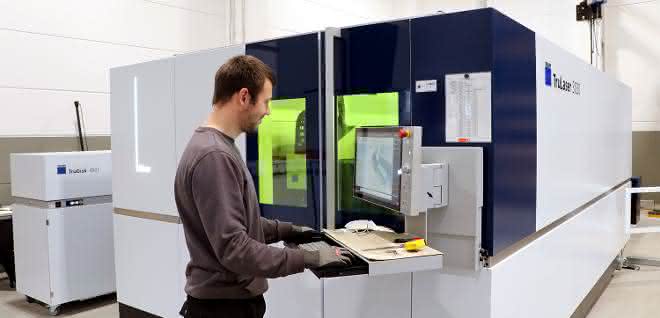
Based in Bergkirchen near Munich, Butz Aufzüge plans design-oriented passenger elevators as well as complex heavy-duty elevators with a load capacity of several tons and installs them in new or existing buildings, always in line with customer requirements and wishes. Even the economic crisis caused by the pandemic has not affected the company's steady growth, as Managing Partner Michael Butz confirms. He names an important success factor: "Delivering high quality reliably and on time is our top priority. We only accept orders if we are sure that we can keep all agreements."
This applies equally to the conversion and modernization of existing elevator systems that are getting on in years. Stefan Förster, authorized signatory and head of the company's New Construction/Modernization department, explains: "In order to always be able to react quickly to the diverse challenges, we rely on a high level of vertical integration with qualified employees. In addition, all parts suppliers are located in close proximity, i.e. in Germany or Switzerland."
Higher productivity, flexibility and quality
The elevator specialist's latest purchases in the new hall built in 2020 include a TruBend 5230 bending machine and a TruLaser 3030 fiber laser cutting system from Trumpf, which is supplemented by the TruTool TSC 100 support strip cleaner. Before making the investment, Förster and his workshop manager Christian Kern compared the laser cutting systems from various manufacturers. An initial study of the price lists quickly made it clear that the current solution would not be the cheapest. This was followed by various tests and demonstrations of the machines at the manufacturers' premises. According to Christian Kern, the sum of all factors was clear: "In particular, the quality of results, operability, energy consumption and service clearly speak in favor of Trumpf, even from today's perspective."
For Butz, the main reasons for investing in the laser system in late fall 2020 were the expected increase in productivity, flexibility, quality and speed of response. According to workshop manager Kern, everything has now been confirmed, as the TruLaser 3030 fiber replaced over 80 percent of the previous technology - a punching machine and a guillotine shear - in both cabin and steel construction at the beginning of 2021. "In addition, we were previously unable to produce some of the stainless steel sheets for the cabin ourselves. Our suppliers produced good quality, but there were still delays," says workshop manager Kern.
Production time significantly reduced
Butz currently uses around 200 tons of galvanized structural steel per year, which is primarily used as support frames, protective devices or fastening elements in steel construction. These steel sheets, which are often up to 25 mm thick, can be processed just as easily on the TruLaser 3030 fiber as the interior cladding, ceilings, operating and other visible elements made of stainless steel. Kern uses an example to illustrate how much more productive the laser solution can be: "In the past, we first cut the two-millimeter-thick stainless steel sheets frequently used in the cabin into strips on the guillotine shears and then punched out the respective shape and length." Total time around 20 minutes per unit. Now Butz specialist Maxi Berghammer places the sheets as a whole in the TruLaser 3030 fiber and removes the finished sheets just four minutes later.
A wide variety of shapes, patterns and radii can be realized that were previously only possible with enormous effort or not at all. Even 2 cm narrow stainless steel sheet strips can be produced in 2 m lengths. "This is impossible on guillotine shears, as the sheets then twist and cannot be used," explains Kern.
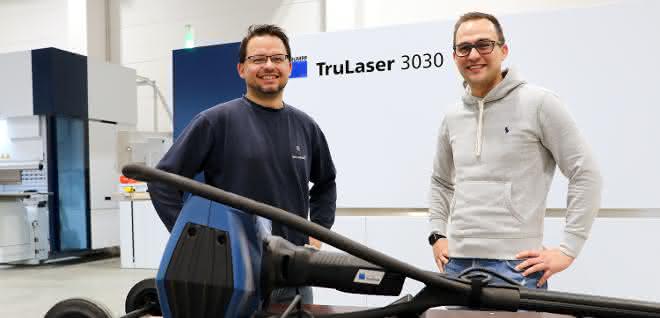
The workshop manager is also very satisfied when it comes to quality. For example, the "BrightLine fiber" feature ensures high-quality edges and "CoolLine" makes it possible to produce even small contours in thick steel sheets. According to Kern, keeping the pallet tables and their support rails clean is just as important for component quality. This is where slag builds up during laser cutting. If this is not removed regularly, the slag can splash back onto the sheet metal, primarily in the case of stainless steel, and visually damage the surface, which can no longer be removed. Before this happens, the slag must be removed. Originally a real challenge, says Maxi Berghammer: "At first I tried to remove the slag with an angle grinder. That was extremely unpleasant. Sparks fly and the fumes are enormous. I therefore needed protective equipment and had to work incredibly long hours to get a halfway decent result."
Cost advantage through support strip cleaner
The alternative was to always use new support strips for slatted skirting boards - a feasible but expensive undertaking. The solution, which is three to four times cheaper and just as good, was not long in coming. Trumpf consultant Markus Wirth demonstrated the TruTool TSC 100 support strip cleaner. The special tool weighs around 16 kg, but - equipped with mountable rollers - can be transported to the laser system without any effort. There, the operator places it on the outside of a bar, switches it on and pushes it to the other side with light pressure. Once at the end, he places the device on the next row of bars and so it goes on.
The principle of the TruTool TSC 100 is as simple as it is effective: two "rows of teeth" clamp the strip and move vertically upwards along it. The slag is scraped off with an even upward movement - both on the sides of the strips and between the tips. As a side effect, slightly bent tips of the support strips are straightened again. It can also be used to remove the slag from all materials that the laser can cut - mild steel, aluminum, collar metals and stainless steel.
As the laser system is not yet working at full capacity due to the current production changeover in connection with the new production hall, it is sufficient for Butz Aufzüge to clean the support rails every two weeks on average. Only when a material change is due with the same pallet does intermediate cleaning have to take place in order to avoid quality problems. However, this is not a problem for the only relevant wearing parts of the device - the cleaning tools. After just under six months of use, they are still almost as good as new. "We don't know how long they actually last. But there are definitely no significant costs involved," says workshop manager Kern.


You might also be interested in
"We are clearly different from the competition"
The IT company 21unity offers a range of hardware and software services, as well as traditional services. Andreas Mühlbauer spoke to Managing Director Anja I. Gondolf about the company's appearance at the Hannover Messe, its services and future...
 read more...
Think digital, act local
When it comes to industrial damping technology, on-site advice is often very valuable for engineers and designers.
read more...Plagiarius 2024 negative prize
On January 26, 2024, the Plagiarius campaign awarded its dreaded "Plagiarius" negative prize for the 48th time to manufacturers and retailers of particularly brazen counterfeits and fakes.
read more...Spindel Full Service records second-best...
Maintenance as an economic success factor
Spindel Full Service, the spindle repair specialist from Baden-Württemberg, can look back on its second-best financial year in its history - with 15% growth compared to the previous year. And the further forecast also looks good.
read more...Thyssenkrupp and Novelis cooperate
Platform for the circular economy
With a platform for the circular economy in the automotive industry, the two companies Thyssenkrupp Materials Services and Novelis want to set new standards for the recycling of used materials. The open platform will enable access to larger...
read more...How production can benefit from AI
Together with AI technology, IIoT networking makes it possible to better control machine parameters and optimize quality with predictive quality. Downtimes and set-up times can also be further minimized. Cloud platforms also make these technologies...
read more...Marco Ghirardello takes the lead
Fanuc has appointed Marco Ghirardello (48) as the new President and CEO of Fanuc Europe. Ghirardello succeeds Shinichi Tanzawa, who has led the company since 2016 and will take on a new role at Fanuc's headquarters in Japan.
read more...Efficient robot monitoring
Microchips are installed almost everywhere - whether in smartphones, washing machines or cars. With increasing digitalization, the demand for semiconductors has been growing rapidly in all areas of the economy for years.
read more...Everything on one platform
Functional and powerful tools are essential for professional work on the construction site, in the workshop or when carrying out repairs.
read more...