

Industrial welding technology
Intelligent welding
Welding has become an indispensable joining technology in industry. With increasing digitalization, the demands on welding technology are also changing. Fronius is meeting these challenges with a new intelligent welding machine platform. By Kai Maikranz
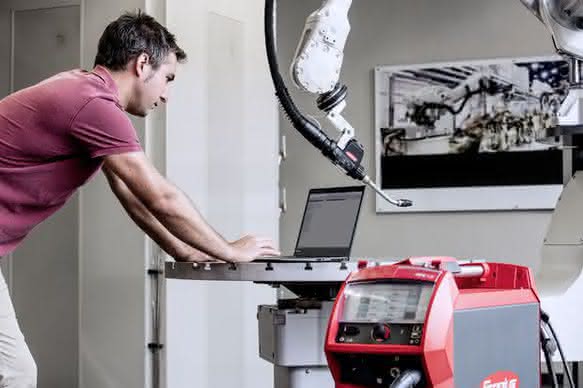
People have been using welding to join metals and other materials for thousands of years. The processes and technologies used have changed rapidly since then - just like the requirements. For a long time, the durability of the joint created was the only important criterion. Nowadays, appearance, speed and efficiency are just as important - and with an ever-increasing variety of materials and applications. Welding is high-tech and, in times of digitalization and networking, requires intelligent technologies that allow users to work flexibly and economically and achieve optimum results.
Fronius has developed the TPS/i to meet these requirements: The current MIG/MAG device platform is versatile, offers extensive operating and communication functions and, last but not least, impresses with its performance. The modular welding system consists of networked and coordinated components. It has a high-performance processor and a high-speed bus. This allows users to transfer more data in less time and implement faster control loops than before. The result is increased welding speed, greater precision and improved welding results.
Function packages increase versatility
With the help of function packages, different short and pulsed arc processes such as the LSC (Low Spatter Control) and PMC (Pulse Multi Control) developed by Fronius can be used. The welder can therefore use the same system for different applications - this saves costs and simplifies operation and handling. The "cold" welding process CMT (Cold Metal Transfer) is also available for the TPS/i. It ensures high and reproducible seam quality and fast welding speeds when joining different materials, for example steel and aluminum. CMT differs from conventional MIG/MAG welding in that it has a very low heat input and allows the energy input into the component to be welded to be continuously adjusted. The result is an extremely stable arc and significantly less spatter.
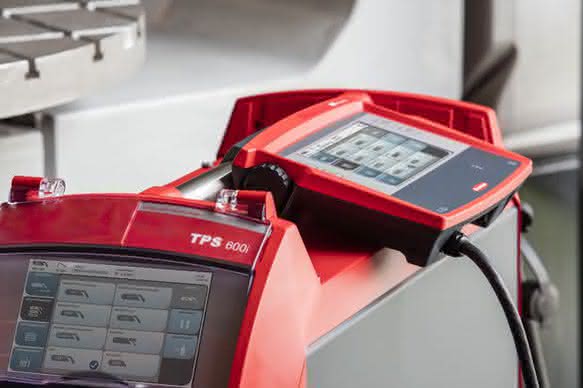
Users have even more control with the new CMT process variant Cycle Step, which allows them to set both the number of individual drops per spot weld and the pause time between cycles. This allows spot welds of any size to be produced and precisely reproduced. The heat input is also minimal with Cycle Step and can be easily controlled. This allows even the thinnest sheets to be joined together and is particularly helpful for position welding with gap tolerances. The process is used, for example, in car body construction in the automotive industry. It is available for all Fronius power sources in the TPS/i series and can be used for all CMT characteristic curves.
Communicative and with an improved burner
The TPS/i is equipped with modern torches for both automated and manual welding. The newly developed Robacta Drive CMT TPS/i push-pull robot welding torch impresses with its compact size for good component accessibility and low weight for use on robots with high travel speeds. The improved PullMig torch for manual welding is not only lighter and more robust than its predecessor, but also has improved cooling, which reduces wear. Fronius has also optimized the wire guide with a dynamic and precise servo motor. As a result, the torch harmonizes with the fast arc control of the TPS/i.
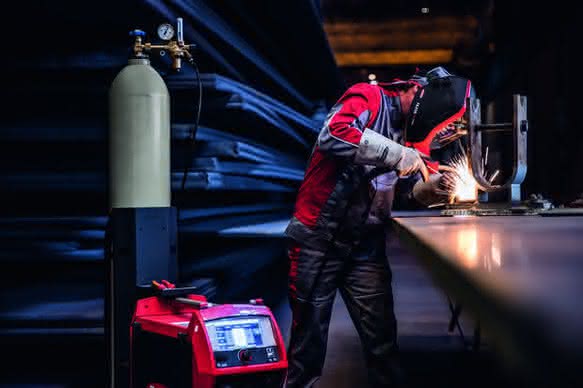
The TPS/i communicates with the user in various ways, making their work easier. An intuitive plain text display provides information on all device parameters; the system automatically recognizes all available components and warns of any incompatibilities. This helps to avoid application errors. Thanks to the clearly laid out control panel and clearly structured menu navigation in various languages, the user can easily call up welding data at any time and change it if necessary. A mini display integrated into the torch allows the power source to be controlled at the welding site. Remote maintenance and system analysis are possible via the Internet. Welding processes are recorded and evaluated with unprecedented speed. This allows users to react flexibly to changing requirements and work much more efficiently.
Conserving resources and sustainable
The topic of sustainability is also becoming increasingly important in welding technology. The basic prerequisite for resource efficiency is a process that is tailored to the welding task. The user benefits from a higher welding speed, savings in system costs, filler material and power consumption as well as a reduced reject rate. The TPS/i also scores points here: The power source is particularly resource-saving and efficient thanks to its modularity and intelligence, high product quality and ongoing further developments at software level.
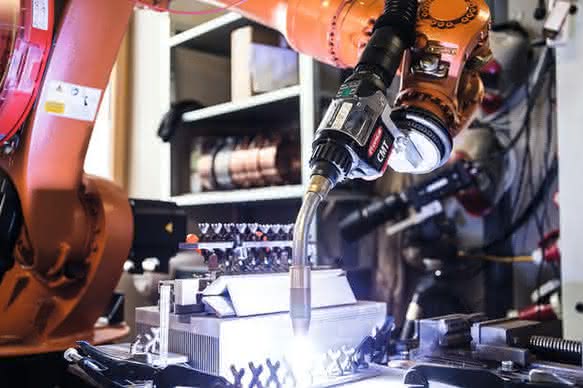
Whether by hand or by robot, the TPS/i covers an extremely wide range of applications and processes and performs a variety of tasks across all industries. For manual welding, it is used in steel construction and structural engineering, among other things. The TPS/i Robotics is also suitable for very high-quality and complex automated welding processes - for example in the automotive industry or industrial series production.
Kai Maikranz, application engineer at Fronius Germany / ag


You might also be interested in
Friction stir welding as a key technology for future industrial joining solutions?
At the DMG MORI in-house exhibition, Hufschmied Zerspanungssysteme presented friction stir welding with process-optimized tools and series production potential for the industry.
 read more...
Tox Pressotechnik at the Blechexpo
Connecting sheet metal and electrically conductive components safely
Joining sheets of different thicknesses easily and reliably without additional elements - Tox Pressotechnik will be demonstrating how this can be achieved at Blechexpo with its clinching and eClinch technology.
read more...Production, machine tools and robots
High-precision welding for perfect sawing
Stihl uses Nimak's portal projection welding systems to manufacture guide rails for chainsaws.
read more...Tox servo press for clean room
The coast is clear here now
In sensitive sectors such as medical technology, the optical industry or electronics, cleanroom-compatible components are required for all processes. This also includes drives. With the servo presses from the Electricdrive Core series, Tox...
read more...Air purity class 5 according to ISO achieved
Tox has servo press certified for the cleanroom
In sensitive sectors such as medical technology, the optical industry or electronics, cleanroom-compatible components are required for all processes. This also includes drives. With the servo presses from the Electricdrive Core series, Tox...
read more...Manufacture of metal bellows couplings
Joining instead of gluing
When manufacturing metal bellows couplings, the connections between the bellows and hub are a critical point. The flared press-fit process can be used here.
read more...ArtiMinds presents automation solutions at automatica
ArtiMinds Robotics is presenting automation solutions from the field of advanced robotics at Automatica in Munich. The applications were programmed using the in-house software solutions ArtiMinds Robot Programming Suite (RPS) and ArtiMinds Learning...
read more...Plug-and-produce with smart subsystem
The mechanical engineering company KMS Automation standardizes pressing and joining applications with the Smart Function Kit from Bosch Rexroth. The mechatronic subsystem simplifies machine design, increases process quality and shortens...
read more...Integrated ERP system for watertight processes
Rubber-based seals are used in window frames and escalators. They are also a must in tunnel projects to prevent water damage. Sealable, a specialist in sealing and insulation solutions, relies on an ERP system from Pro Alpha, which covers everything...
read more...