
High-speed welding
Handling and welding robots from a single source

Tawers Super Active Wire Feed Process, or S-AWP for short, is the name of the low-spatter, high-speed welding process from Panasonic Robot & Welding, a division of Panasonic Industry Europe.
This welding process combines two aspects which, according to the company, previously seemed impossible to combine.
The first key aspect is the critical current limit. S-AWP is able to achieve a stable short arc above the critical current; the transition arc is usually located in this current range. The second aspect is humping. S-AWP prevents the arc from humping even during high-speed welding.
Thanks to a pendulum wire feed combined with a continuously monitored, modified current curve that controls the material transfer during the entire short arc current transfer cycle, welding spatter and material deformation can be reduced to a minimum. This results in clean weld seams, especially when processing very thin materials. This is made possible by a lower heat input and a higher material input in the welding process. The number of short circuits during material transfer during welding has been significantly increased. This reduces droplet size and spatter. In addition, disturbances caused by downstream vibrations in the weld pool are almost completely eliminated. A 200 W wire feed motor and a direct drive for the wire feed rollers ensure precise feed. The oscillation frequency can exceed 150 movements per second.
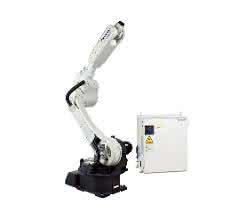
Panasonic Industry Europe will also be presenting the newly developed LA1800G3 multi-purpose robot. With a maximum payload of 26 kg and a working range of up to 1.801 m, the articulated arm robot is designed for handling tools, components and TIG welding equipment. Using the cooperation function, the movements of both robots can be synchronized when combining the LA-1800G3 with a welding robot from Panasonic Industry Europe. This means that only the position of the component needs to be programmed during welding and the relative position of the welding torch to the component is automatically maintained. Programming the weld seam remains as simple as with a fixed component.
The new LA-1800G3 can also be used to automatically load and unload components to enable more cost-effective and faster production. The G3 controller also enables cooperative operation with the Panasonic TM / TL-G3 series welding robots.
According to documents from Panasonic Industry Europe / ag


You might also be interested in
Plagiarius 2024 negative prize
On January 26, 2024, the Plagiarius campaign awarded its dreaded "Plagiarius" negative prize for the 48th time to manufacturers and retailers of particularly brazen counterfeits and fakes.
 read more...
Ivalua honors winners of the Generative AI...
AI-supported "add-ons" for buyers within 48 hours
Ivalua, provider of cloud-based spend management solutions, announced the winners and innovations of the first Generative AI Innovation Cup. The competition took place in December 2023. It was open to all Ivalua partners and employees - more than...
read more...Efaflex celebrates 50 years of high-speed...
The emphasis is on "fast"
Since day one, Efaflex has wanted to use new technologies as early as possible and drive progress in the industry. This year, the family business is celebrating its 50th anniversary under the motto "Fast Forward".
read more...Security of supply even during power outages
In the winter of 2022, Germany was worried about energy shortages. The drugstore retailer dm did not paint any horror scenarios, but nevertheless saw the possibility of controlled, temporary, regional power cuts (brownouts).
read more...Safety technology in mechanical engineering
Modules with new functions
Euchner's product highlights at EMO 2023 include the communication-capable solenoid interlocks.
read more...Transforming the paper industry towards climate neutrality
Together with partners from industry and research, Voith is developing a project for the optimization of energy and material flows in paper production. The aim of the research project is to develop a digital framework that enables effective process...
read more...Up to 95 percent less flue gas thanks to direct extraction
The requirements for occupational safety measures and safety technology are also constantly increasing in welding technology. The Technical Rules for Hazardous Substances (TRGS) stipulate that welding fumes and harmful substances must be extracted...
read more...Competitive advantages with large machines
Whether 3D-printed components for machines and systems, prototypes or aids for design: additive manufacturing is almost indispensable for modern companies in mechanical and plant engineering and automation if they want to play in the premier league.
read more...Transport technology from the modular system
Many transport tasks can be realized with the help of linear technology. Pre-configured solutions are available to simplify the interaction between the linear unit, motor, gearbox and controller. This minimizes the effort required for research and...
read more...