

Friction stir welding
Lightweight construction with Tailor Welded Blanks
In automotive development, functional lightweight construction is considered to play a decisive role in the efficient use of resources and energy.
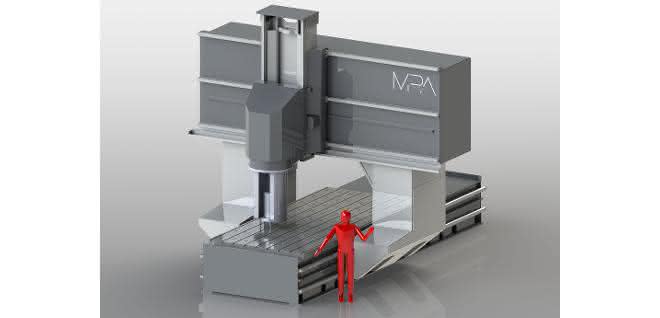
Friction stir welding of sheets of different thicknesses and materials to create so-called Tailor-Welded Blanks (TWB) offers new design freedom and high lightweight construction potential for the automotive industry. However, the process is subject to high requirements, for example in terms of plant and control technology.
Sustainability through functional lead construction
Traffic on Germany's roads causes around 160 million tons ofCO2 every year, which is around 20% of the country's totalCO2 emissions. One effective way to reduce this figure is to reduce vehicle weight through functional lightweight construction. In addition to appropriate lightweight materials, stress-optimized Tailor-Welded Blanks (TWB) are a particularly promising technology for lightweight car body production.
These are blanks that are assembled from different material grades and sheet thicknesses before forming. The mixed construction of aluminum and steel offers further potential for lightweight construction, allowing the positive properties of both materials, such as the high strength of steel and the low weight of aluminum, to be combined in a positive way.
CO2-HyChain research project
The automotive industry is striving to combine these measures in the form of hybrid aluminum-steel TWBs in order to further reduce vehicle weight. As part of theCO2-HyChain research project, solutions developed under laboratory conditions at the Materials Testing Institute of the University of Stuttgart for joining sheet metal blanks made of aluminum and steel by friction stir welding are being further developed, scaled up and transferred to industrial practice in an interdisciplinary research network.
During the welding process, a rotating tool introduces heat into the joint via friction and plastic deformation. As a result, the joining partners soften locally and are stirred in this state. However, at no time is the melting temperature of the joining partners reached. In conventional fusion welding processes, the weld seam is formed by the solidification of a liquid weld pool, whereby up to 70 % of the strength can be lost due to precipitate dissolution and grain growth.
Joining high-strength aluminum alloys
In contrast, friction stir welding enables the joining of high-strength aluminum alloys by avoiding the liquid phase with almost no loss of strength. Other lightweight alloys such as magnesium or hybrid mixed joints such as the joint of aluminum alloy and steel described here can also be welded. When joining aluminum and steel using friction stir welding, intermetallic phases are formed which are very brittle and therefore limit the strength and formability. However, this limitation can be almost completely eliminated by subsequent heat treatment.
One challenge in friction stir welding is the high process forces in the kN range, which require clamping technology to prevent the sheets from being pressed apart and a counterholder to absorb the axial forces. The friction stir welding process is subject to high demands on the selection of and compliance with the process parameters, especially for hybrid welds. In combination with relatively large tolerance ranges of the semi-finished products used, this results in challenging requirements for the entire system technology and the control technology used.
The joint projectCO2-HyChain, funded by the BMWK and involving the University of Stuttgart and a broad consortium of industrial partners, has set itself the goal of addressing these issues. In the project, two highly efficient production systems for the manufacture of hybrid TWBs and tailor-welded coils (TWC) are being developed, tested experimentally and their further processing secured until they are ready for use in order to ensure the corresponding process reliability and thus the quality of the joined blanks and coils.
Three project tracks
In the first of three project tracks, a portal system for the economical, piece-by-piece production of large-format hybrid aluminum-steel TWBs is being developed and put into operation. Previous friction stir welding systems have either only been optimized for very specific applications, such as the production of very long crane girders, or the systems are adaptations of 5-axis milling machines. In principle, however, 2.5D machining is sufficient for the production of TWBs. Machining requires a relatively large work surface with significantly different force collectives than those required for milling. For the friction stir welding gantry system, the University of Stuttgart is developing and implementing a control kinematic system for positioning the tool in the joining plane.
The aim of the second project track, which is running in parallel, is to develop, commission and validate a continuous line for the quasi-continuous production of hybrid aluminum-steel TWCs. This is an approach that offers great potential for the particularly economical production of hybrid sheet metal composites. The continuous movement of the sheet metal strips poses a challenge for the clamping and the counterholder and requires innovative solution concepts. Due to the high feed speeds and the demanding aluminum-steel weld seam, there are high demands on the control and regulation strategies of the system.
Because friction stir weld seams allow new degrees of freedom for the product development process, methods are being developed in the third project track to determine optimum weld seam profiles and then verify manufacturability using numerical process simulation. In the context of the computer-aided process design used in industry today, it is planned to represent the component design, the forming process and the evaluation of the achievable component properties virtually as far as possible, thus saving costs and time. This also includes the development, conception and design of the necessary forming tools. Particular attention is paid here to the interaction of the blank geometry and thus the course of the weld seam with the tool.
Control of the process temperature
Getting a firm grip on the friction stir welding process in order to guarantee consistently high welding quality is an important requirement for its industrial series use. A conventionally position-controlled machine tool can only achieve this to a limited extent. Due to component tolerances, the inflexible control of the tool's immersion depth can lead to strongly varying contact forces and thus to uncontrolled temperature distributions.
In the state of the art, this problem is usually countered with force control of the tool axis, which can already achieve significantly better results. However, as the force control does not take into account the geometry of the blank or the weld seam, heat build-up can occur with tight radii and on the outer edges of the blanks. As a result, the component can soften, which, in conjunction with the force control, leads to excessive immersion. In addition to poor seam quality, this can also result in damage to the tool, the counterholder or the clamping device, which in turn leads to downtimes and production losses.
Reliable process with consistent quality
For this reason, the welding temperature is to be monitored in the project and controlled by adjusting the speed in order to ensure a reliable process with consistent quality. The research system developed is to be equipped with additional temperature sensors for this purpose. The sometimes high additional costs and the integration effort of such sensors are usually not desirable in industrial use due to a lack of economic efficiency. For this reason, a supplementary process model is being developed that maps the temperature on the basis of material parameters and measurement data from the real machine.
The process model developed already provides plausible temperature curves based on measurement data from initial welding tests. In additional welding tests at the MPA, the temperature curves during friction stir welding are now also to be measured in order to validate the process model. In the future, it should be possible to use the model to monitor and control the welding temperature based on the machine data at runtime without using additional temperature sensors.
Authors: Nico Helfesrieder, Dr.-Ing. Armin Lechler, Prof. Dr.-Ing. Alexander Verl, Fabian Fritsche, Robin Göbel, Dominik Walz, Dr.-Ing. Martin Werz, Prof. Dr.-Ing. Stefan Weihe
University of Stuttgart, Institute for Control Engineering of Machine Tools and Manufacturing Units (ISW), www.isw.uni-stuttgart.de
University of Stuttgart, Materials Testing Institute (MPA), www.mpa.uni-stuttgart.de


You might also be interested in
Friction stir welding as a key technology for future industrial joining solutions?
At the DMG MORI in-house exhibition, Hufschmied Zerspanungssysteme presented friction stir welding with process-optimized tools and series production potential for the industry.
 read more...
Tox Pressotechnik at the Blechexpo
Connecting sheet metal and electrically conductive components safely
Joining sheets of different thicknesses easily and reliably without additional elements - Tox Pressotechnik will be demonstrating how this can be achieved at Blechexpo with its clinching and eClinch technology.
read more...Production, machine tools and robots
High-precision welding for perfect sawing
Stihl uses Nimak's portal projection welding systems to manufacture guide rails for chainsaws.
read more...Tox servo press for clean room
The coast is clear here now
In sensitive sectors such as medical technology, the optical industry or electronics, cleanroom-compatible components are required for all processes. This also includes drives. With the servo presses from the Electricdrive Core series, Tox...
read more...Air purity class 5 according to ISO achieved
Tox has servo press certified for the cleanroom
In sensitive sectors such as medical technology, the optical industry or electronics, cleanroom-compatible components are required for all processes. This also includes drives. With the servo presses from the Electricdrive Core series, Tox...
read more...Manufacture of metal bellows couplings
Joining instead of gluing
When manufacturing metal bellows couplings, the connections between the bellows and hub are a critical point. The flared press-fit process can be used here.
read more...ArtiMinds presents automation solutions at automatica
ArtiMinds Robotics is presenting automation solutions from the field of advanced robotics at Automatica in Munich. The applications were programmed using the in-house software solutions ArtiMinds Robot Programming Suite (RPS) and ArtiMinds Learning...
read more...Plug-and-produce with smart subsystem
The mechanical engineering company KMS Automation standardizes pressing and joining applications with the Smart Function Kit from Bosch Rexroth. The mechatronic subsystem simplifies machine design, increases process quality and shortens...
read more...Integrated ERP system for watertight processes
Rubber-based seals are used in window frames and escalators. They are also a must in tunnel projects to prevent water damage. Sealable, a specialist in sealing and insulation solutions, relies on an ERP system from Pro Alpha, which covers everything...
read more...