

Electron beam welding
Electron beams for nuclear fusion
At the European nuclear fusion test reactor ITER, high-energy plasma is enclosed in strong magnetic fields. The surrounding solid vessel is welded together from individual parts, whereby the weld seams must meet the very highest requirements. The required quality can be achieved using electron beam welding technology.
There are currently 7.6 billion people living on Earth. It is predicted that there will be 11 billion inhabitants by the end of the century. As the world's population increases, so does energy consumption. The research project currently being carried out at the ITER (International Thermonuclear Experimental Reactor) in Cadarache in the south of France is intended to pave the way for mankind to a climate-friendly, efficient and safe source of energy - nuclear fusion. Electron beam technology plays a key role in the experiment.
Thirty-five nations are working on the mega project, including European countries, Russia, the USA and China. The magnetic fusion device is intended to prove the feasibility of fusion as a large-scale and carbon-free energy source on our planet and imitate the principle of the sun. The core component of the international experimental power plant is a gigantic donut-shaped reactor. This contains a vacuum vessel weighing around 8,000 tons made of chrome-nickel steel, a special production with a quality specified specifically for ITER. In the future, a strong magnetic field will hold one gram of deuterium-tritium gas on narrow helical paths. This gas will be heated to 150 million degrees Celsius and brought into the plasma state. The plasma is hotter than the sun itself, so its principle of energy output can be simulated.
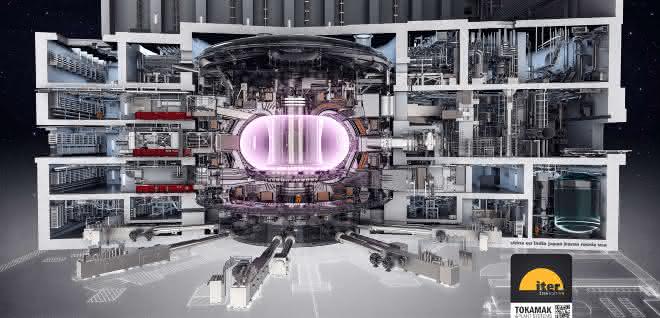
Electron beam adds tons of weight to boiler
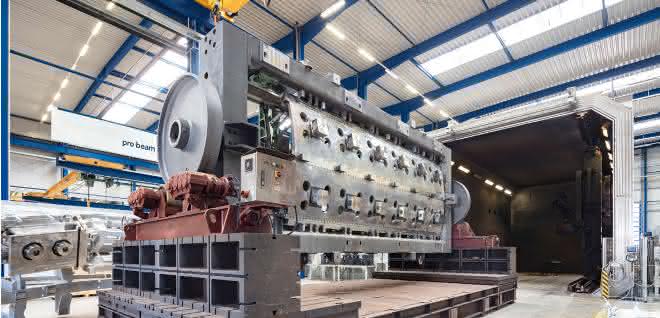
In order to withstand the forces involved, five of the nine sectors of the vessel were welded using Pro-Beam 's electron beam technology. "Never before had electron beam been used in nuclear pressure vessel construction. We therefore had to do a lot of convincing twenty years ago when we presented our technology as the most suitable solution for the planned welding tasks. In addition, even the French nuclear regulations RCC-MR had to be specially adapted to the electron beam," says Dr. Thors-ten Löwer, CTO at the Pro-Beam Group. In 2001, Fusion for Energy integrated the German specialist into the development of the production strategy. The positive characteristics of the technology convinced the decision-makers. In addition, Pro-Beam has the largest civilian welding system in the world and was therefore able to provide the mechanical basis for the components, which are up to twelve meters high and five meters wide.
The welding system had a huge impact on the development of the various sectors. After numerous feasibility studies and trial welds on test parts for various components of the system, the final welding of the boiler was started in 2017.
Gigantic project - enormous challenges
Due to the collaboration with international companies, a strict schedule must be adhered to throughout the entire project. This is because the parts are processed elsewhere before and after welding. The high concentration of energy in the focal point of the electron beam results in a high power density and therefore enables high welding speeds. This speed and the associated high productivity and efficiency are important in order to stay on schedule. In addition, the robust organizational structures implemented in the company support compliance with the deadlines and the high quality standards of the nuclear code.
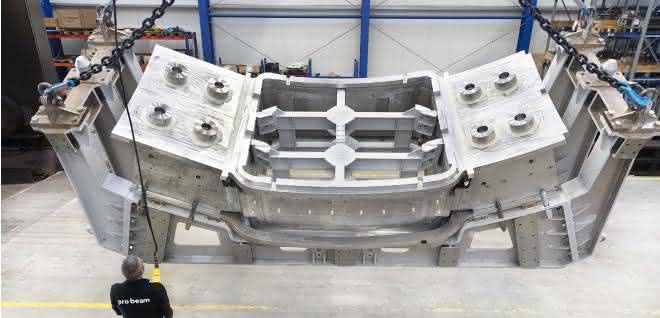
Another challenge is the welding tasks themselves: Unlike in normal contract manufacturing, where several thousand parts of the same type are usually produced, in this case every task is different and the welders have to deal with new seams again and again: from components with a seam length of 240 millimetres to six meters. What's more, no research project of this size has ever been carried out before, which is why there are always delays. "The project is extremely challenging, both from a technical and organizational point of view. Nevertheless, we are proud to be working on the largest experiment in human history. We also feel that we are more than equipped for future projects of this scale thanks to the experience we have gained," says Löwer.
Why weld with the electron beam?
With electron beam technology, all processes run digitally, from seam search to inspection. The seam is then welded in a single pass and with maximum precision. In addition, comparatively little energy is applied to the component, which means that welding is virtually distortion-free and extreme long-term stability and high dimensional accuracy can be achieved. The latter is extremely important for the accuracy of fit of the meter-long ITER components - distortion may only occur in the millimetre range or less.
The welding process takes place in a vacuum, which keeps the seam particularly clean and minimizes seam defects. In this special project, the seams are also checked in an X-ray bunker afterwards.
When the project is completed in spring 2020, Pro-Beam will have welded a total of 470 components with more than 1,800 weld seams and over 2,400 meters of seam. As things stand, the experimental reactor will be put into operation for the first time in 2025.
Stefanie Köhr, Marketing, Pro-Beam / am


You might also be interested in
Plagiarius 2024 negative prize
On January 26, 2024, the Plagiarius campaign awarded its dreaded "Plagiarius" negative prize for the 48th time to manufacturers and retailers of particularly brazen counterfeits and fakes.
 read more...
Ivalua honors winners of the Generative AI...
AI-supported "add-ons" for buyers within 48 hours
Ivalua, provider of cloud-based spend management solutions, announced the winners and innovations of the first Generative AI Innovation Cup. The competition took place in December 2023. It was open to all Ivalua partners and employees - more than...
read more...Efaflex celebrates 50 years of high-speed...
The emphasis is on "fast"
Since day one, Efaflex has wanted to use new technologies as early as possible and drive progress in the industry. This year, the family business is celebrating its 50th anniversary under the motto "Fast Forward".
read more...Security of supply even during power outages
In the winter of 2022, Germany was worried about energy shortages. The drugstore retailer dm did not paint any horror scenarios, but nevertheless saw the possibility of controlled, temporary, regional power cuts (brownouts).
read more...Safety technology in mechanical engineering
Modules with new functions
Euchner's product highlights at EMO 2023 include the communication-capable solenoid interlocks.
read more...Transforming the paper industry towards climate neutrality
Together with partners from industry and research, Voith is developing a project for the optimization of energy and material flows in paper production. The aim of the research project is to develop a digital framework that enables effective process...
read more...Up to 95 percent less flue gas thanks to direct extraction
The requirements for occupational safety measures and safety technology are also constantly increasing in welding technology. The Technical Rules for Hazardous Substances (TRGS) stipulate that welding fumes and harmful substances must be extracted...
read more...Competitive advantages with large machines
Whether 3D-printed components for machines and systems, prototypes or aids for design: additive manufacturing is almost indispensable for modern companies in mechanical and plant engineering and automation if they want to play in the premier league.
read more...Transport technology from the modular system
Many transport tasks can be realized with the help of linear technology. Pre-configured solutions are available to simplify the interaction between the linear unit, motor, gearbox and controller. This minimizes the effort required for research and...
read more...