
Control systems
Synchronized drive
Ever-increasing demands on the accuracy of modern machines require high-precision drive systems. The accuracy of rack and pinion drives is impaired by the non-ideal synchronization of the gearing. This problem can be solved by adding intelligence to the control system.
Modern production systems are expected to deliver high production quality with high dynamics. Both properties are largely determined by the drive systems installed in the machine. In addition to the achievable drive forces, they are also responsible for the positioning accuracy and the static and dynamic rigidity of the motion axis. Rack and pinion drives (ZRA) offer position-independent rigidity and, in principle, enable unlimited travel lengths and scalability at moderate costs. These properties have given ZRAs a firm place, for example, in the field of portal milling machines for large components or as linear axes for extending the working area of industrial robots.
However, the aforementioned advantages of ZRA also come with problems. One area that is still largely unexplored is the non-ideal synchronization behavior of rack and pinion. If a fixed transmission ratio of the gearing is always assumed in practice, closer examination reveals volatile deviations from this nominal value. Figure 1 shows an example of the difference between the actual and the theoretically calculated position of a ZRA along the travel path. The consequences are poor surface quality of components, vibration excitation of machine structures and excessive noise generation. A reliable prediction of the deviations at runtime and thus also approaches for compensation are not possible with the current state of research.
Root cause analysis
At the Institute for Control Engineering of Machine Tools and Manufacturing Units (ISW) at the University of Stuttgart, two key aspects were identified in a series of tests that are responsible for the scattering of the synchronization. Firstly, real gears always exhibit certain geometric errors. For example, the production of rack and pinion results in tolerance-related concentricity errors, pitch deviations and a non-ideal tooth flank shape. During assembly of the ZRA, impact errors also occur when the individual rack elements are lined up and inaccuracies occur in the alignment of the rack and pinion. The individual geometry errors of the components result in a kinematic error of the axle during operation. Due to the direction-dependent load distribution in the gearing, the amount of this error depends not only on the position, but also on the direction of movement. The described deviations can theoretically be completely avoided by tolerance-free production and assembly, but this is not feasible in practice and from an economic point of view.
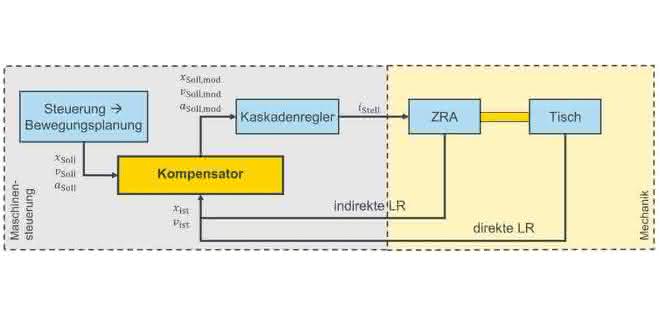
In addition, structural deformations due to the transmitted contact forces cause dynamically occurring position deviations. The stiffness of the drive system is dominated by the torsional stiffness of the gearbox and the pinion shaft as well as the contact stiffness between the teeth of the pinion and rack. The toothing stiffness and the gearbox stiffness fluctuate periodically with the angle of rotation of the pinion, as the tooth mesh and the length of the contact line are constantly changing. In addition, the overlap of the gearing is often not an integer, which results in gear impacts due to the changing number of teeth in mesh. As a result, the load-related displacement of a feed axis with ZRA is not only dependent on the acting forces, but also varies with the position of the toothing. During a movement, the fluctuations in stiffness lead to vibration excitation of the entire system and to cyclically occurring position errors that cannot be fully compensated by the position control. The ISW is researching approaches that can be used to minimize errors resulting from the effects of geometric deviations and fluctuating stiffness in terms of control technology. For this purpose, a compensator is added to the existing axis control system, as shown in Figure 2. This modifies the set values for the axis control in such a way that the synchronization errors are compensated. The exemplary structure of such a compensator is illustrated in Figure 3, where the kinematic errors are first compensated for after reconstructing the position of the gearing and the load on the axis. To do this, the geometric deviations of the drive system under consideration are precisely recorded along the entire travel path in both directions of movement. No additional hardware is required in addition to the existing position measuring system.
Prediction based on models
The position- and load-dependent stiffness of the drive system is then described using a model in order to predict the behavior more precisely. The modeling constantly adapts to the deviations measured during operation and improves future predictions. This eliminates the need for time-consuming metrological identification of stiffnesses. The resulting position errors can then be calculated in real time using the stiffness model taught to the respective drive and compensated for by adjusting the target values. These measures improve the synchronization properties of the drive without any adjustments to the components. Vibration excitation due to cyclically fluctuating synchronization errors is reduced and the accuracy of the drive is improved.
As described, rack and pinion drives exhibit synchronization errors along their travel path, which lead to vibration excitation and position deviations. The causes are mainly to be found in kinematic errors and variable stiffnesses. The measurement of geometric errors and the model-based prediction of structural deformations are intended to compensate for synchronization errors during operation. In this way, synchronization and path accuracy can be directly increased.
Lukas Steinle, M.Sc., Research Assistant; Dr.-Ing. Armin Lechler, Deputy Head of Institute; Prof. Dr.-Ing. Alexander Verl, Head of Institute, ISW of the University of Stuttgart / am. Funded by the German Research Foundation (DFG).


You might also be interested in
Plagiarius 2024 negative prize
On January 26, 2024, the Plagiarius campaign awarded its dreaded "Plagiarius" negative prize for the 48th time to manufacturers and retailers of particularly brazen counterfeits and fakes.
 read more...
Ivalua honors winners of the Generative AI...
AI-supported "add-ons" for buyers within 48 hours
Ivalua, provider of cloud-based spend management solutions, announced the winners and innovations of the first Generative AI Innovation Cup. The competition took place in December 2023. It was open to all Ivalua partners and employees - more than...
read more...Efaflex celebrates 50 years of high-speed...
The emphasis is on "fast"
Since day one, Efaflex has wanted to use new technologies as early as possible and drive progress in the industry. This year, the family business is celebrating its 50th anniversary under the motto "Fast Forward".
read more...Security of supply even during power outages
In the winter of 2022, Germany was worried about energy shortages. The drugstore retailer dm did not paint any horror scenarios, but nevertheless saw the possibility of controlled, temporary, regional power cuts (brownouts).
read more...Safety technology in mechanical engineering
Modules with new functions
Euchner's product highlights at EMO 2023 include the communication-capable solenoid interlocks.
read more...Transforming the paper industry towards climate neutrality
Together with partners from industry and research, Voith is developing a project for the optimization of energy and material flows in paper production. The aim of the research project is to develop a digital framework that enables effective process...
read more...Up to 95 percent less flue gas thanks to direct extraction
The requirements for occupational safety measures and safety technology are also constantly increasing in welding technology. The Technical Rules for Hazardous Substances (TRGS) stipulate that welding fumes and harmful substances must be extracted...
read more...Competitive advantages with large machines
Whether 3D-printed components for machines and systems, prototypes or aids for design: additive manufacturing is almost indispensable for modern companies in mechanical and plant engineering and automation if they want to play in the premier league.
read more...Transport technology from the modular system
Many transport tasks can be realized with the help of linear technology. Pre-configured solutions are available to simplify the interaction between the linear unit, motor, gearbox and controller. This minimizes the effort required for research and...
read more...