
Machining centers
Swiss precision with IO-Link
Using IO-Link, a machine manufacturer enables all the components of a new machining center to communicate with each other and with the outside world. The consequences include easier operation and maintenance as well as lower costs. By Wolfgang Zosel
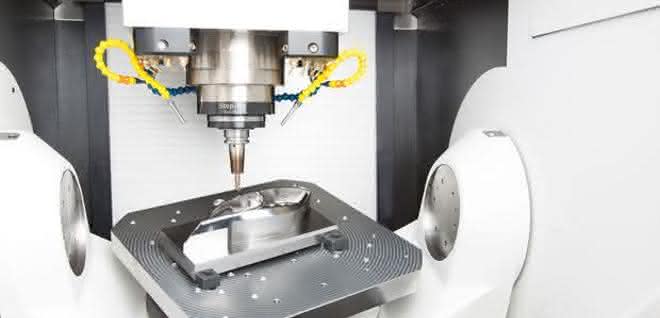
The Swiss manufacturer GF Machining Solutions is equipping its Mikron Mill P 500 U 5-axis high-performance machining centers with the versatile IO-Link communication interface throughout. In future, users will benefit from easier handling and unprecedented availability of process data for parameterization, diagnostics and service purposes. IO-Link shortens the installation and commissioning phase and makes it easier to meet individual customer requirements for feeds and tool management. IO-Link is a veritable push technology for digitized and networked system concepts at GF Machining Solutions.
Stefan Fahrni, Milling Product Manager, says: "With accuracies of micrometers, we meet demands for maximum precision and consistently high quality. To ensure thermal stability, the machine bed is made of a particularly robust mineral casting. With water-cooled components, we rule out the possibility of heat sources having a detrimental effect on the customer's product." Mikron Agie Charmilles, which is part of GF Machining Solutions and based in Nidau near Biel, is a global manufacturer of machines and automation solutions for mold and tool making as well as for the production of precision parts. The new Mill P 500 U is a 5-axis high-performance milling center that can machine a wide range of mechanical parts, components for jet engines and aircraft nozzles as well as master molds for the production of precision parts for the automotive and household appliance industries. At its core, the machine consists of a basic module that is loaded from above or from the front. Depending on the customer's requirements, partially or fully automated feeding devices and differently sized tool magazines can be added. "Our customers often work with expensive, high-quality materials. Process stability and consistently high quality are therefore also cost factors," emphasizes Fahrni.
Initial approaches to the development of the Mill P 500 U date back several years. The focus was on the question of what requirements customers will have tomorrow. "In addition to pure position values, intelligent sensors today offer a wide range of process data from the point of action. How can this be used easily and efficiently for process optimization? What does this change in terms of system handling? What are the benefits for the customer and what will change for us as a manufacturer?" says Konrad Meier, Head of Electrical Design, summarizing the fundamental questions.
Communication with a wide variety of components
In 2014, the company launched the "Integral Connectivity 4" project. GF Machining Solutions' aim was to achieve greater functional safety in the control system, modular electrical concepts with decentralized connection of peripherals and a simple, integrated communication solution between the control and sensor/actuator levels. The aim was to eliminate complex multi-pin wiring, reduce installation, assembly and maintenance costs and increase diagnostic capability.
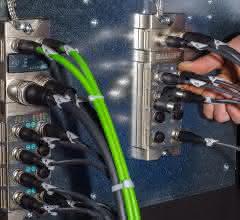
"In spring 2014, we had the opportunity to present the IO-Link communication standard, which was barely known at GF Machining Solutions at the time. Two engineers quickly realized that the bidirectional interface would provide answers to a large number of questions. Shortly afterwards, we received the order to develop an integrated IO-Link concept for the planned Mill P 500 U together with GF Machining Solutions," recalls Thomas Zumbrunn, sales engineer at the Swiss Balluff subsidiary. As a global IO standard, IO-Link enables uncomplicated data exchange between sensor-actuator and master control level - exclusively via a standard three-wire cable and M12 connector. The powerful point-to-point connection is not a fieldbus, but a consistent further development of the previous connection technology for sensors and actuators.
In addition to extensive sensor technology for position and object detection, valve terminals and pressure sensors on the rotary swivel table, including RFID-supported tool management, dozens of signals have to be organized in the machine with its various feeding devices. IO-Link is connected to the Siemens and Heidenhain controllers operating in the system via Profinet IO-Link masters. "From the design to the installation and commissioning phase, IO-Link offers unprecedented simplification through standardization. The use of IO-Link has a lasting effect for our customers: They can now parameterize centrally, diagnose transparently and implement predictive maintenance concepts easily for the first time," says Fahrni.
Installation with IO-Link means error-free plugging instead of wiring. Shielded special cables and expensive plug-in cards are a thing of the past, cable trailing is drastically streamlined and systems with IO-Link guarantee high EMC stability. The versatile communication standard saves space in the field and in the control cabinet, often reduces the footprint and creates a completely new cable arrangement. Above all, IO-Link saves time and therefore money. Over the entire life cycle of a system, IO-Link makes processes simpler and more transparent. The non-proprietary standard allows complete freedom in the choice of components. GF Machining Solutions can meet almost any customer requirement when selecting components, especially for customer-specific peripherals.
Parameterize and monitor sensors centrally
IO-Link reveals its strengths when used by customers: operators can re-parameterize entire sensor groups in seconds from the master or control level via an easy-to-use central recipe management system. Even the threshold value of a pressure sensor is no longer set on the device, but centrally via the master or from the HMI. Replacing a defective sensor no longer results in a long system downtime: a few seconds after plugging in the cable, the device receives its relevant values from a central location and then performs its intended task again.
Intelligent sensors are able to transmit a wealth of parameter and status data in real time, providing a comprehensive picture of the state of affairs at process level. This opens up new diagnostic and predictive maintenance approaches: The milling tool equipped with an RFID chip transmits its specific product and usage data to the control system and announces a regrinding date in good time. If the optical lens is dirty, an optical sensor indicates a loss of performance and automatically requests a remedy. A drive indicates overheating. Service and maintenance work can be carried out remotely down to sensor-actuator level, always in compliance with the safety requirements imposed by the operator.
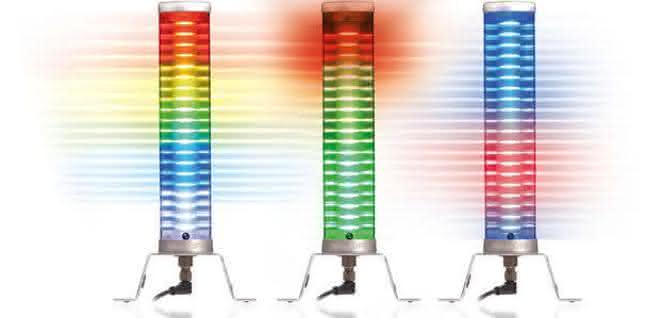
The IO-Link equipment portfolio of the Mill P 500 U also includes the SmartLight from Balluff. The IO-Link signal light is freely programmable and can display segment, level, running light and flexi modes with a wide range of colors. "This allows us to easily display all conceivable status displays, warning messages or requests for action. Above all, we now only have to stock a single, universally applicable light type," says Meier.
With the use of IO-Link, GF Machining Solutions and Balluff have shown that a simple technology can further optimize an essentially highly precise and reliable process. "Balluff was not only a parts supplier, but also a consultant and know-how project partner," summarizes Stefan Fahrni.
Wolfgang Zosel, specialized journalist Reutlingen / am


You might also be interested in
Hebotec at the Hannover Messe 2025
Connecting consumers without tools
Additional robots, control cabinets, control panels or other consumers can be easily integrated into the EMC concept of an existing production line using the PAK 25 equipotential bonding terminal from Hebotec.
 read more...
Motion controller for small drives
Medium power range covered
Faulhaber has another housing-less and compact motion controller in its range, which is particularly suitable for integration in device construction and medical technology applications.
read more...Safe solutions for cable installations
From thick power cables to thin sensor lines, cables and lines must be routed safely through systems and machines. A challenge that should not be underestimated, explains Jörg Sokat, Head of Product Management at Pflitsch.
read more...Displacement measuring systems
Economic positioning
The integrated position measuring system IMS from Bosch Rexroth is now also available as IMS-compact for absolute measurement. The non-contact solution with magnetic measuring principle enables robust and economical position detection for linear...
read more...Economic positioning
The integrated position measuring system IMS from Bosch Rexroth is now also available as IMS-compact for absolute measurement. The non-contact solution with magnetic measuring principle enables robust and economical position detection for linear...
read more...Sensors with IO-Link for extruders
The melting pressure always in view
Macchi, a manufacturer of blown film extrusion lines, optimized its extruders for Industry 4.0 by integrating melt pressure transmitters with digital IO-Link output for precise recording of the melt pressure and magnetostrictive displacement...
read more...Vision with good visitor response
6505 visitors and 378 exhibitors attended the machine vision trade fair in Stuttgart.
read more...Würth Elektronik at the embedded world
Würth Elektronik, manufacturer of electronic and electromechanical components, is presenting itself as a partner to developers at embedded world. At stand 110 in hall 2, the company will be presenting its portfolio and the associated services.
read more...Die-cast electronics housing
CTX Thermal Solutions manufactures cost-effective die-cast housings in application-specific geometries.
read more...