

Cutting-edge research
Experiments in weightlessness
The new "Einstein Elevator" in Hanover simulates different gravitational conditions. Frequency inverters from Gefran help with the control.
The moon is an ideal base for expeditions and may even be used as a research station in the future. In manned space travel, more and more devices are therefore needed that can be used, for example, to process resources into building materials on site or to manufacture construction and spare parts. To this end, researchers from the Laser Zentrum Hannover e.V. and the Institute of Space Systems (IRAS) at the Technical University of Braunschweig are currently developing a laser in the Moonrise project that will melt moon dust and turn it into solid spheres.
"This is a first step towards later bringing 3D printing to the moon," reports Prof. Dr.-Ing. Ludger Overmeyer, Head of the Institute of Transport and Automation Technology (ITA) at Leibniz Universität Hannover, Chairman of the Scientific Board of Directors at the Laser Zentrum Hannover e.V. and project manager of the Moonrise project. "Production or machining processes have to take place under completely different gravitational conditions than on Earth."
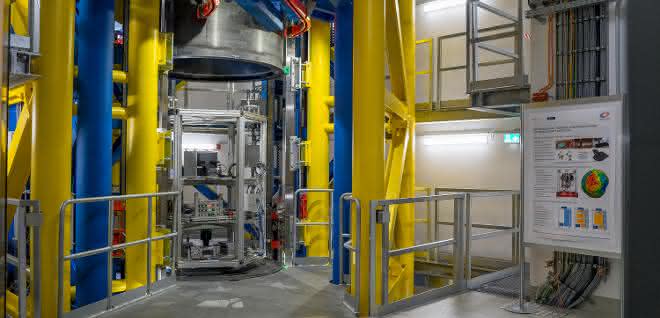
In order to simulate extraterrestrial environmental conditions, the ITA, together with colleagues from the Institute of Quantum Optics at Leibniz Universität Hannover, has set up a major project in recent years: The Einstein Elevator. It was put into operation at the beginning of this year. The first experiments are now taking place in it.
Up to 300 flights a day
While the repetition rate for other drop towers is only around two to three attempts per day, a new run can take place in the Einstein Elevator every four minutes at most, meaning that up to 300 flights are theoretically possible in three-shift operation per day. Instead of large vacuum chambers and free fall, as is usually the case, a test chamber - in the form of a gondola - races up and down on rails at enormous speed.
The Einstein Elevator is also the first facility in the world that can simulate different gravitational conditions in addition to weightlessness. The gondola has space for experimental set-ups with a diameter of 1.7 meters, a height of 2 meters and a maximum weight of 1000 kilograms.
Enormous motor power
"The Einstein elevator is a masterpiece of interdisciplinary engineering, combining drive technology from roller coaster construction with the positioning accuracy of a machine tool," says Overmeyer. The challenge is to move large loads at very high speeds and to brake them again with pinpoint accuracy. The motors must therefore deliver enormous power and the system must have extremely precise measurement, control and guidance technology as well as a high degree of automation.
The inverters are also very important for synchronization. Three independent drive trains are installed in the system. Two of these are used to accelerate the nacelle. "Five frequency inverters from Gefran's ADV200 series, each with an output of 400 kilowatts plus an overload of up to 180 percent, are connected in parallel in each line to move the system upwards very symmetrically," explains Christoph Lotz, Project Manager for the Einstein Elevator at the ITA. The third drive train is used to control the levitation altitude (weightlessness) and to generate the variable accelerations.
High-performance drive
Intrasys developed the sophisticated drive, braking and control system for the Einstein elevator's travel sequence, including hover control, together with Leibniz Universität Hannover. This allows the gondola, which weighs several tons and weighs 5 g, to accelerate vertically to 72 kilometers per hour in 0.5 seconds and brake again safely. The company's linear drives require very high currents for just a few seconds.
"When the nacelle is launched, a large amount of energy is taken from Stercom's supercap energy storage system by the Gefran converters and passed on to the stators," says Dr. Tobias Hollmer, Managing Director of Research and Development at Intrasys, explaining the functional principle of the drive. There, the current generates a magnetic field, which then interacts with a magnetic field and drives the vehicle.
The Einstein Elevator not only uses standard components from the drive manufacturer, but also special components that were developed specifically for the drop tower. "In contrast to our tried-and-tested roller coaster drives, we had to implement a much more precise position detection system here, for example," Hollmer continues. "This was necessary in order to meet the high control accuracy requirements of the system." In order to do justice to the dynamics of the application, the company also uses a new method for optical data transmission, as no ready-made solution was available on the market.
Measurement and control in the Einstein elevator
The seamless interaction of the control system with the measurement technology is also of crucial importance. "Our sensors are located directly on the nacelle and send data in real time to the drive, which is installed at the bottom of the tower," explains Christoph Lotz from ITA. "That was quite a challenge when you consider that it not only has to work at high speeds, but also over such a long transmission distance in the 40-metre-high drop tower."
In order to achieve precise levitation control, Intrasys has also developed a new system control and a specially designed magnetic yoke to achieve a significant weight reduction compared to standard yokes. "We have definitely broken new technical ground with this system," says Hollmer. "From my point of view, the combination of such a high drive power of up to five megawatts and precise control accuracy - which makes it possible to keep the experiment's hovering height in the nacelle constant to within a few millimetres - is particularly impressive."
High-performance memory
When it became clear during the planning of the drop tower that such high power for the drive could not simply be drawn from the grid, the company Stercom, which specializes in the construction of high-performance storage systems, came into play. "If the Gefran converters were simply connected to the power grid to generate DC voltage from the AC voltage, the grid would be under extreme strain and the voltage in the sensitive research facilities in the neighborhood would plummet," explains Robert Sterff, CEO and founder of Stercom.
"This is why a high-performance storage unit had to be used as a buffer for the required power in the Einstein elevator, which is charged slowly and can then release very high currents - up to 7000 amps - in a short time. While in other applications the braking energy can be recovered and used to charge the accumulator, the ITA deliberately decided against regenerative braking: "The savings in electricity are disproportionate to the safety risk. It was important to us to bring the system to a safe standstill at all times," says Overmeyer. After the energy has been used up during a test, the system has four minutes to recharge.
With around one million charging cycles, the service life of a supercap is much longer than that of a normal battery with only a few thousand cycles. The storage elements used are so-called double-layer capacitors or supercaps, which are innovative high-performance capacitors with enormous capacity. Although they can store less energy than modern lithium batteries, they can release it much faster and more often. For a better understanding, Robert Sterff explains: "Conventional batteries are like endurance athletes, while supercaps are like sprinters with extreme speed."
Further development in planning
The researchers at Leibniz Universität Hannover are very satisfied with the interaction of the drive components used and the interdisciplinary cooperation between the project partners. "There will soon be further developments to the system in the course of new experiments," says Ludger Overmeyer. Intrasys will then work with the ITA research team to create additional driving profiles for an even broader range of experiments in the Einstein Elevator in order to simulate various gravitational, air and environmental conditions down to the smallest detail. "Particularly in the control and regulation technology, there are special subtleties that need to be implemented," says Christoph Lotz. And this brings research one step closer to the goal of being able to carry out the necessary production or processing steps for a functioning infrastructure in space, on the moon or other planets.


You might also be interested in
Motors, gearboxes and encoders: Faulhaber expands Ø 16 mm portfolio
Faulhaber is expanding its portfolio with new DC motors from the SXR and GXR family, a 16 mm planetary gearbox and the IEX3 magnetic encoder for compact drive solutions.
 read more...
New drive solutions for industrial automation and robotics
Faulhaber presents drive solutions with the new GXR and SXR motor family, which offer high efficiency and flexibility in combination with powerful gearboxes and encoders. These optimized components open up new possibilities for applications in...
read more...Marco Altherr becomes new Chief Financial Officer
The Supervisory Board of Ziehl-Abegg has appointed Marco Altherr as the company's new Chief Financial Officer (CFO). Altherr will take up his post in May 2025.
read more...Hydrogen storage in metal hydride
With its focus on storage systems for green hydrogen in solid form (metal hydride), GKN Hydrogen presents itself as a pioneer in safety and efficiency for the industry. GKN Hydrogen offers safe storage systems for green hydrogen and focuses on two...
read more...INDUSTRIAL Production Products of the year...
2nd place, Robotics category: EGS Automation
The SUMO automation systems from EGS Automation - economical standard solutions for automating a wide range of processes in plastics and metalworking - took second place in the robotics category in the competition for Product of the Year 2024.
read more...More productivity with Drive Intelligence
The trends in automation are productivity, sustainability and connectivity. Baumüller is launching new products on the market that address these trends, including new tools for smart energy monitoring, condition monitoring in the drive and new...
read more...Intelligence in Motion
At SPS, Koco Motion will be showcasing its expertise in customized drive solutions based on DC and BLDC motors, stepper motors, servo motors, linear drives and controllers.
read more...Nomination Products of the Year 2024
EGS Automation: SUMO automation systems
The SUMO automation systems from EGS Automation, economical standard solutions for automating a wide range of processes in plastics and metalworking, have been nominated in the Robotics category in the competition for Product of the Year 2024.
read more...Transport technology from the modular system
Many transport tasks can be realized with the help of linear technology. Pre-configured solutions are available to simplify the interaction between the linear unit, motor, gearbox and controller. This minimizes the effort required for research and...
read more...