

Robotics and servo axes
Drive technology for flexible packaging machines
Packaging processes are very complex. The machines have to be loaded automatically, both with the packaging material and with the respective products. By the time the finished packs leave the machine, the automation used has to achieve a great deal.
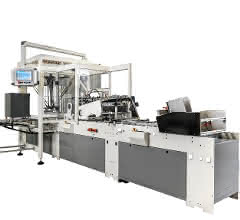
The processes involved in handling and the actual packing process require many powerful servo axes, which often also have to work together smoothly with pick-and-place robotics. It is practical if the different components can be controlled via a common controller. The programmer can concentrate entirely on the application and does not have to deal with the underlying technology of the different systems.
Esatec, a French specialist for packaging machines, has developed Turbomailing, a particularly flexible packaging machine that can place and glue almost all types of rigid and soft products, whether pre-cut or from a roll, onto any type of carrier or cardboard sheet and then fold the packs. These include perfume or cosmetic samples, gift cards or even Bluerays or DVDs as well as bags for powders, liquids or food. A2C, Esatec's parent company, already has such a turbomailing packaging machine in operation at its plant in Puymoyen near Angoulême. The company specializes in packaging work for the cosmetics and food industries and can respond quickly and flexibly to a wide range of customer requirements thanks to its machinery.
Perfume and cosmetic samples individually packaged
The new Esatec machine in Puymoyen is used to individually package cosmetic and perfume samples for promotional campaigns. Different operating modes make it possible to place up to three different samples on one carrier and, if necessary, combine them with leaflets. Samples and carriers first enter the machine via a conveyor belt and are positioned in the loading station by a friction feeder.
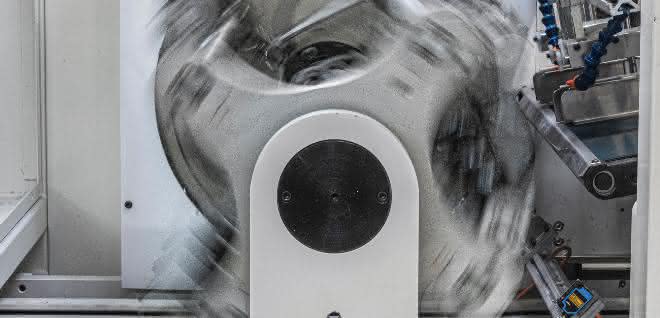
A four-axis delta robot and another patented 5-axis pick-and-place unit place the samples on the carrier, which is then folded twice or three times. Depending on the product specification, approx. 6,000 to 10,000 high-quality packaging units are produced per hour in this way. This means that the cycle times are extremely short and fast-reacting drives are required. For several reasons, Yaskawa components were chosen for both the robotics and the servo axes.
Quickly loaded via pick-and-place
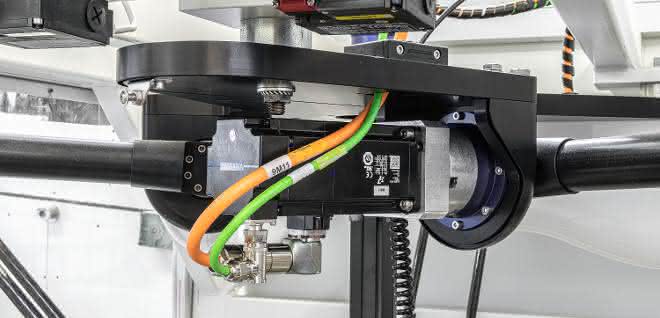
The D4 Delta robot from Codian Robotics used in the packaging machine, for example, with its four precisely controlled axes, is virtually predestined for such pick-and-place applications, as it can position even the smallest products quickly and accurately to the millimeter with a reproducibility of 0.1 mm in a confined space. While the second pick-and-place unit is more suitable for flat objects, the product shape is irrelevant for this robot. Equipped with a camera vision system, the Delta robot picks up elements of any shape that are delivered by the friction conveyor.
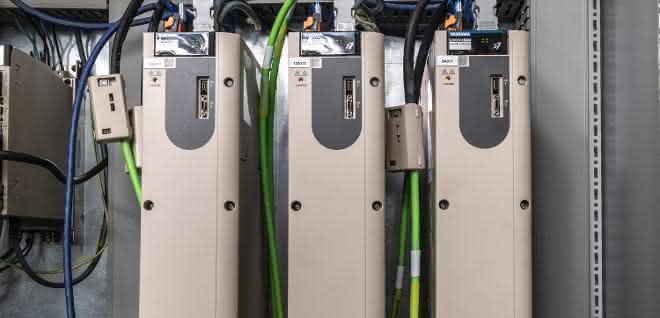
All other drive tasks for loading and packaging the cosmetic and perfume samples are performed by servo drives from the Sigma 7 series. Two of these servo axes drive the main conveyor belt, two others ensure a precisely controllable product spacing on the friction conveyor, the five axes of the patented pick-and-place unit are also moved by these drives and a Sigma-7 servo axis is installed in the folding unit.
High power density and simple commissioning
There were many reasons for using these drive systems. When developing the servo drives of the Sigma 7 series, the focus was on features such as fast commissioning, high production output and maximum operational reliability, which benefited the packaging machine designers. Added to this was the large selection. The fast-reacting AC servomotors cover outputs from 50 W to 15 kW at supply voltages of 200 or 400 V and impress with their extremely compact dimensions and very smooth running.
The series includes narrow single and double-axis amplifier modules for 200 V or 400 V in a space-saving design, which can be arranged in a row without gaps in the control cabinet and optionally wired very easily via daisy chain. This reduces the installation effort. There is also a further space advantage: no additional cooling is required at ambient temperatures of -5 to 55 °C. The servos impress with their high resolution (integrated 24-bit absolute encoder), high dynamics and functions such as vibration suppression, suppression of machine resonance frequencies and tuning-less function for simple commissioning.
Compact controller for servo drives and robots
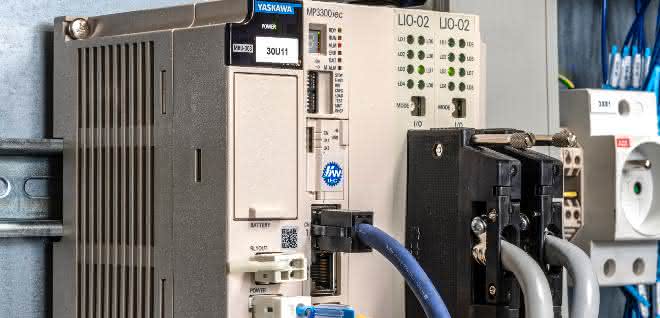
The servo axes and the delta robot can be controlled via a single controller. This is made possible by the MP3300iec RBT compact machine controller used in Turbomailing. It was recommended to the French packaging machine specialists by Yaskawa, primarily because of the uniform application programming via a single software tool with standard PLCopen and Yaskawa-specific function blocks, which are available free of charge and make system programming much easier.
The range of functions also includes the integration of visualization, the integration of camera systems, conveyor tracking, a group toolbox to support G-code and many other features. Machine builders can even use this solution to implement robots without the need for a programming device (teach box) or a proprietary robot programming language. The motion sequence of the robot's individual axes is calculated in the controller's firmware and transferred to the robot controller. This allows the programmer to concentrate fully on the application without having to worry about the underlying complex technology.
The servo axes can also be programmed in the same software environment. With the Mechatrolink III real-time Ethernet bus, the compact controller ensures simple synchronization of robots and servo axes. The motion controller really comes into its own in conjunction with the Sigma 7 servo systems. Up to 62 real and 2 virtual axes can be controlled.
In addition to process data, the servo systems also provide the controller with status information, e.g. for a vibration analysis. The data allows conclusions to be drawn about the condition of the entire system and enables efficient maintenance planning. All in all, this provides the best conditions for high-performance motion applications such as the packaging machine described.


You might also be interested in
Further simplify assembly processes
In addition to the proven racks with a length of one meter, Wittenstein alpha now offers optional two-meter racks for linear systems. They are particularly suitable for use in short axes, for example, in order to simplify assembly even further.
 read more...
Hiwin manufactures its own shaft gearboxes
Have you ever waited several months for an urgently needed corrugated gearbox? Hiwin has too. That's why the Offenburg-based drive specialist has decided to produce its own space and weight-saving reduction talent.
read more...Human-robot interaction at the trade fair
Sumitomo Drive Technologies is presenting its drive solutions for automation and robotics at Automatica 2023 together with the Lafert Group. The company will be showcasing two different applications of the Tuaka drive system for robot applications...
read more...Partial automation with robots
At Automatica, Promess will be showcasing its modular individual workstations and how these can be partially automated with robot support. The servo press manufacturer will also be providing information about the latest features of its Revolution X...
read more...A new benchmark for collaborative robots
At this year's Automatica, Denso Robotics will be showcasing its innovations in the field of robotics. The collaborative Cobotta Pro product family will be the focus of the presentations. Visitors to the trade fair can see all variants in various...
read more...Clamping system for a new milling machine
Investments in machinery often lead to further purchases - as is the case at Joma-Maschinenbau, whose modern production facility has recently been supplemented by a 5-axis milling machine.
read more...Schunk wants to simplify processes in automated production
The declared aim of automation specialist Schunk is to make its customers' processes comprehensible, simple and efficient. Data transparency plays an important role in this. It enables reliable processes and provides the basis for resource-saving...
read more...Festo and Hahn Automation develop battery tester for greater safety
The success and reputation of electric vehicle manufacturers depend on the safe and flawless functioning of batteries. Hahn Automation has therefore developed a battery tester that performs a fully automated 100% test of mobile energy storage...
read more...SPN Schwaben Präzision presents gearbox solutions for automation and industrial robotics
Short cycle times, robust technology, wear-free surfaces and compact designs have always been relevant for automation and robotics solutions. This year's Automatica trend topics include "Sustainable production" and "Digitalization and AI". SPN aims...
read more...