

Safety PLC
Automation of tunnel shaft elevators
Two maintenance elevators at the Gleinalm Tunnel in Austria have been modernized with ABB AC500-S safety controllers to ensure state-of-the-art functional safety.
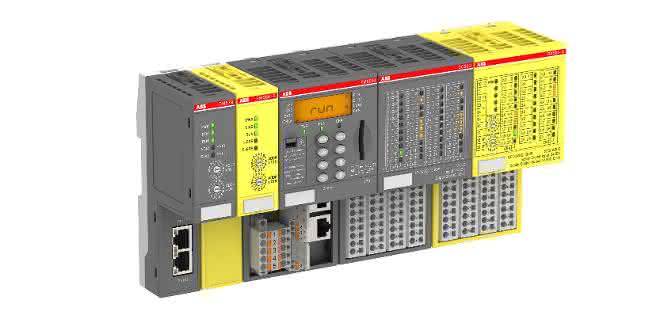
The safety functions in the elevators can be reliably implemented using the Structured Text programming language. The Gleinalm tunnel on the A9 Pyhrn highway in Austria connects the districts of Leoben and Graz-Umgebung. Over a length of 8.3 km, there are two ventilation shafts that descend more than 300 m into the mountain. Elevators were installed in the shafts in 1980 in order to maintain them and inspect the condition of the shafts. After a good four decades of operation, the shaft elevators were to be refitted and brought up to the latest technical standard - also in terms of functional safety.
The Austrian infrastructure company ASFiNAG commissioned Strabag Infrastructure & Safety Solutions (SISS) to modernize the elevators in the two maintenance shafts. Thanks to the good cooperation with ABB on other tunnel projects, SISS decided to upgrade the elevators with the AC500-S safety PLC.
Bernhard Heinzel, Group Manager Technical Support at SISS, is satisfied with the result: "Before the retrofit, the maintenance workers often got stuck with the elevator - in a dark, cold place with no cell phone reception. Now everything works smoothly."
Performance level c as a requirement
The AC500-S can be used for safety functions up to Performance Level (PL) e in accordance with ISO 13849-1. As part of a risk analysis, PL c was defined as a requirement for some functions in this project. In order to fulfill this requirement, a rotary encoder is evaluated via the control system, which supplies the signals for the functions "safely limited speed" and "safe brake control/safe stop". If the encoder indicates that the elevator speed is above a certain limit value, the control system triggers the activation of a hydraulic brake that reduces the speed to a safe level or performs a safe stop.
As the PLC was attached to the steel cable drum, but the elevator movement is controlled from the car, safe decentralized peripherals are located in the car. It was therefore necessary to create a connection between the PLC and the peripherals that would also function reliably 360 m into the mountain and process safety-related data. With the AC500-S and the integrated PROFINET/PROFIsafe field bus, this is achieved via a redundant WLAN connection and radio relay.
Due to the extreme climatic conditions, icicles up to 3 m long can form in the shaft, especially in winter, which can endanger personnel and equipment. The icicles can be smashed using a special sheet metal construction on the elevator. ABB's non-contact Eden safety sensors (IP69K) were used for this purpose. The sensors indicate when the shaft elevator is in a predefined position from which the icicles can be safely broken by a predefined movement.
Programming safety functions with ST
The main argument for using the AC500-S was the possibility of programming the safety functions using the Structured Text (ST) programming language. ST allows very flexible and fast programming. Any programming errors can be counter-checked with the Safety Code Analysis (SCA) tool from ABB. This safety code analysis tool can be used to verify safety-relevant programming rules in accordance with IEC 61508-3 for the ST, FBD (Function Block Diagram) and LD (Ladder Logic) languages. The SCA tool is certified by TÜV SÜD for applications up to SIL 3 (IEC 61508) and PL e (ISO 13849-1). The resulting code with a clear structure not only speeds up commissioning, but also significantly reduces certification and maintenance work after implementation. The SCA tool was also used in this project for acceptance by the expert.
Control unit supports complex arithmetic functions
The possibility of trigonometrically controlled safety applications is another advantage of the AC500-S. The controller supports complex safety arithmetic functions (SIN, COS, TAN, LOG, LN, SQRT etc.) with floating point calculations. For elevators, this allows the safely limited speed to be monitored dynamically and very precisely for the application.


You might also be interested in
From risk to resilience
NIS2 significantly increases the requirements for industrial security concepts. In addition to cyber resilience, physical access protection is becoming increasingly important.
 read more...
Security Operations Center module
When cyber attacks reach production
Adlon is further developing its Security Operations Center and adding another module to the existing Managed SOC for Microsoft 365 environments (based on Managed XDR): Managed SOC Advanced.
read more...Lifecycle management and safe IO-Link communication
At SPS, Pilz will be presenting solutions that combine safety and security in production. The focus is on the digital Myzel Lifecycle Platform, a SaaS offering for the management of machinery and personnel over the entire lifecycle.
read more...The basics of warehouse safety
Safety in the warehouse primarily relates to the employees. However, goods must also be transported safely and transport equipment must not be damaged.
read more...Environmental containers and fire protection
Companies can choose from a wide range of environmental containers for storing chemicals and other hazardous substances.
read more...Secure focus on access
To ensure comprehensive safety, holistic safety concepts for safety and industrial security on machines are required. Authorizations and access must be clearly regulated.
read more...Added value through safety and productivity
Machine malfunctions can have serious consequences and put people's health at risk. Functional safety therefore plays a central role in industry. With control and inverter technology including integrated safety functions from ABB, plant operators...
read more...Protect Ethernet interfaces
Pilz is expanding its portfolio of operating and signaling devices with the control element PIT oe ETH. It is equipped with an Ethernet port that can be activated and protects freely accessible Ethernet interfaces in industry against unauthorized...
read more...Protective tool in everyday life
Cybershield is a company founded in 2021 with a focus on operational technologies and has set itself the goal of significantly advancing IT security in the OT sector and supporting customers.
read more...