
Automation and control of a film bag machine
Complete system modularly bagged
A film bag machine can produce plastic bags, pouches and bags in a wide variety of designs. Baumüller was commissioned to design a new, cost-optimized, efficient and future-proof film bag machine. This was to achieve a higher throughput and, thanks to its modular design, also allow the manufacturer flexibility and fast commissioning in the production process. This meant that the machine operator would not have to buy more than the necessary machine modules.
Whether food or shipping, hygiene products or waste disposal - when it comes to transport or outer packaging, there is no way around plastic bags and pouches. Lemo Maschinenbau from Niederkassel is one of the world market leaders in this field with its economical and innovative systems for the production of flexible film packaging. Baumüller has been supplying the company with components and assemblies for many years.
The decision to have a new film bag machine both designed by Baumüller engineering specialists and completely automated with Baumüller systems had several reasons. The Nuremberg-based company has been a reliable business partner for Lemo for many years and also has many years of interdisciplinary engineering expertise. A large number of customized complete solutions have been implemented in the past.
Intelligent overall solution increases efficiency
Lemo wanted a modular system with an increased number of cycles. The Baumüller specialists were able to fulfill this wish with the help of a new automation concept. Among other things, they opted for a modern and lean drive and control architecture - a consistent fieldbus system, a minimum number of devices and a reduced control structure. The control cabinets were optimized and a future-proof communication structure was chosen for the software.
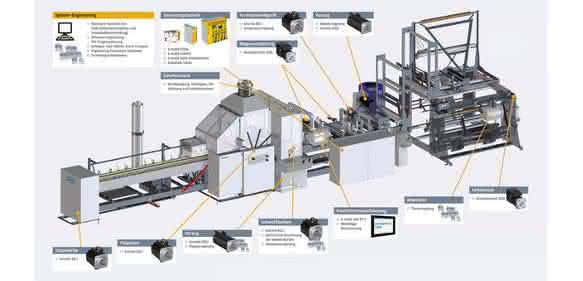
The new film bag machine is based on a complete drive and automation package with control technology, machine visualization, control cabinet, b-maXX inverters and various motors. Thanks to the coordinated machine concept and the use of EtherCAT as a universal fieldbus system, it was possible to increase the number of cycles while maintaining the same high production quality. Thanks to this concept and the standardization of the variants through intelligent modularization, productivity was more than 10 percent higher than with comparable machines. "Thanks to the comprehensive system know-how of the Baumüller specialists, the new film bag machine offers the machine manufacturer and operator absolute flexibility and has an optimum price-performance ratio," says Willi Fenninger, Managing Director and owner of Lemo. Co-owner and Managing Director Bernd Schlarp adds: "This gives our customers a future-proof and cost-effective production system that is characterized by top quality, the latest technology, energy efficiency and maximum production speed."
Standardized modularity and web-enabled visualization
It goes without saying that the film bag machine is "Industry 4.0-ready". Switching between different formats such as loop carrier bags, shirt carrier bags, bread bags or bin liners is no problem thanks to the modular design. The basic machine has six drives in the minimum configuration and can be extended to create a customized machine, depending on whether the machine modules form sealing and stacking chain are required, for example. If more modules are installed than are required for a current production process, slaves in the control system help to temporarily deactivate the modules. This means that the film bag machine can be ordered in different variants despite standardization.
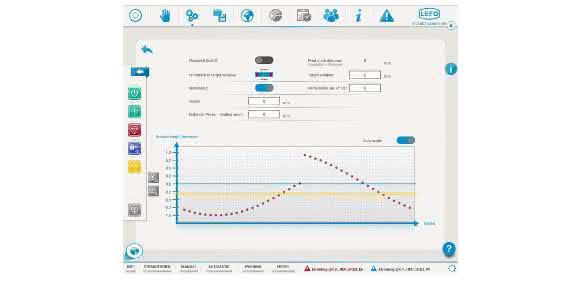
The operation and monitoring of the new machine is also future-proof and Industry 4.0-ready. The web-enabled machine visualization can be accessed via mobile devices. Baumüller uses automated software parameterization to ensure that the machine manufacturer can start series production quickly and without errors and that no time is lost during servicing. The production and service concept is therefore a further component in increasing efficiency.
Complete automation in hardware and software
The film bag machine consists of several stations. It begins with the unwinding and folding of the film, which stretches the single-layer web of the film roll into two layers. The process continues with form welding, where, for example, carrying handles are welded. At the sealing bar, the double-layer films are given their actual bag shape by separation welding. The separated bags are then transported onwards via the impeller and deposited in packs on the stacking chain.
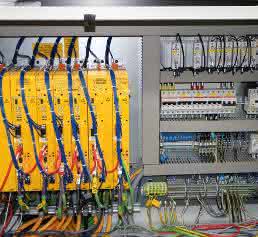
The control cabinet planned and manufactured by Baumüller contains the control technology with the bayable b maXX 5000 servo converter series, a b maXX PCC-04 industrial PC and a b maXX-safePLC. The latter is a combination of safety control and standard control functions in one device. The machine is operated via a 17" touchscreen monitor, which is located on a movable support arm. A standard browser is sufficient for the web-enabled machine visualization, and remote access via web-enabled end devices is also possible using an app.
Various operating modes can also be selected via the visualization. To enable service activities, for example, up to four individual operating modes, each with different user rights, can be selected via the machine visualization using a transponder.
The right motor for every station
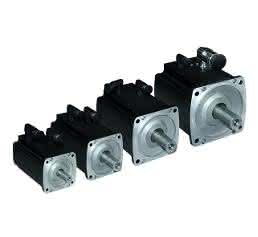
The entire film bag machine is equipped with Baumüller motors. DSC1 motors are used for the two sealing stations, the stacking chain and the impeller. The servomotors are compact and high-torque. The two feed stations with register control are driven by DSD2 servomotors, as extremely dynamic braking and acceleration is required at this point. The motors in this series are characterized by their high dynamics and good start-stop qualities. The third motor type is a three-phase synchronous motor with integrated electronics. The DSDI drive has a very short design and supports the modular machine design, as it does not require a separate inverter.
With its application-specific technology modules, including those for register and dancer control, Baumüller provides complete basic functions for the film bag machine that reduce the programming effort to a minimum. The technology modules for the controllers are purchased with a corresponding runtime license. This allows both simple movements and complex processes to be mapped.
The production and service concept enables the automatic parameterization of devices, modules and entire machines quickly and without programming effort. If a machine goes into series production, the machine manufacturer has the option of automating the entire software parameterization - just as in the case of servicing. Via fieldbus communication, the higher-level control system recognizes all participants in the system and automatically transfers them to the configuration of the control project.
A major advantage of the concept is the option of using automatic programming for machine variants. The maximum expansion of the machine series is stored in the system for this purpose. The engineering specialists' many years of expertise, coupled with complete automation consisting of hardware and software from Baumüller, helped Lemo to develop a consistent machine concept with a lean drive and control architecture. The standardization of the variants through intelligent modularization also led to a short time-to-market.
Lemo's requirement was to design an economically efficient film bag machine in which the entire servo drive technology, including motors and electronics, came from a single manufacturer. "This has advantages both during commissioning and when it comes to servicing," explains Fenninger. And so Baumüller supplies automation expertise, software and hardware as well as a production and service concept for the new film bag machine. With just one contact person and good project management for the machine concept and the construction of the prototype, the machine could be presented after a short development period.
According to documents from Baumüller / am
Automatica, Hall B6, Stand 303


You might also be interested in
Motors, gearboxes and encoders: Faulhaber expands Ø 16 mm portfolio
Faulhaber is expanding its portfolio with new DC motors from the SXR and GXR family, a 16 mm planetary gearbox and the IEX3 magnetic encoder for compact drive solutions.
 read more...
New drive solutions for industrial automation and robotics
Faulhaber presents drive solutions with the new GXR and SXR motor family, which offer high efficiency and flexibility in combination with powerful gearboxes and encoders. These optimized components open up new possibilities for applications in...
read more...Marco Altherr becomes new Chief Financial Officer
The Supervisory Board of Ziehl-Abegg has appointed Marco Altherr as the company's new Chief Financial Officer (CFO). Altherr will take up his post in May 2025.
read more...Hydrogen storage in metal hydride
With its focus on storage systems for green hydrogen in solid form (metal hydride), GKN Hydrogen presents itself as a pioneer in safety and efficiency for the industry. GKN Hydrogen offers safe storage systems for green hydrogen and focuses on two...
read more...INDUSTRIAL Production Products of the year...
2nd place, Robotics category: EGS Automation
The SUMO automation systems from EGS Automation - economical standard solutions for automating a wide range of processes in plastics and metalworking - took second place in the robotics category in the competition for Product of the Year 2024.
read more...More productivity with Drive Intelligence
The trends in automation are productivity, sustainability and connectivity. Baumüller is launching new products on the market that address these trends, including new tools for smart energy monitoring, condition monitoring in the drive and new...
read more...Intelligence in Motion
At SPS, Koco Motion will be showcasing its expertise in customized drive solutions based on DC and BLDC motors, stepper motors, servo motors, linear drives and controllers.
read more...Nomination Products of the Year 2024
EGS Automation: SUMO automation systems
The SUMO automation systems from EGS Automation, economical standard solutions for automating a wide range of processes in plastics and metalworking, have been nominated in the Robotics category in the competition for Product of the Year 2024.
read more...Transport technology from the modular system
Many transport tasks can be realized with the help of linear technology. Pre-configured solutions are available to simplify the interaction between the linear unit, motor, gearbox and controller. This minimizes the effort required for research and...
read more...