
Zero-point clamping technology
Uncomplicated, suitable packaging
Thinking outside the box, a packaging specialist and a stretching technology expert found an amazing solution for handling medicine cartons.
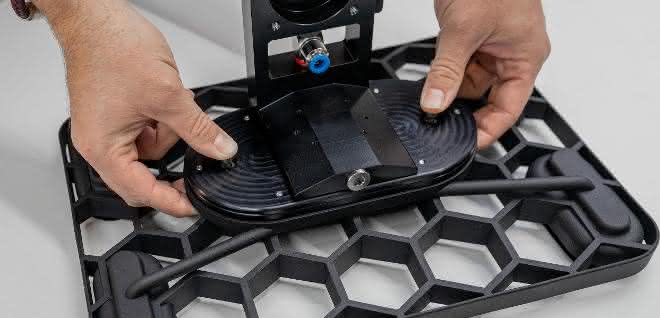
With the help of efficient zero-point clamping technology from AMF, Pester Pac Automation accelerates and flexibilizes the change of suction plates in its packaging machines. The robot arm can be equipped with a suction pad that matches the packaging cartons without the need for tools. This benefits safety when packaging high-priced medicines. "The fact that the suction pad plates can be changed so quickly and easily without tools has amazed us and makes the operation of our packaging machines safer and more efficient," says Christoph Rechner from Pester Pac Automation. Thanks to zero-point clamping modules with a latching function from AMF, the closure of the format plates can be opened with a simple press of the thumb, where previously four screws had to be loosened in a time-consuming process. Rainer Guggenmoos from AMF was certain from the outset that the zero-point clamping systems would also be convincing in unfamiliar terrain.
Clamping technology in a new application
The suction plates form the interface between the robot arm of the packaging machine and the cartons containing the pharmaceutical products. The machine uses vacuum technology to pack these onto pallets in a product-specific manner ready for dispatch. Depending on the size of the carton, various precisely fitting suction pads are used. When the products or batches are changed, this format part must be changed if the shape of the cartons also changes.
The fact that zero-point clamping modules are used here is new and unusual. This is because the modules used here are usually found in manufacturing or assembly environments, where they clamp fixtures, for example. Other modules in this series clamp workpieces in processing machines, for example. However, Christoph Rechner and Rainer Guggenmoos had the idea and the courage to think outside the box. And so two mechanical zero-point clamping modules from AMF (Andreas Maier) are now used in every laser-sintered suction cup plate. They have a special latching function that allows them to be opened with the press of a finger on the actuating button, latch into position and remain there. After the panel has been changed, the next time the button is pressed, the module locks again using spring force.
Packaging with tracking is the big challenge
Pester developed the optimal shape of the suction cup plates himself as part of a master's thesis. As a 3D-printed format part, it weighs only a fraction of the previous plates made of aluminum or stainless steel and bolted together. "We took several development steps at once with this project," emphasizes Rechner. The machines from Pester are used in product-contact-free final packaging.
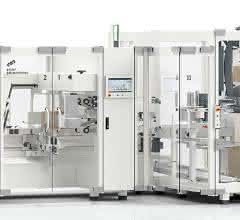
Almost two thirds of the machines delivered go to the pharmaceutical and medical sectors, while around a third pack consumer products such as cosmetics or care products. The fully automated machines bundle - for example by means of tight banding, shrink banding or full wrapping - and pack for dispatch to customers and wholesalers. The products can be packed and palletized in both film and cardboard boxes. Customers of the long-established Allgäu-based company include many global players in the pharmaceutical industry as well as large contract packers.
One special feature is the 100% control and tracking required by the European directive for packaging and shipping these products. Thanks to a sophisticated digitalized track-and-trace system, all products are 100% recorded, registered and the data for traceability is stored in exact batches. It also makes counterfeiting more difficult and protects users from plagiarism. Not only do several high-speed cameras and sensors help with this, but the suction plate is also parameterized. In addition, collision detection ensures that no damage occurs or cartons are lost if the plate is tilted, for example.
The packaged goods can quickly become very valuable. If, for example, a state-of-the-art new drug for cancer treatment is packaged, the value of a pallet can quickly reach the mid-six-figure range. The process times for packing, assembling and transferring are not the biggest challenge. Nevertheless, it is part of Pester's company philosophy to constantly improve the machines for the operators. And when it comes to set-up times, i.e. changing the suction pads, the developers have recognized the great potential. "What's more, some of our customers tell us how long the changeover to another product may take," says the development engineer.
"In the past, operators had to loosen four star screws and hold the heavy panel at the same time. That's almost impossible with two hands," recalls Rechner. The new technology makes this much easier. "The latching function of the zero-point clamping modules not only makes changing the suction plates easier and faster, it is also very intuitive," adds Guggenmoos. What's more, the plate is no longer as heavy because it is additively manufactured from plastic. "This has the side effect that the robot can now lift more product weight," says Rechner. "In this respect, the switch to these clamping modules is actually a good thing for us."
Small clamping modules with high holding force
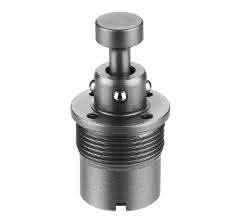
Two of AMF's RM251 mechanical zero-point clamping modules with latching function are screwed into the suction cup plate, while the matching clamping sleeves are located in the holder of the robot arm. "We have both screw-in and press-fit clamping sleeves in our range," says Guggenmoos. The 28 g lightweight components are pulled in with a force of 100 N, close and then hold the plate firmly with 1,000 N each. "This is enough to securely hold the suction plate on the robot, withstand the acceleration forces and is sufficient to lift parcels weighing 20 to 25 kg," assures Guggenmoos. "But we don't push it to the limit," explains Rechner. The housing and pistons of the modules are hardened for a long service life. They can be opened and closed mechanically using an integrated spring. This is done reliably and with a repeat accuracy of less than 0.1 mm. The entire assembly is easy to clean. It is usually sufficient to occasionally blow off the surfaces with the pneumatic gun when changing the format part.
"If these zero-point clamping modules with latching functions didn't exist, they would have to be invented," concludes Rechner. And Guggenmoos adds: "We have had these products in our range for a long time. They are the smallest zero-point clamping modules in our product portfolio. What's new here is the area of application." And so the project shows once again what solutions can be found when those involved think outside the box.
|
on
AMF, http://www.amf.de


You might also be interested in
Housing and inserts for plenty of power
Lapp presented the expansion of its Epic Power series at SPS 2023: four new M23 circular connector inserts and three new M23 housings. The special feature: all housings can be combined with any of the four inserts.
 read more...
News and product updates from Smartgas
Portable gas analyzers for outdoor use
Smartgas is starting the second half of the year with a series of updates to existing products and a number of new products. Portable analyzers expand the range of applications, while new accessories such as protective housings and heating modules...
read more...Everything accurate in switch cabinet construction
To ensure smooth work processes, tools for processing enclosures and housings must function flawlessly and reliably. Häwa rounds off its punching range with the Multi-Press 500.
read more...Shafts and conversion parts
The Rodriguez range includes ball bushings including matching housings, shaft brackets, crossbars and supports.
read more...Cooling and temperature control units
Hygienic packaging sells safely
In few industries are the requirements for hygiene in the production process as strict as in the food sector - the health of consumers has top priority. This results in enormous challenges for all machines and components involved, especially in...
read more...Simple tool change in seconds
With the CMS, Schunk is launching a user-friendly, manual change system for quick component replacement. In addition to its simple and convenient operation, the CMS also stands out with its extensive range of optional modules and complementary end...
read more...Motion controller for small drives
Medium power range covered
Faulhaber has another housing-less and compact motion controller in its range, which is particularly suitable for integration in device construction and medical technology applications.
read more...Welding solutions in the name of resource efficiency
At the Welding & Cutting trade fair in Essen (September 11-15), Fronius will be focusing on the major drivers in welding technology. Quality requirements are increasing in all industries, but the required welding specialists are scarce. In...
read more...Safe solutions for cable installations
From thick power cables to thin sensor lines, cables and lines must be routed safely through systems and machines. A challenge that should not be underestimated, explains Jörg Sokat, Head of Product Management at Pflitsch.
read more...