
Know-how
Supply with electrical energy
Power electronics. Without a reliable, flexible power supply with direct or alternating voltage, neither process technology nor plant and mechanical engineering can function smoothly and without interruption. Innovations are therefore aimed at long-term availability with increased cost-effectiveness of an overall system. In addition to circuit structure, compatible passive components and a number of other factors, power electronics provide the basis for this.

Power electronics (LE) has so far been largely based on silicon. Actuators or power converters equipped with diodes, thyristors, GTOs, IGBTs and MOSFETs are used to supply, control, convert and switch electrical energy from the watt to the megawatt range. The situation is characterized by an increasing ratio of the properties of the components to their costs. This means a decrease in static and dynamic switching losses with lower cooling requirements and a simultaneous increase in overload capacity as well as a reduction in volume due to the increase in power density to values above 30 watts per cubic centimeter with increasing operating temperature.
Compounds such as silicon carbide or gallium nitride are increasingly being used as the material basis. At the same time, the market offers compatible passive components to achieve the framework target in the power range. Such valves for high switching frequencies exist not only in individual designs, but also as integrated modules for complete topologies.
Higher power
For large AC and DC consumers, 3-phase high-performance power converters with DC link voltages of less than or equal to 500 volts are available, equipped with the above-mentioned components. The function of the converter type depends on the supply task. This includes DC motors and networks (for example for inverter-fed multi-motor drives in intralogistics) as well as AC drives, networks and systems. The focus is always on efficiency. In addition to low-loss LE components, regulated solutions contribute to power factor correction and active harmonic and EMC filtering. In addition, dips of up to more than 65 percent of the mains voltage are compensated. As a result of this suppression of converter grid perturbations, losses are reduced by up to 8 percent.
The core of such converters is the 3-phase, pulsed, self-guided four-quadrant converter. It eliminates the problems mentioned above, which also disrupt other network participants, while at the same time improving the cost balance of the overall system. Pulsed circuits such as power factor correction filters operate up to a frequency of 400 kilohertz, while converters pulse between one and 16 kilohertz. Despite this, the actuators meet the EMC requirements for both residential and industrial environments.
Lower power
For around four decades, linear power supply units with a heavy 50 hertz transformer dominated the power supply for control and measurement technology. To stabilize the DC output voltage, their DC side contains a power-electronic, regulated linear actuator. Due to its low efficiency of around 60 percent, this circuit generates a lot of heat. They have therefore been replacing switching power supplies for some time. As flyback or resonant converters, they have become established in the industry thanks to their improved properties, despite their higher price.
These shortcomings are eliminated by the single-phase switched-mode power supply with a primary frequency of approx. 50 kilohertz in the corresponding power range. In addition, its residual ripple reaches the low level of the linear regulator. As a result of the high-frequency transformer, the required space is also reduced. The output, which is fed back to the switching transistor via the control device, ensures a load-independent, low harmonic voltage. Such devices can not only be installed in products, but can also be mounted on control cabinet walls and guarantee data transmission. But they offer even more advantages:
- Convection cooling
- Efficiency up to 95 percent
- Parallel connection capability
- Average operating time between failures higher than one million hours
- Volume and weight three to five times smaller.
Silicon carbide or gallium nitride switching transistors are increasingly being used in low-power devices operating as resonant converters. With gate control integrated in the same chip, they achieve switching times that are 10 times shorter. The associated lower switching and conduction losses further increase efficiency.
Harvesting
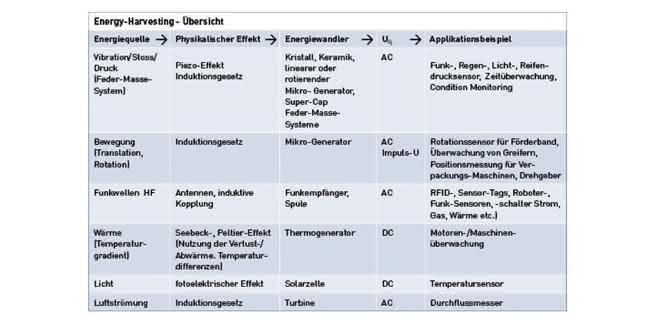
Challenges such as Industry 4.0 are extremely decentralized. The low energy requirements of components such as sensors cannot be met economically by either a grid connection or batteries. Micro-generators, known as energy harvesters, close this gap. Using a converter, they harvest energy from the environment, which is then amplified and stored before being fed to the consumer. Its processing result (measurement signal) is transmitted wirelessly.
Selection aids make it easier to use the wide range of products on offer. In the future, there will be more and more opportunities for contactless energy transmission. Numerous industrial applications are emerging. Wireless power has already established itself in the consumer sector. Joachim Krause/dsc


You might also be interested in
Hebotec at the Hannover Messe 2025
Connecting consumers without tools
Additional robots, control cabinets, control panels or other consumers can be easily integrated into the EMC concept of an existing production line using the PAK 25 equipotential bonding terminal from Hebotec.
 read more...
Motion controller for small drives
Medium power range covered
Faulhaber has another housing-less and compact motion controller in its range, which is particularly suitable for integration in device construction and medical technology applications.
read more...Safe solutions for cable installations
From thick power cables to thin sensor lines, cables and lines must be routed safely through systems and machines. A challenge that should not be underestimated, explains Jörg Sokat, Head of Product Management at Pflitsch.
read more...Displacement measuring systems
Economic positioning
The integrated position measuring system IMS from Bosch Rexroth is now also available as IMS-compact for absolute measurement. The non-contact solution with magnetic measuring principle enables robust and economical position detection for linear...
read more...Economic positioning
The integrated position measuring system IMS from Bosch Rexroth is now also available as IMS-compact for absolute measurement. The non-contact solution with magnetic measuring principle enables robust and economical position detection for linear...
read more...Sensors with IO-Link for extruders
The melting pressure always in view
Macchi, a manufacturer of blown film extrusion lines, optimized its extruders for Industry 4.0 by integrating melt pressure transmitters with digital IO-Link output for precise recording of the melt pressure and magnetostrictive displacement...
read more...Vision with good visitor response
6505 visitors and 378 exhibitors attended the machine vision trade fair in Stuttgart.
read more...Würth Elektronik at the embedded world
Würth Elektronik, manufacturer of electronic and electromechanical components, is presenting itself as a partner to developers at embedded world. At stand 110 in hall 2, the company will be presenting its portfolio and the associated services.
read more...Die-cast electronics housing
CTX Thermal Solutions manufactures cost-effective die-cast housings in application-specific geometries.
read more...