
Workplace design
It's all in the mix
Modern workplace design. From baby boomers to millennials to Generation Z - different age groups are represented in offices. It is important for companies to attach central importance to modern workplace design.
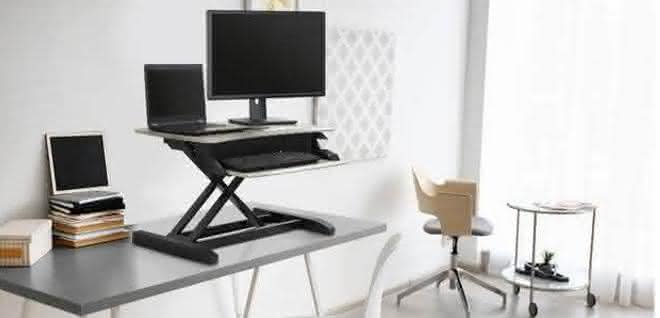
For a long time, the focus of workplace design was mainly on preventing accidents and injuries. Today, many people spend the majority of their working day at their desk - with different requirements in terms of safety, health and well-being. A modern work philosophy that takes into account the various dimensions of well-being in terms of physical, social and intellectual aspects facilitates the development of a healthy working environment and meets the needs of employees of all ages.
A diverse workforce brings advantages, but is a challenge in terms of office design. In the past, the office landscape consisted mainly of individual offices, but today many companies prefer an open-plan design with team workstations. Open areas and shared workstations have their advantages - however, employees are often distracted here, which reduces productivity. A work environment that meets the needs of multiple generations includes a mix of individual workstations, team areas, café-like temporary workstations and various meeting rooms. This differentiated approach responds to employees' need for consistency and quiet, while other employees have the option to opt for variety with background noise.
Companies should try to support employee productivity through spatial diversity and health-promoting measures. In the office environment, attention should be paid to natural light, air quality and access to healthy food, for example in the company canteen. The same applies to more movement for employees, for example by giving them the option of working either sitting or standing.
Reassessing business needs helps to identify problem areas - such as health complaints caused by a lack of ergonomics and too much sitting. Sit-stand workstations are one of the easiest ways for organizations to incorporate low-intensity physical activity into the workday and improve the well-being of their employees. Ergotron's workplace movement analysis found that employees of all ages benefit from sit-stand desks. Research shows that older generations are sometimes reluctant to participate in fitness programs. In contrast, this age group started using sit-to-stand solutions early, and younger generations have seen long-term health benefits from working at a sit-to-stand desk.
Meeting the different needs of all generations of employees is crucial for a productive working environment. Satisfied and healthy employees perform well, and professionals are now more interested than ever in a modern corporate culture that values the well-being of its employees in the workplace. as


You might also be interested in
Products of the year 2025: the competition starts again
The INDUSTRIAL Production Products of the Year are entering a new round. This year, our readers can vote in eight categories. We are also awarding a special prize.
 read more...
Digital assistance systems make manual production easier
Increasing productivity in the face of a shortage of skilled workers and a growing number of product variants is a challenge for many medium-sized industrial companies. Software-based assistance systems such as elution two assembly from Elabo offer...
read more...Florian Becker is the new Managing Director at Krieg
Generation change at Krieg in Heimsheim: Andreas Krieg handed over the management of the company to Florian Becker on October 1, 2022. The company, which specializes in workplace systems and office furnishings, intends to focus even more strongly on...
read more...Better jobs in the industry
Bott is presenting an exemplary production landscape at Motek.
read more...Customized assembly stations
Not every product can be manufactured fully automatically. Automated production is often not practical, especially for complex, varied products in small quantities.
read more...Assembly stations and production islands with ESD protection
Allmendinger Elektromechanik, based in Bad Überkingen, has established itself as a specialist for CNC machines and PLC systems and continues to expand rapidly.
read more...Ergonomic workstation systems
item Industrietechnik is expanding its portfolio to include the new Economy Tables, the E Drawer Cabinets and the Economy Modular Cable Tray.
read more...Flexible mounting stations in U-shape for measuring device manufacturers
SIKO GmbH has equipped its new production, sales and administration center in Bad Krozingen with one hundred new workstation systems.
read more...Efficient workpiece transport in assembly
Linear conveyor modules are an alternative to rotary indexing tables for certain assembly tasks.
read more...