
Man and machine
With assistance for digitization
The industry is changing. Digitalization demands new working models, new approaches and new ideas. However, those who know how to use the advantages of man and machine efficiently need not be afraid of digitalization.
Digitalization and automation have given rise to numerous nightmare scenarios, ranging from the threat to jobs and the dangers of digitalization to the decline of entire population groups such as the middle class. However, the idea that we will all be replaced by robots is above all a dystopian narrative. There have always been changes to structures and jobs as a result of technological developments. The spread of trucks from the 1950s onwards, for example, had a massive impact on inland shipping. Shipping companies had to close, seamen and dock workers lost their jobs. On the other hand, it was necessary to move trucks, expand roads and build logistics centers. There was no wave of unemployment. Employees underwent further training or retraining to meet the changing requirements.
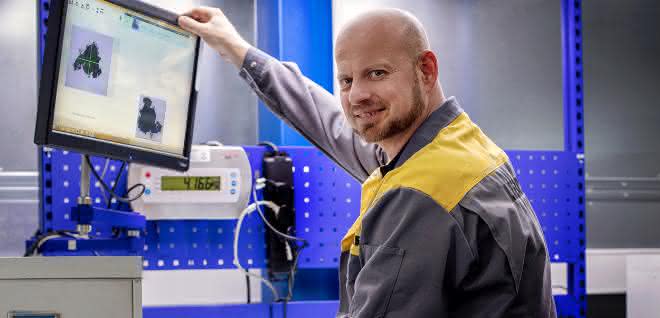
This development will repeat itself. It is already clear today that digitalization is not about robots replacing employees. Rather, it is about systems that enable humans and machines to work together more closely and in a more networked way. Optimum from Karlsruhe has developed just such a system with its Smart Klaus assistance system. "As specialists in industrial image processing and intelligent databases, we have developed an assistance system that enables humans and computers to work together in real time," says Optimum Managing Director Wolfgang Mahanty, explaining the principle. "Smart Klaus can be implemented in almost any working environment and, thanks to three neural networks, is able to expand its own knowledge independently."
In use at numerous companies, from Audi to Liebherr and Miele, the digital assistant impresses with its high recognition rate, uncomplicated operation and open visual feedback. It supports the assembly of various components, recognizes individual parts and thus relieves employees. The result: increased quality, time saved and error-free work steps.
Wolfgang Mahanty sees the future in this system: "The transfer of analog to digital data, its preparation and provision for all employees of a company and the constant expansion of this knowledge will define the working world of tomorrow." as


You might also be interested in
Robotics and autonomous order picking
Locus Robotics acquires Nexera Robotics and expands autonomous warehouse logistics
Locus Robotics takes over Nexera Robotics and may have taken a decisive step towards truly universal warehouse automation. A new gripping technology should now make possible what was previously considered difficult to automate.
 read more...
How bridging steps, stairs and catwalks are changing processes in production and logistics
At Logimat 2026, Munk Günzburger Steigtechnik will be showcasing modular bridging steps, stairs, platform and walkway systems for production, warehousing and logistics. With online configurators, distances can be efficiently shortened, processes...
read more...Highly automated warehouse for...
SSI Schaefer implements highly automated warehouse for CERP in France
SSI Schaefer and CERP are building a highly automated logistics center for pharmaceutical logistics in Wissous with shuttle storage, A-Frame, robotics and WAMAS software.
read more...Start of construction for new production hall
Mayr Antriebstechnik invests in its home base and internationally
Mayr Antriebstechnik strengthens location and international logistics: Construction of a new hall in Mauerstetten - parallel expansion of the plant in Poland as a logistics hub.
read more...Conveyor systems that adapt
Modern conveyor systems must reliably transport different product sizes, shapes and materials. The new modular product system from Kipp offers flexible, modular solutions for this: Adjustable side guides ensure precise alignment and gentle...
read more...Focus on sustainability and AI at the trade fair
With more than 120,000 square meters of exhibition space, LogiMAT 2025 will once again occupy all ten halls of the Stuttgart exhibition grounds. From March 11 to 13, global players, medium-sized companies and start-ups will provide an overview of...
read more...Workstation system for shipping and logistics
With Sintro Packing, Karl is launching a workstation system that is designed to meet the specific requirements of shipping and logistics. It is characterized by modular adaptability and ergonomic efficiency.
read more...Deutsche Messe announces Robotics Award
On the occasion of Hannover Messe 2025, Deutsche Messe is once again presenting the Robotics Award after a break of several years. Prizes will be awarded for robot-supported automation and logistics solutions. Companies and institutions from Germany...
read more...Micro motors as the driving force behind intralogistics
Suitable transport structures in intralogistics are a prerequisite in all industries in order to withstand competitive pressure in the future. The basis for this is comprehensive automation, which would be inconceivable without an armada of powerful...
read more...