
Sustainable production
New research focus at KIT
Scientists at KIT are investigating how companies can improve the production process, for example with autonomous production control, the reduction of wear parts or the principles of resource-conserving manufacturing. The new research focus "Sustainable Production" was created for this purpose.
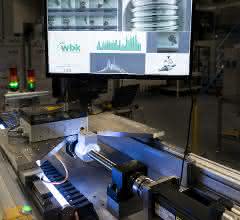
The new research focus "Sustainable Production" at the wbk Institute of Production Engineering will support companies in the future in developing their production processes from a linear economic approach to circular approaches of a circular economy. These include remanufacturing, i.e. the reprocessing of used products, with modular systems for disassembly and reassembly, autonomous production control and integrated quality assurance, as well as production networks and business models for the circular economy.
DigiPrime: Information flow in the circular economy
One of currently 15 research projects on this topic is "DigiPrime - Digital Platform for Data-enhanced Circular Economy Business Models". The aim of DigiPrime is to develop a digital platform to enable the mutual flow of information between different players in the circular economy and thus ensure that no information is lost along the value chain. In particular, life cycle data such as usage statistics and common causes of errors can be used, for example, to improve internal planning processes for recycling in this complex and dynamic environment.
The project team also aims to reduce barriers to the processing, sale and use of products in the second life cycle by integrating industrial and social clusters. In pilot projects, new concepts are developed, tested and prepared for market-ready implementation. The European Commission is funding the project over a period of four years with a project volume of around 15 million euros.
Research focus on the challenges and goals of industry
"A new research focus is being created at wbk not only on the basis of theoretical considerations, but also in very close cooperation with partners from industry. Together, we identify future challenges and goals and thus ensure that our solutions are implemented directly in industry," says Professor Gisela Lanza, Director of the wbk Institute of Production Engineering at KIT. A topic becomes a research focus if it is of great economic, social and technological relevance and there are several research projects in the subject area.
Furthermore, at the wbk it must be examined from different perspectives across the research areas. A research focus sometimes remains in place for 15 years - and thus far beyond the duration of most research projects. With the new research focus, the scientists want to make the processes, plants, systems and networks in industrial companies more sustainable and thus increase resource efficiency.
The political relevance of the topic is also reflected in the European Union's circular economy strategy, for example - also in view of Germany's goal of achieving climate neutrality by 2050. Among other things, the aim is to develop sustainable processes and products that are durable or can be recycled, repaired or reprocessed. The aim is also to reduce the need for new resources.
First steps towards sustainable production
Companies that initially continue to work in linear production chains are also supported by the researchers in using resources more efficiently in future by developing resource-efficient components and designing corresponding systems on the one hand and increasing the material and energy efficiency of production processes on the other. One research project in the field of predictive maintenance therefore aims to work as resource-efficiently as possible, starting with screws, nuts and associated components.
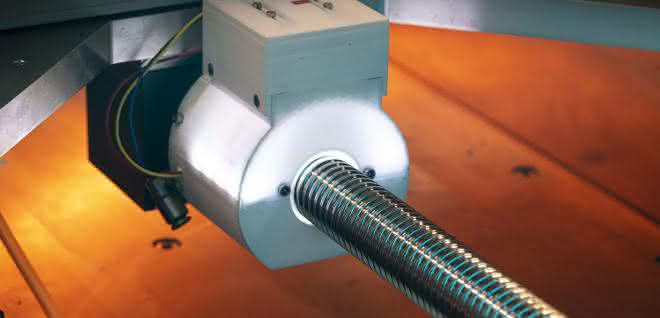
The focus of the "Acoustic Emission Sensors" project is therefore on ball screws and the question of how they can be kept in operation for as long as possible without risk. Up to now, they have usually been replaced very early as a preventative measure, as they carry the risk of failing and temporarily shutting down a machine tool - and in the worst case, even the entire production process.
Acoustic emission sensors, i.e. sensors that detect events in the low-frequency ultrasonic range between 20 kilohertz and two megahertz, can be used to detect early signals of an imminent failure of the ball screw drive. This makes it possible to monitor the ball screw and replace it at the ideal time in order to use fewer ball screws. The project is being funded by the German Research Foundation (DFG) to the tune of around 266,000 euros.
Resource efficiency thanks to optimized processes
Surface conditioning in machining can be used as another method to make production more resource-efficient and to react to disturbance variables in the process. The DFG is funding the priority program with twelve million euros over a period of six years. Research is being conducted into processes that can be used to optimize component surface layers. The aim is to develop dynamic pre-control and control systems based on a combination of suitable sensor technology, simulation calculations and artificial intelligence. As a result, the manufactured components achieve the desired state despite the presence of disturbance variables in the process. This makes products more durable, reduces the use of materials and significantly improves the energy efficiency of assemblies. as


You might also be interested in
Plagiarius 2024 negative prize
On January 26, 2024, the Plagiarius campaign awarded its dreaded "Plagiarius" negative prize for the 48th time to manufacturers and retailers of particularly brazen counterfeits and fakes.
 read more...
Ivalua honors winners of the Generative AI...
AI-supported "add-ons" for buyers within 48 hours
Ivalua, provider of cloud-based spend management solutions, announced the winners and innovations of the first Generative AI Innovation Cup. The competition took place in December 2023. It was open to all Ivalua partners and employees - more than...
read more...Efaflex celebrates 50 years of high-speed...
The emphasis is on "fast"
Since day one, Efaflex has wanted to use new technologies as early as possible and drive progress in the industry. This year, the family business is celebrating its 50th anniversary under the motto "Fast Forward".
read more...Security of supply even during power outages
In the winter of 2022, Germany was worried about energy shortages. The drugstore retailer dm did not paint any horror scenarios, but nevertheless saw the possibility of controlled, temporary, regional power cuts (brownouts).
read more...Safety technology in mechanical engineering
Modules with new functions
Euchner's product highlights at EMO 2023 include the communication-capable solenoid interlocks.
read more...Transforming the paper industry towards climate neutrality
Together with partners from industry and research, Voith is developing a project for the optimization of energy and material flows in paper production. The aim of the research project is to develop a digital framework that enables effective process...
read more...Up to 95 percent less flue gas thanks to direct extraction
The requirements for occupational safety measures and safety technology are also constantly increasing in welding technology. The Technical Rules for Hazardous Substances (TRGS) stipulate that welding fumes and harmful substances must be extracted...
read more...Competitive advantages with large machines
Whether 3D-printed components for machines and systems, prototypes or aids for design: additive manufacturing is almost indispensable for modern companies in mechanical and plant engineering and automation if they want to play in the premier league.
read more...Transport technology from the modular system
Many transport tasks can be realized with the help of linear technology. Pre-configured solutions are available to simplify the interaction between the linear unit, motor, gearbox and controller. This minimizes the effort required for research and...
read more...