
Screwdriving technology
Suitably dressed
Screwing in assembly technology. One of the most important tasks in assembly with the support of screwdriving technology is to apply the necessary preload force. Deprag has developed the Clamp Force Control adaptive tightening process for this purpose.
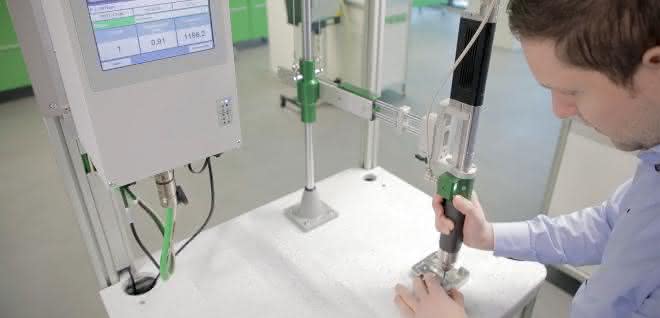
The most important application for bolting in assembly technology is the application of a defined preload force. The preload force must be determined in such a way that, on the one hand, the intended function is still given at every possible operating force and, on the other hand, the permissible load on the screw connection is not exceeded.
In series production, it is difficult to determine the preload force achieved. Indirect measured variables must therefore be used to control the assembly process. As a rule, this is the tightening torque of the screw connection. In addition, other specifications such as angle of rotation, screw-in times or friction values can also be determined experimentally, which serve as reference variables for the assembly process. Furthermore, methods for detecting the screw head contact have been developed in order to improve the consistency of the preload force.
In addition to the torque-controlled and angle-controlled tightening process, the friction value-dependent torque bolting and the yield point-controlled tightening process, Deprag has developed the adaptive tightening process CFC Clamp Force Control. This tightening method ensures that the preload force remains constant even with fluctuating insertion torques. A complete screw connection consists of the head contact detection screw pattern and a screw connection based on differential torque or a screw connection based on angle of rotation. The main component is head contact detection. For this purpose, a mathematical evaluation function is continuously formed on the basis of the torque curve. If the trend line calculated in this way exceeds a defined limit value, the head support is considered to have been detected - the torque and angle of rotation are saved at the time of the head support.
The calculation method combines two advantages: It is robust against random fluctuations and increases in the torque curve, which are not caused by the actual head support, and the algorithm is generally valid, so that the user does not have to set any parameters relevant for the calculation.
The screwdriving process is used when there are variable boundary conditions that lead to widely varying insertion torques. "Fluctuations result, for example, from changes in the screw and/or hole geometry, the structure of the component material, changing surface conditions of the screw thread, springy elements or settling phenomena," says Daniel Guttenberger, Product Manager Deprag Schraubtechnik. By detecting the head contact, Clamp Force Control ensures a uniform initial state for the subsequent final tightening, which ultimately results in a significantly better consistency of the preload force. Typical application examples are direct screw connections in plastic or metal. "Depending on the application and changing boundary conditions, a suitable tightening method can be determined for each fastening case, thereby improving the consistency of the preload force," adds Guttenberger. as


You might also be interested in
Plagiarius 2024 negative prize
On January 26, 2024, the Plagiarius campaign awarded its dreaded "Plagiarius" negative prize for the 48th time to manufacturers and retailers of particularly brazen counterfeits and fakes.
 read more...
Ivalua honors winners of the Generative AI...
AI-supported "add-ons" for buyers within 48 hours
Ivalua, provider of cloud-based spend management solutions, announced the winners and innovations of the first Generative AI Innovation Cup. The competition took place in December 2023. It was open to all Ivalua partners and employees - more than...
read more...Efaflex celebrates 50 years of high-speed...
The emphasis is on "fast"
Since day one, Efaflex has wanted to use new technologies as early as possible and drive progress in the industry. This year, the family business is celebrating its 50th anniversary under the motto "Fast Forward".
read more...Security of supply even during power outages
In the winter of 2022, Germany was worried about energy shortages. The drugstore retailer dm did not paint any horror scenarios, but nevertheless saw the possibility of controlled, temporary, regional power cuts (brownouts).
read more...Safety technology in mechanical engineering
Modules with new functions
Euchner's product highlights at EMO 2023 include the communication-capable solenoid interlocks.
read more...Transforming the paper industry towards climate neutrality
Together with partners from industry and research, Voith is developing a project for the optimization of energy and material flows in paper production. The aim of the research project is to develop a digital framework that enables effective process...
read more...Up to 95 percent less flue gas thanks to direct extraction
The requirements for occupational safety measures and safety technology are also constantly increasing in welding technology. The Technical Rules for Hazardous Substances (TRGS) stipulate that welding fumes and harmful substances must be extracted...
read more...Competitive advantages with large machines
Whether 3D-printed components for machines and systems, prototypes or aids for design: additive manufacturing is almost indispensable for modern companies in mechanical and plant engineering and automation if they want to play in the premier league.
read more...Transport technology from the modular system
Many transport tasks can be realized with the help of linear technology. Pre-configured solutions are available to simplify the interaction between the linear unit, motor, gearbox and controller. This minimizes the effort required for research and...
read more...