
Robust line design
More productive on the line
Robust line design. Even with low quantities and high variance, an assembly line can be superior to box assembly. It enables better visualization and, with the right personnel deployment planning, cycle spreads of up to 30 percent can be absorbed.

Market experience and modular structures do not yet exist for products in an early life phase. This makes it all the more important to map change management. Here, robust, scalable line concepts offer an effective alternative to box assembly. Provided the following framework conditions are taken into account, the assembly can be realized in a short lead time. The line offers improved visualization, particularly in the event of faults and variance.
The basic design of the line serves as a basis: a continuous I-line can later be designed as a Y-line. In the final stations, product variance is mastered and complexity is eliminated. A qualified start team can compensate for disturbance variables: In the event of fluctuations in the number of units, employees switch to neighboring production lines; the interaction between Q-gate and change management is crucial. Complex shift models tend to be a hindrance in this phase of life.
The logistical connection follows the robust structure: a maximum of three types of load carriers (small load box, pallet, special load carrier for core components) in simple call-off processes must be sufficient. The special load carriers should allow direct pre-assembly with good accessibility. Material disposition must take place close to the line; the simplest disposition methods can also be selected here. The simple transport system for the assembly item should be designed to avoid reloading processes.
The standards must be defined at a very early stage: Standard assembly cells, operating equipment, digital systems and logistical facilities form the central building blocks for the further adaptation of the line to the framework conditions. The process of continuous improvement can thus be channeled. Investment management (CaPex) is simplified and lead times are minimized.
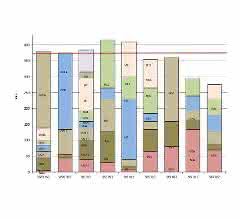
A work distribution diagram is required to balance the line. The work content is distributed evenly to the line stations. Variances/options are outsourced to pre-assembly. Pre-assembly can be expanded flexibly. The work content must be shown in standard worksheets; a connection to lifecycle management (CAD) helps with visualization. The introduction of a management execution system (MES) can be dispensed with in this phase. As a digital backbone, the common ERP systems offer good overview transactions, which the worker can use to view the parts lists/production orders/product lists at a glance and enter feedback. Checklists and Q-Tor data are integrated here.
There should be clarity about the buffers: A defined intermediate buffer before the bottleneck resource, for example the test run, must be sufficient. In the event of an overflow, the line is stopped and the problem becomes visible.
The construction is flanked by a suitable engineering set-up: Industrial engineers (balancing, line design) and equipment planners (CaPex, operating equipment) are required close to the line. Launch engineers are brought in on a project-by-project basis. Change managers channel the engineering change process so that material deployment planning (entry/exit) and attachment testing as well as equipment procurement are moderated. The weekly adjustment of parameters is crucial in the early life phase. The process must be kept simple, but must be followed consistently.
As soon as there is clarity about these framework conditions, principles for further processes and changes can be crystallized. In addition to the principles of lean production, occupational safety must also be anchored.
If the framework conditions are well designed, the robust assembly line is clearly superior to the box: buffers are clearly recognizable and the supply of materials and resources is simplified. Working on the cycle contents makes it easier to increase efficiency. With clear personnel deployment planning, cycle spreads of up to 30 percent can be absorbed without any loss of cycle time. Scaling up for later, higher-volume product life cycles is greatly simplified with the help of the standards. as


You might also be interested in
Plagiarius 2024 negative prize
On January 26, 2024, the Plagiarius campaign awarded its dreaded "Plagiarius" negative prize for the 48th time to manufacturers and retailers of particularly brazen counterfeits and fakes.
 read more...
Ivalua honors winners of the Generative AI...
AI-supported "add-ons" for buyers within 48 hours
Ivalua, provider of cloud-based spend management solutions, announced the winners and innovations of the first Generative AI Innovation Cup. The competition took place in December 2023. It was open to all Ivalua partners and employees - more than...
read more...Efaflex celebrates 50 years of high-speed...
The emphasis is on "fast"
Since day one, Efaflex has wanted to use new technologies as early as possible and drive progress in the industry. This year, the family business is celebrating its 50th anniversary under the motto "Fast Forward".
read more...Security of supply even during power outages
In the winter of 2022, Germany was worried about energy shortages. The drugstore retailer dm did not paint any horror scenarios, but nevertheless saw the possibility of controlled, temporary, regional power cuts (brownouts).
read more...Safety technology in mechanical engineering
Modules with new functions
Euchner's product highlights at EMO 2023 include the communication-capable solenoid interlocks.
read more...Transforming the paper industry towards climate neutrality
Together with partners from industry and research, Voith is developing a project for the optimization of energy and material flows in paper production. The aim of the research project is to develop a digital framework that enables effective process...
read more...Up to 95 percent less flue gas thanks to direct extraction
The requirements for occupational safety measures and safety technology are also constantly increasing in welding technology. The Technical Rules for Hazardous Substances (TRGS) stipulate that welding fumes and harmful substances must be extracted...
read more...Competitive advantages with large machines
Whether 3D-printed components for machines and systems, prototypes or aids for design: additive manufacturing is almost indispensable for modern companies in mechanical and plant engineering and automation if they want to play in the premier league.
read more...Transport technology from the modular system
Many transport tasks can be realized with the help of linear technology. Pre-configured solutions are available to simplify the interaction between the linear unit, motor, gearbox and controller. This minimizes the effort required for research and...
read more...