
AI for SMEs
Reduce machine run-in times with simulation and AI
The SimKI project aims to use machine learning to evaluate data from real production in order to make the running-in processes of forming machines more efficient. Inneo is participating in the project with its IoT platform ThingWorx.
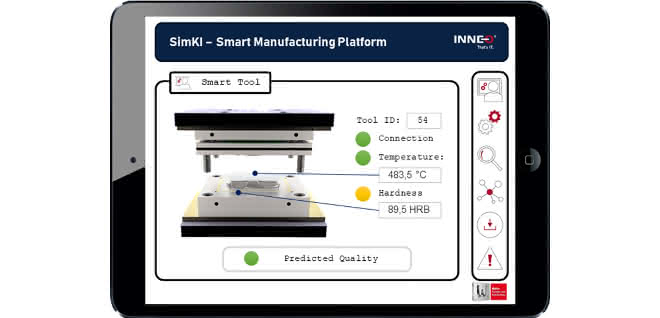
Running in forming machines is often a lengthy and cost-intensive process. The machines are then often blocked for hours or even days by "experimenting" and "trying out" different process parameters. The rejects generated in the process, the so-called faulty parts, increase the costs incurred in addition to the machine hours.
Basically, run-in processes block machines, materials and people, leaving them unavailable for actual, productive manufacturing. To remedy this situation, a team of companies has come together around Aalen University and contributed their expertise and software tools to find a solution to this very problem.
The IoT platform ThingWorx (PTC), provided by the company Inneo Solutions in Ellwangen, as well as the corresponding simulation software LS-DYNA and AI software from Mathlab, which are integrated into the process model by Aalen University under the direction of Dr. Wolfgang Rimkus, Julius Schlosser and Dr. Sebastian Feldmann, will be used.
The aim of the project is to use machine learning to evaluate data from real production, in this case forming, by means of image recognition and the correlation of the production parameters used. The data is collected using a smart tool with integrated sensors. Algorithms are then generated from this using machine learning. This allows corresponding patterns that lead to defective parts to be recognized and stored as a cause-effect relationship.
This process knowledge is then made available to the virtual world for simulation purposes. The LS-DYNA simulation software uses the CAD data of the tool and blank and the process knowledge gained to carry out forming simulations every minute. The reference data obtained from the forming process is used to train the AI. These results are then continuously evaluated by connected AI software and recognized patterns are recorded. On this basis, the AI software optimizes the production parameters provided and suggests process parameters for real production, which then reduces the running-in of the machine to a minimum.
The potential savings that can be achieved in this way can give industry a head start in terms of production times and production costs. The project "Real-time data acquisition and parameter correction using an AI trained with simulation data ("SimKI")" is funded by the Baden-Württemberg Ministry of Economic Affairs, Labor and Housing as part of the "AI for SMEs" innovation competition. as


You might also be interested in
Intelligent sensor technology for the packaging industry
At Interpack 2026, Sick will be showcasing its portfolio of sensor, automation and AI-supported solutions for secure and digitally networked packaging processes in the consumer goods, healthcare and pharmaceutical industries.
 read more...
Sales growth in a turbulent market environment
Thanks to innovations and a focus on strategic industrial markets, Sick was able to moderately increase its sales in the 2025 financial year. In a turbulent market environment, the company was able to maintain its position and gain market share with...
read more...Photonic microchips with 3D connector
How a 3D system makes photonic chips industrially viable
A research team from Heidelberg is developing a 3D-printed "connector" for photonic microchips. The solution promises a low-loss, standardized coupling of glass fibre and chip - and could fundamentally simplify the production of photonic integrated...
read more...Advanced material retrieval system
Steute shows nexy wireless network with extended connectivity
Steute's Leantec division is presenting an enhanced version of the nexy wireless network with improved connectivity and additional cybersecurity functions. The background to the further development is the increasing use of automated guided vehicles...
read more...Detecting air bubbles in liquids
EBE is launching a capacitive bubble sensor on the market that reliably detects air bubbles and liquid breakages, regardless of the liquid and the condition of the hose.
read more...Miniature acceleration sensors
Structural tests on printed circuit boards
The Z22198 family consists of very small triaxial accelerometers from Kistler that measure vibrations in three orthogonal axes.
read more...Positive development in sensor and measurement technology
In the first quarter of 2025, the sensor and measurement technology industry recorded sales growth of three percent compared to the previous quarter - according to the results of the quarterly member survey conducted by the AMA Association for...
read more...Sick extends contract with CEO
The Supervisory Board of Sick has extended the contract of CEO Dr. Mats Gökstorp by 5 years. The company also announced that Feng Jiao has resigned from his position as Chief Sales Officer at his own request. Markus Scaglioso has been appointed to...
read more...Kistler and Keller Pressure deepen partnership in China
The Kistler Group is intensifying its cooperation with Keller Pressure. By signing the agreement, the two companies are reaffirming their commitment to strengthening synergies and developing the Chinese market in a targeted manner.
read more...