
Camera-based worker assistance
Memorizing instructions was yesterday
Camera-based worker assistance: Smart Klaus recognizes components, provides assembly instructions and points out design errors. At Siemens, the assistance system from Optimum is used in THT assembly.
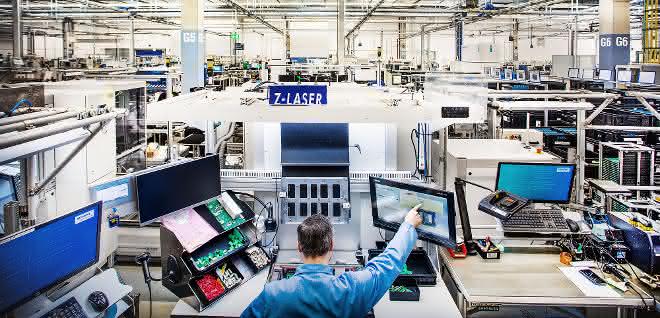
Siemens is a pioneer in numerous issues relating to digitalization. Low-emission drive technology, energy generation and automation solutions in industry are all part of the company's product portfolio. But in some areas, even the technology giant needs a little help. And Optimum from Karlsruhe is one of the companies providing it.
The specialists for camera-based assistance systems have been successful on the market for over 26 years - including with the cognitive worker assistance system Smart Klaus. Smart Klaus relies on intelligent image recognition as the technological basis for all other tasks. This includes the identification of articles that are difficult to distinguish, support in the manual assembly of complex components and continuous quality control. By comparing images with the internal image database in real time, the system is able to optimize work processes, save time and enable error-free production.
At Siemens, Smart Klaus is used in THT assembly. Integrated into differently structured production lines, it ensures faster and more error-free work processes. This is because the variety of products is huge and the demands on the workers are correspondingly extensive. Full concentration is required for each new piece. Once the components have been soldered incorrectly, it is difficult to correct them.
The tasks of the assistance system: managing a wide range of variants, recognizing components, providing instructions, pointing out design errors.
To provide noticeable relief, Clever Klaus has to be flexible. His tasks include dealing with the wide range of variants, recognizing components, providing guidance, pointing out design errors and motivating. He also checks, confirms and documents the entire process. To guide the worker, the individual work steps are demonstrated on a screen in a short video clip and the position of the individual elements is displayed directly on the workpiece. Tools such as screwdrivers and scanners are also directly connected. Measurement data is recorded, used for assembly and included in quality control. A camera is mounted above the work area. With its help, the digital assistant checks in real time whether the respective step has been carried out correctly and points out errors, which can then be corrected immediately. Once the first step has been completed, the next one continues until a smiley appears on the screen at the end, confirming successful completion.
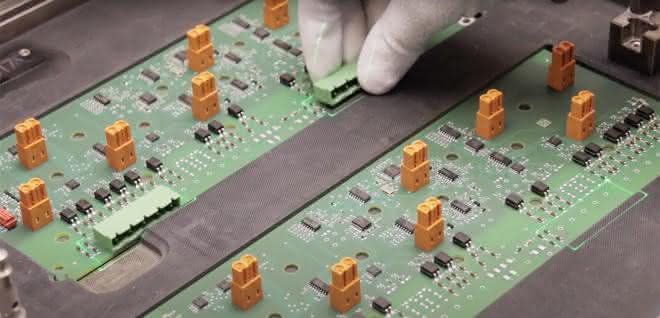
Since assembly often requires delicate work, Siemens uses a recently introduced innovation from Smart Klaus. Thanks to an integrated laser, it is no longer necessary to look at the screen. All assembly points of the various components are displayed directly on the workpiece. This means that the worker is no longer distracted and can concentrate fully on his task. The laser's capabilities are not limited to displaying small points. Complex contours and the exact position of components are also displayed directly on the workpiece. Successful assembly is therefore child's play. Once the work step has been completed, the light goes out, signaling successful completion. In addition to the advantages in production, Smart Klaus also makes an important contribution to the success of a company. This is because it secures knowledge and experience within the company in the long term. Proven practices and techniques are stored digitally and are therefore permanently available. This reduces the loss of expertise and manpower caused by employee absences, whether due to illness, retirement or job changes. The step-by-step instructions ensure that even unskilled workers carry out all steps correctly. Training new colleagues is simplified and work is successful and error-free right from the start.
The step-by-step instructions ensure that even unskilled workers can carry out all the steps correctly.
Since Smart Klaus has been in use at Siemens, the company has benefited from higher quality, productivity and competitiveness in manual production. This is also confirmed by the employees: "You simply work faster," they say. "Smart Klaus saves a huge amount of time." Production is more efficient, more successful and more relaxed. The support provides more security, as errors practically no longer occur. as


You might also be interested in
The AKIMI Research Project at WZL
Agent-Based AI Aims to Simplify Robotics for Small and Medium-Sized Businesses
The AKIMI research project is developing an agent-based AI designed to significantly simplify the setup, programming, and reconfiguration of robotic systems for small and medium-sized enterprises. The goal is to make robotics more flexible and...
 read more...
BS Rollen Strengthens Its Presence in North Rhine-Westphalia
With the groundbreaking ceremony, BS Rollen is launching the construction of a new company facility in Hückeswagen. The new building will house administrative offices, an assembly line, and a high-bay warehouse, and is intended to facilitate further...
read more...Intelligent brownfield networking
Many industrial companies are struggling with established plant structures and proprietary interfaces. Stefan Klaus' presentation will show in a practical way how brownfield environments can be efficiently networked with open technologies and made...
read more...Factory-X in practice
How can set-up processes in highly variant production be automated efficiently? Markus Benndorff from soffico shows how Factory-X, industrial data rooms and modular architectures create new possibilities for flexible production concepts.
read more...Mechanical engineering | Case study
Cordless in brush production
The machine manufacturer Wöhler Bohemia is integrating wireless HMI panels from Keba into its brush production systems. The background to this is the need for flexibility, robotics integration and new market strategies.
read more...International product approvals as a strategic competitive advantage in the global market
Which certificates are valid worldwide? Christian Latte, Head of Technical Compliance and Approval Officer at Hummel AG, explains this in an interview. He provides insights into product approvals and explains why early approval strategies shorten...
read more...Foundry modernizes plant park with continuous wire belt shot blasting system
The Spanish foundry Funosa is modernizing its equipment fleet with an RDGE 1250 wire belt continuous shot blasting machine from Rösler. Focus: sand removal from heavy iron castings, energy efficiency, ease of maintenance and ESG strategy.
read more...How bridging steps, stairs and catwalks are changing processes in production and logistics
At Logimat 2026, Munk Günzburger Steigtechnik will be showcasing modular bridging steps, stairs, platform and walkway systems for production, warehousing and logistics. With online configurators, distances can be efficiently shortened, processes...
read more...Drilling cycles optimized
A new replaceable head drill from Walter can reduce machining time in series production thanks to its patented interface and screwless design.
read more...