
People in the workplace
Manual assembly networked in future
Workplace systems are also changing with the comprehensive transformation of industrial production structures. Handling editor-in-chief Petra Born spoke to Jan Willem Jongert, CEO of Bott, about requirements and trends.

Mr. Jongert, you exhibited at Logimat - what current wishes and requirements for workstation systems did trade fair visitors express?
Jongert: Apart from functional and ergonomic requirements for the workplace, work processes that are supported by assistance systems are an important topic of discussion.
In what way and how do Bott workstation systems contribute to improving industrial processes?
Jongert: "Thanks to the flexibility of the individual Avero system components, the Bott workstation systems can be optimally adapted to the customer's individual process flow. Aavero thus enables a well-structured material flow and product-specific material provision. Fifo shelves organize replenishment and provide an excellent overview.
How will it be possible to integrate the previously rather pragmatic worker's workplace in the factory into the future smart production and logistics environment?
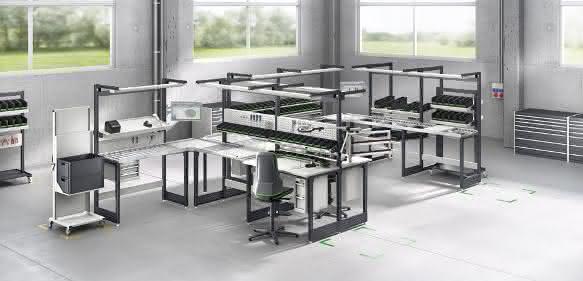
Jongert: In future, the workstation for manual assembly will be networked and connected to the IT infrastructure. This will provide the worker with the necessary process data and work steps. These workstations will therefore be firmly integrated components of the digital production process. Assistance systems or collaborative robots can be easily integrated into the Avero workstations.
To what extent do ergonomic optimizations and the consideration of ageing employees in the workplace dominate the design of your solutions?
Jongert: Ergonomics plays a major role in all Bott products. It is a unique selling point in the design of our products. The height of the Avero work tables is infinitely adjustable. All shelves can be infinitely adjusted for an optimum gripping range, enabling ergonomic and fatigue-free working. Naturally, this also makes them suitable for older employees. Collaborative robots can also be used in the Avero system to avoid strenuous, monotonous activities or to take over lifting tasks.
Will there be a "self-explanatory" Bott workplace at some point?
Jongert: Together with our partners, we can already offer this to a certain extent. The Avero workstation with assistance systems uses monitors and smart glasses to show the next assembly step, guides the user to the correct component using pick-to-light systems and provides the fitter with assistance for correct assembly via projections on the assembly module.
You have been at the helm of Bott since the beginning of the year. What specific projects are you tackling?
Jongert: I don't presume to be able to explain the world after three months. But on the basis of the company's solid foundation and the currently very strong economy, we are on a solid growth path and will be introducing some interesting new products in the near future.
How do you see Bott in five years' time?
Jongert: Based on its outstanding products, I see Bott becoming even more of a provider of integrated solutions and a system provider in the future.
Mr. Jongert, thank you very much for the interview!


You might also be interested in
Robotics and autonomous order picking
Locus Robotics acquires Nexera Robotics and expands autonomous warehouse logistics
Locus Robotics takes over Nexera Robotics and may have taken a decisive step towards truly universal warehouse automation. A new gripping technology should now make possible what was previously considered difficult to automate.
 read more...
How bridging steps, stairs and catwalks are changing processes in production and logistics
At Logimat 2026, Munk Günzburger Steigtechnik will be showcasing modular bridging steps, stairs, platform and walkway systems for production, warehousing and logistics. With online configurators, distances can be efficiently shortened, processes...
read more...Highly automated warehouse for...
SSI Schaefer implements highly automated warehouse for CERP in France
SSI Schaefer and CERP are building a highly automated logistics center for pharmaceutical logistics in Wissous with shuttle storage, A-Frame, robotics and WAMAS software.
read more...Start of construction for new production hall
Mayr Antriebstechnik invests in its home base and internationally
Mayr Antriebstechnik strengthens location and international logistics: Construction of a new hall in Mauerstetten - parallel expansion of the plant in Poland as a logistics hub.
read more...Conveyor systems that adapt
Modern conveyor systems must reliably transport different product sizes, shapes and materials. The new modular product system from Kipp offers flexible, modular solutions for this: Adjustable side guides ensure precise alignment and gentle...
read more...Focus on sustainability and AI at the trade fair
With more than 120,000 square meters of exhibition space, LogiMAT 2025 will once again occupy all ten halls of the Stuttgart exhibition grounds. From March 11 to 13, global players, medium-sized companies and start-ups will provide an overview of...
read more...Workstation system for shipping and logistics
With Sintro Packing, Karl is launching a workstation system that is designed to meet the specific requirements of shipping and logistics. It is characterized by modular adaptability and ergonomic efficiency.
read more...Deutsche Messe announces Robotics Award
On the occasion of Hannover Messe 2025, Deutsche Messe is once again presenting the Robotics Award after a break of several years. Prizes will be awarded for robot-supported automation and logistics solutions. Companies and institutions from Germany...
read more...Micro motors as the driving force behind intralogistics
Suitable transport structures in intralogistics are a prerequisite in all industries in order to withstand competitive pressure in the future. The basis for this is comprehensive automation, which would be inconceivable without an armada of powerful...
read more...