
High-speed assembly cell
From zero to 90 in 1.2 seconds
Assembly system for injection molded parts. The high-speed assembly cell from Aerne Engineering assembles three components in less than 1.2 seconds. Eight electric pick-and-place units with pneumatic parallel grippers and swivel units ensure short cycle times.
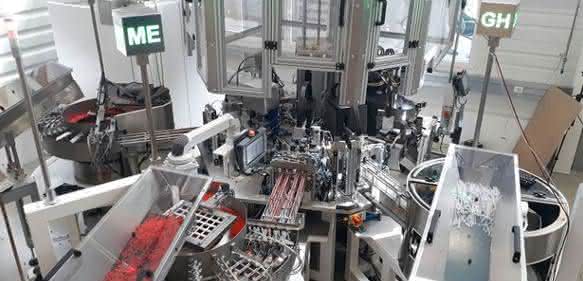
Aerne Engineering has developed a high-speed assembly cell specifically for injection-molded parts. In less than 1.2 seconds and with a reject rate of less than one percent, three parts, which are available in a total of 50 variants, are assembled into more than 90 different assemblies.
Instead of just checking the presence of the correct components and the position, the system monitors the respective press-fit pressure and feeds in faulty and calibrated parts in defined cycles in order to continuously verify the inspection process. Bad parts are automatically separated into four categories based on the defined type of defect. This ensures that deviations in the upstream processes can be quickly detected, assigned and eliminated with pinpoint accuracy. If components or sub-components change or the range of parts increases, the system can be converted quickly and with minimal effort.
A total of eight electric pick-and-place units ensure short cycle times of less than 1.2 seconds and a high degree of variability in the assembly system. The units are combined with pneumatic parallel grippers and in some cases with dynamic, high-performance damped swivel units. The pneumatic actuators are supplied directly with compressed air via micro valves that are integrated directly into the units. On the one hand, this minimizes compressed air consumption and therefore energy consumption, and on the other, the micro valves enable extremely short closing times.
The gripper fingers, in turn, have been designed so that they can grip different components without the need for manual intervention and without damaging sensitive areas of the components. According to the company, it will even be possible to integrate an automatic gripper change in the longitudinal direction of the pick-and-place units if components with larger geometric deviations need to be handled in the future.
The unit is moved via a wear-free direct drive instead of a motion transmission that is susceptible to tolerances and wear. This minimizes maintenance costs, increases continuous repeat accuracy and simplifies programming. Equipped with two stationary motors, the unit does not require any moving motor cables, which are prone to failure. It also has a repeat accuracy of 0.01 millimetres per axis. Intelligent controllers can control both the boom arm and the actuators without a higher-level controller. The necessary software is already integrated. Depending on the component, different positions can be reached on the fly. as


You might also be interested in
Motors, gearboxes and encoders: Faulhaber expands Ø 16 mm portfolio
Faulhaber is expanding its portfolio with new DC motors from the SXR and GXR family, a 16 mm planetary gearbox and the IEX3 magnetic encoder for compact drive solutions.
 read more...
New drive solutions for industrial automation and robotics
Faulhaber presents drive solutions with the new GXR and SXR motor family, which offer high efficiency and flexibility in combination with powerful gearboxes and encoders. These optimized components open up new possibilities for applications in...
read more...Marco Altherr becomes new Chief Financial Officer
The Supervisory Board of Ziehl-Abegg has appointed Marco Altherr as the company's new Chief Financial Officer (CFO). Altherr will take up his post in May 2025.
read more...Hydrogen storage in metal hydride
With its focus on storage systems for green hydrogen in solid form (metal hydride), GKN Hydrogen presents itself as a pioneer in safety and efficiency for the industry. GKN Hydrogen offers safe storage systems for green hydrogen and focuses on two...
read more...INDUSTRIAL Production Products of the year...
2nd place, Robotics category: EGS Automation
The SUMO automation systems from EGS Automation - economical standard solutions for automating a wide range of processes in plastics and metalworking - took second place in the robotics category in the competition for Product of the Year 2024.
read more...More productivity with Drive Intelligence
The trends in automation are productivity, sustainability and connectivity. Baumüller is launching new products on the market that address these trends, including new tools for smart energy monitoring, condition monitoring in the drive and new...
read more...Intelligence in Motion
At SPS, Koco Motion will be showcasing its expertise in customized drive solutions based on DC and BLDC motors, stepper motors, servo motors, linear drives and controllers.
read more...Nomination Products of the Year 2024
EGS Automation: SUMO automation systems
The SUMO automation systems from EGS Automation, economical standard solutions for automating a wide range of processes in plastics and metalworking, have been nominated in the Robotics category in the competition for Product of the Year 2024.
read more...Transport technology from the modular system
Many transport tasks can be realized with the help of linear technology. Pre-configured solutions are available to simplify the interaction between the linear unit, motor, gearbox and controller. This minimizes the effort required for research and...
read more...