
Equation solver for simulations
Redefining the design process
Fraunhofer IGD has developed Ristra to accelerate and optimize design processes. The solution offers to obtain simulation results in near real time. The preliminary version of was presented at the beginning of 2018 and a further developed version is now available.
Designing has become a demanding job. Starting with the product idea and its basic functionality, everyone involved must ensure that the product not only meets the requirements in operation, but can also be manufactured economically. The most important concrete component requirements include the structural-mechanical properties as a reaction to static and dynamic load cases. Thermal behavior and electromagnetic compatibility must also be taken into account. Questions of material consumption or the energy required for production and disposal have recently become increasingly relevant.
No safety without simulation
Designs are created using powerful 3D CAD programs. However, before a design is handed over to production, it must be ensured that it meets the requirements set out in the specifications. One way of predicting the behavior of a component is numerical simulation. Starting in high-tech sectors such as aerospace and energy technology, simulation has long since reached SMEs. One of the aims is to obtain a component that meets all strength requirements with minimal material usage by gradually changing parameters such as material thickness.
In order to be able to simulate, a calculation model must be created from the CAD data. A special program, the so-called preprocessor, breaks down the component into small parts, usually tetrahedrons, so-called "finite elements". The calculation engineer parameterizes the calculation model in the preprocessor by specifying the material and the boundary conditions of the loads to which the component is to be subjected. Increasingly, however, the designers are also taking on this task.
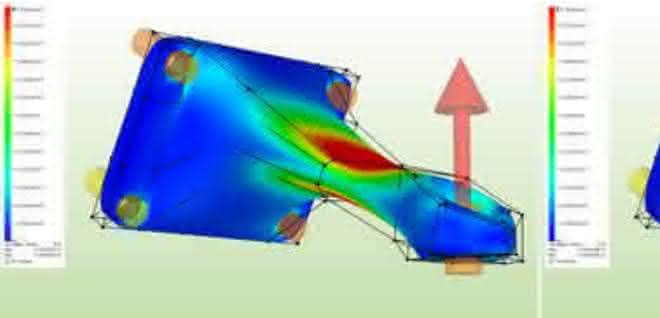
The model can now be transferred to the solver (structural mechanics solver). This is the name of the actual simulation program that calculates the mechanical behavior. This imports the calculation model and generates a linear system of equations from it, taking into account the partial differential equations of structural mechanics. Several million equations are no exception, depending on the complexity of the design. In the case of mechanical simulation, the solver calculates how the specified load cases affect the structure of the component. In subsequent steps, distortions, stresses and nodal forces are then calculated. The results are then displayed graphically. False color models are commonly used, which provide information about the stresses in the material and the deformations at a glance.
Labour-intensive and time-consuming
To date, the people involved in design have needed different computer-aided tools, usually on different computers, for this iterative process of geometric modelling, initialization, simulation and analysis of the results. It is not uncommon for the data models to have to be converted between these tools. Up to now, the simulation itself has taken up the most time. Depending on the computer system used, this can take many hours or even days. To save time, many companies transfer the structural data to high-performance computers that can be used as part of a cloud solution.
Once the simulation results are (finally) available, those responsible can use them to make changes to the design and the load parameters. They are often guided by their experience and try out how a change in material thickness affects the stability of the component, for example. And the cycle starts all over again: a new mesh structure has to be calculated as input for the simulator so that the next simulation run can begin. Many designers do not come completely close to their goal of achieving a design that is truly optimized in all respects. They simply run out of time or are slowed down by budget limits.
Technological leap for the design process
The Darmstadt-based Fraunhofer Institute for Computer Graphics Research IGD has been working on improving this situation for years. At the beginning of 2018, the institute presented "Ristra - (Rapid, Interactive Structural Analysis)", a new type of technology for the structural mechanics solver. The special feature here is that the solver does not run on the CPU, but uses the massively parallel calculation potential of commercially available, inexpensive graphics cards (GPU - graphics processing unit). As the computing time is orders of magnitude shorter than with standard simulations, the designer sees the simulation results on his screen virtually in real time and can draw his conclusions immediately. Ristra was developed for commercially available graphics cards from Nvidia. By shifting the simulation calculation from the CPU to the graphics processor, Fraunhofer IGD utilizes the enormous resources of this massively parallel computer architecture. While a CPU today has four to eight cores, the graphics card currently has up to 5,000 cores available. Ristra currently supports the following structural-mechanical concepts: geometrically linear elasticity, linear isotropic and anisotropic materials as well as linear, quadratic and cubic attachment functions on tetrahedra.
Even the preliminary version presented at the beginning of 2018 delivered impressive results. A comparison of Fraunhofer IGD's interactive simulation solution with fast commercial software revealed that standard software used for the comparison required 150 seconds for a model with more than 1.3 million finite elements. Ristra delivered a result after 0.875 seconds of pure computing time. The calculation engineer or designer immediately recognizes potential for improvement and can then make immediate changes to the design. If changes are made to the load situations or the geometry within the solver as a "small iteration loop", the simulation can be repeated immediately. This results in unprecedentedly short times - an "interactive simulation". The design changes resulting from such an interactive optimization process must then be incorporated into the CAD model in order to obtain consistent, valid production data.
If more complex geometry modifications are required, the "large iteration loop" must be used and the changes are made directly in the CAD system. The path to the subsequent simulation is via renewed pre-processing with a pre-processor, which generates the calculation model. In the "large iteration loop", Ristra has to import the new model and analyze the tetrahedral mesh in order to generate the linear system of equations. In the preliminary version of Ristra, these steps still run on the CPU and take around 20 seconds in the above example. Although the simulation solution is already significantly faster than the comparison software, the time saved in the actual simulation was counteracted by the still unacceptably long initialization times.
New version Ristra 2019
However, the developers at Fraunhofer IGD have now also found a solution to this problem and presented it in the new version Ristra 2019. The operations for generating the system of linear equations have been specially optimized for processing with the graphics processor. As a result, all calculation operations can now be performed on the GPU after importing the calculation model. The pre-processing steps of the "large iteration loop", which took 20 seconds in the above example, are drastically reduced to less than one second. For the above-mentioned model with more than 1.3 million finite elements, Ristra can deliver a result after a total of 1.83 seconds - making Ristra more than 80 times faster than the comparison software. In the large iteration loop, efficiency depends on the sub-process chain of the CAD system and the pre-processor and the data exchange. However, there are already possible solutions here too, but they need to be worked on together with the software providers in the sub-process chain.
Depending on the complexity of the design, the simulation results are available almost in real time. The user can intuitively change material parameters, load cases and geometry changes to the given mesh structure in Ristra and see what happens. These findings form the basis for the necessary changes to the design or geometry in the CAD program. The IGD researchers are therefore predicting a fundamental change in design processes, a development towards a direct, intuitive working style. This will naturally lead to better results, not only in terms of the development time required, but also in terms of the quality of the design.
At the current stage of development, however, only simple, prototypical geometry changes can be made in Ristra, in which the simulation mesh is adapted directly. If the simulation has shown that certain geometry changes come closer to the optimization target, these must be reproduced manually in the CAD system. The institute is therefore in negotiations with software providers who will integrate the new algorithms into their software environment as licensees. An initial partnership already exists with Meshparts.
D.Weber/as


You might also be interested in
ESTIA aims to strengthen Europe's cloud
New tech alliance for EU sovereignty
Twelve companies, including Dassault Systèmes, are founding the European Sovereign Tech Industry Alliance (ESTIA). The initiative aims to strengthen Europe's technological independence and define requirements for sovereign cloud services. The start...
 read more...
Deutsche Telekom and Nvidia launch one of Europe's largest AI factories
With the Industrial AI Cloud in Munich, Deutsche Telekom and NVIDIA are creating one of the largest AI factories in Europe. Companies can train AI models, carry out simulations and access 10,000 GPUs.
read more...Leveraging data potential with AI and streaming
Huge data treasures are still lying dormant in many manufacturing companies. And yet it is high time that these treasures were unlocked. There is often a lack of resources and capacity to make data usable in real time. Streaming production data can...
read more...More awareness of noise
Dematic offers solutions that are tailored to different cloud environments and reduce environmental impact through reduced material consumption and improved energy efficiency.
read more...Generative AI in the automation environment
The mechanical engineering and automation industry is undergoing profound change. This transformation is being driven by more volatile global trade, geopolitical crises and increasing market pressure, which demands greater agility, technological...
read more...Rigid data structures have had their day
The traditional data center is no longer the center of data. A hybrid cloud storage approach enables manufacturing companies to both meet the current requirements of data-intensive processes and future-proof their infrastructure.
read more...Software as a service in three stages
CIM Database Cloud is a new out-of-the-box solution from Contact for end-to-end digital product development.
read more...How production can benefit from AI
Together with AI technology, IIoT networking makes it possible to better control machine parameters and optimize quality with predictive quality. Downtimes and set-up times can also be further minimized. Cloud platforms also make these technologies...
read more...More expertise for digital engineering
Altair, a computational science and artificial intelligence (AI) company, has acquired OmniV, a technology from Michigan, USA-based software company XLDyn.
read more...