

Material Handling
Efficient workpiece transport in assembly
Linear conveyor modules are an alternative to rotary indexing tables for certain assembly tasks.
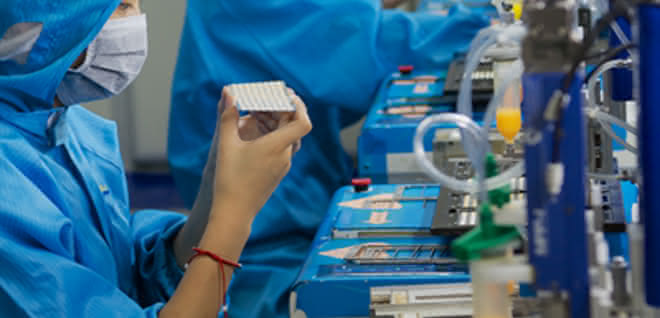
Success in manufacturing is a constantly changing goal. Planners are regularly faced with demands to reduce throughput times, increase capacity, introduce new products more quickly and make efficient use of available space. The way in which workpieces are transported between the various production processes can have a significant impact on the degree to which targets are achieved.
Increase in quantity when the entire production area is occupied
Rotary indexing tables are sometimes used to quickly move workpieces from one machine to the next to perform a sequence of assembly processes. When designing and setting up an assembly sequence to be performed with rotary indexing tables, process engineers must consider critical rotary indexing table parameters such as resolution, repeatability, accuracy, allowable backlash and hysteresis.
If throughput needs to be increased, it may be possible to simply increase the speed of rotation as the table moves between index positions. If an additional machine needs to be added to the assembly sequence, installed either around the perimeter of the table or in the center, this can be a complex task. Existing fixtures usually need to be moved to a new position to accommodate the additional machine. However, scalability is limited by the circumference of the rotary indexing table. Adding an additional machine may even be physically impossible. If the limits of the rotary indexing table's speed and size are reached, the only alternative may be to add another rotary indexing table. This would require considerable additional space, which may not be available.
Further options for shortening the line cycle time
When it comes to transporting workpieces along a production line from process to process, conventional belt and roller conveyors are often the means of transportation of choice. They are equally suitable for transporting workpieces between both automated machines and manual assembly stations.
Typically, the conveying speed is not variable and the transport direction is unidirectional. In order to shorten the cycle time and thus increase the throughput of the production line, increasing the conveyor speed can be an obvious measure. However, this is not always successful and can even be counterproductive in some situations. The problem occurs when the moving workpieces are stopped, typically by a mechanism such as a microswitch or a limit stop that brings the conveyor belt to an abrupt halt. Some companies have found that this has caused workpieces to be displaced and workpiece carriers or pallets to be damaged. Stopping the line to rectify these problems reduces productivity.
Save costs and space through process sharing
When analyzing the concept of how to automate the assembly of a new product, it is often found that some processes - such as screwing in screws, applying adhesive or attaching a multi-piece panel - may be performed more than once on the same workpiece. To complete the operations in a traditional, unidirectional sequence, the same type of machine would need to be installed at multiple locations along the assembly line. Both space and capital investment could be saved if, for example, a workpiece could be returned to a screwdriving machine to install a second set of screws immediately after a process that positions an outer cover or housing. However, moving workpieces back along the production line is not easy to accomplish with conventional transport systems.
Optimization of workpiece handling
Another aspect of conventional conveyor belts that can slow down production and hinder attempts to increase productivity is the fact that workpieces usually have to be removed from the belt and placed in a fixture such as a workpiece carrier, chuck or clamp before an assembly process can be carried out. This can be done manually or using an automated pick-and-place mechanism. The workpiece must then be placed back on the conveyor belt in order to proceed to the next process step. Arranging this sequence of picking, placing and depositing operations increases the cost of process automation as well as the cycle time of the line. One advantage of rotary indexing tables is that this is generally not necessary. However, they are subject to the limitations already described.
Increasing the number of units with the help of linear modules
Linear conveyor modules such as Yamaha's LCMR200 units make it possible to make workpiece transportation an active part of the assembly process. Compared to conventional transport systems, these modules enable higher throughput speeds and at the same time smoother, faster acceleration and deceleration as well as higher positioning accuracy, tighter tolerances and greater rigidity.
With high precision and flexibility, linear conveyor modules provide an alternative to rotary indexing tables, enabling faster and easier production scaling. Yamaha recently helped a manufacturer to simultaneously increase production capacity and speed up the introduction of new products with linear conveyor modules. The production team knew they would not have been able to achieve these goals with the rotary indexing tables the company had been using previously.
The company's engineers quickly realized that with linear conveyors, it was easier to increase the number of processes involved in a production sequence by adding additional modules than would be possible with rotary indexing tables. In addition, the team was also able to use the available factory space more efficiently. They were also able to precisely define the workpiece stop positions and easily fine-tune them by reprogramming the conveyor modules. The slides of the modules are individually controlled by the Yamaha YHX universal controller, which has 64 output channels.
By using the linear modules, this company was able to set up its new production line with additional processes as part of a more complex assembly sequence in about half the time it took to reorganize a simple sequence on a rotary indexing table.
Reduce cycle time
For those companies looking to improve cycle time, linear modules enable smooth, servo-controlled acceleration and deceleration, higher maximum speed and repeatability, and faster positioning of workpieces to the desired positions.
Yamaha's linear conveyor modules have enabled manufacturers producing high-value products such as smartphone handsets to reduce cycle time and increase efficiency by eliminating line stoppages to fix problems such as broken pallets and displaced workpieces. Introducing new products or reconfiguring and scaling the line to produce new products and increase throughput has also become faster. Thanks to the modular design, the line layout can be changed quickly and easily and all stop positions can be quickly reprogrammed if required.
The LCMR200 modules are available in various standard lengths between 200 and 1000 millimetres. The speed of the carriage can be set to values of up to 2500 millimetres per second for payloads of up to 10 kilograms. The maximum acceleration is 1.3 g, which corresponds to acceleration from 0 to 100 km/h in less than 2.2 seconds. This offers great scope for reducing the time required to transport workpieces between processes.
Benefit from the flexibility of process sharing
In addition, linear conveyor modules offer the flexibility to move workpieces both forwards and backwards between processes in the line thanks to the option of bidirectional movement. This creates the prerequisite for handling double processes - such as the aforementioned two-stage screwdriving process - via a single workstation without affecting other upstream or downstream inline devices. The investment costs and space requirements of the system can thus be optimally adapted to the available budget and factory space.
The YHX controller centralizes the control of linear conveyor carriages and other factory automation devices such as SCARA and Cartesian robots and their peripherals, allowing users to quickly and easily set up a complete, automated assembly cell. The YHX Studio software tool simplifies programming using ladder diagram graphics or text input and helps to visualize the cell as a complete unit, optimizing all interactions between robots and transport carriages.
Reduce transport times by 50 percent
Linear feed modules such as Yamaha's LCMR200 series are equipped with highly rigid guides that provide the necessary stability to allow assembly operations to be performed directly on the slide without having to remove the workpiece from the module.
The LCMR200 provides precise and repeatable control of part position and the enclosed design prevents foreign objects, such as process debris, from entering the module. Performing processes while parts are on the slide saves the time to build automated equipment to unload and reload workpieces from the conveyor, as well as the cost of equipment and factory space. The impact on cycle time when workpieces are unloaded for processing and then transferred back onto the conveyor is also eliminated.
Conclusion
Saving space, reducing cycle time, enabling multiple use of processes and eliminating the avoidable picking and replacing of workpieces are four ways in which linear conveyor modules can help increase productivity in manufacturing. In addition, individual control of transfer carriages with programmable parameters such as stop positions and speed promotes flexibility and scalability to meet dynamically changing market demands and accelerate the introduction of new products. Linear conveyor modules are an ideal complement to industrial robots and enable centralized control for easy and efficient use.


You might also be interested in
Housing and inserts for plenty of power
Lapp presented the expansion of its Epic Power series at SPS 2023: four new M23 circular connector inserts and three new M23 housings. The special feature: all housings can be combined with any of the four inserts.
 read more...
News and product updates from Smartgas
Portable gas analyzers for outdoor use
Smartgas is starting the second half of the year with a series of updates to existing products and a number of new products. Portable analyzers expand the range of applications, while new accessories such as protective housings and heating modules...
read more...Everything accurate in switch cabinet construction
To ensure smooth work processes, tools for processing enclosures and housings must function flawlessly and reliably. Häwa rounds off its punching range with the Multi-Press 500.
read more...Shafts and conversion parts
The Rodriguez range includes ball bushings including matching housings, shaft brackets, crossbars and supports.
read more...Cooling and temperature control units
Hygienic packaging sells safely
In few industries are the requirements for hygiene in the production process as strict as in the food sector - the health of consumers has top priority. This results in enormous challenges for all machines and components involved, especially in...
read more...Simple tool change in seconds
With the CMS, Schunk is launching a user-friendly, manual change system for quick component replacement. In addition to its simple and convenient operation, the CMS also stands out with its extensive range of optional modules and complementary end...
read more...Motion controller for small drives
Medium power range covered
Faulhaber has another housing-less and compact motion controller in its range, which is particularly suitable for integration in device construction and medical technology applications.
read more...Welding solutions in the name of resource efficiency
At the Welding & Cutting trade fair in Essen (September 11-15), Fronius will be focusing on the major drivers in welding technology. Quality requirements are increasing in all industries, but the required welding specialists are scarce. In...
read more...Safe solutions for cable installations
From thick power cables to thin sensor lines, cables and lines must be routed safely through systems and machines. A challenge that should not be underestimated, explains Jörg Sokat, Head of Product Management at Pflitsch.
read more...