
Automatic assembly cell
A cell for the cable car
Automation increases the quality of individual products, while at the same time increasing the demands on the plant engineers who are to develop the automated production lines. Hainzl supplied a functioning system from a single source for synchronous motor components to cable car manufacturer Leitner.
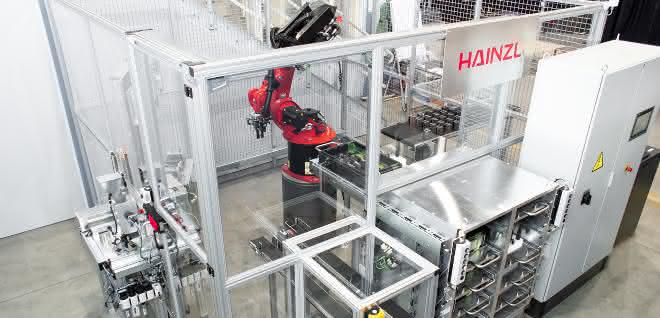
International ropeway manufacturer Leitner ropeways needed an automated production step for a globally unique ropeway drive system that works with a synchronous motor but without a gearbox. With the drive, called "Leitner DirectDrive", the output shaft is connected directly to the sheave. The rotor required for the motor consists of hundreds of so-called rotor poles. For logistical and quality reasons, the poles are assembled at the company's North Tyrolean branch in Telfs. The Linz-based system provider Hainzl developed a concept for the installation of a fully automated assembly cell with integrated quality control there - from the initial idea and realization through to delivery and implementation in the production process.
The heart of the fully automated production cell for rotor poles is a six-axis articulated robot. It performs the necessary handling work and manipulates the individual parts between the assembly stations. A total of over 20 work steps have to be carried out at different stations. The individual parts are each provided separately. Due to the advantageous positioning of the individual part magazines, which are located outside the safety area of the robot, filling can be carried out safely and without interrupting the assembly process.
To minimize errors, various work steps are optically recorded using high-resolution cameras and monitored by image processing. This includes checking the applied adhesive pattern or the position of the individual parts to be removed.
Correct further processing of the rotor poles requires compliance with the dimensional, shape and position tolerances. The length tolerance of the width and height is recorded and evaluated by digital measuring probes. If there is a deviation from the tolerances to be adhered to, the rotor poles concerned are declared as faulty. In order to measure the shape and position tolerances of the rotor poles, they are also randomly removed from the production cell and checked by a quality employee.
In contrast to manual assembly, the use of the robot not only offers advantages in terms of time. The assembly cell has been in operation at the Leitner Group in Telfs since mid-March, significantly improving the quality and flexibility of the rotor poles, including their assembly. In addition, digital error recording is available thanks to the actual value measurement and optical checks of the adhesive patterns. as


You might also be interested in
Basler acquires 76% of Indian image processor
Basler, supplier of image processing components for computer vision solutions, has acquired 76% of the Indian sales partner Alpha TechSys Automation.
 read more...
Process monitoring and fault detection
Cameras ensure quality during laser melting
Powder bed-based laser melting (PBF-LB/M) opens up new possibilities in additive manufacturing. Modern camera systems provide crucial process data to further increase quality and efficiency.
read more...Vision Sensor is three times faster than its predecessor
The 'CS-62' vision sensor from di-soric is around three times faster than its predecessor, the 'CS-60'. In combination with the 'nVision-i 25.1' software, it enables image processing solutions that were previously reserved for smart cameras.
read more...Thermal imaging cameras for quality control
Automated thermal imaging cameras are often suitable for quality control applications where temperature plays a role. However, while there are various solutions on the market for slow processes, it is challenging to select a camera that reliably...
read more...Easy entry into industrial VGA thermography
Reliable temperature measurement is a prerequisite for the success of many industrial processes. Berlin-based manufacturer Optris presents the Xi 640 infrared camera, a new member of its Compact Line, which enables non-contact temperature...
read more...Powder bed-based laser melting optimized
Aconity3D has set itself the goal of optimizing the stability of the manufacturing method of powder bed-based laser melting and thereby promoting its use in a wide range of industries. By using high-speed industrial cameras from SVS-Vistek, the...
read more...INDUSTRIAL Production Products of the year...
2nd place, category handling, assembly and production logistics: SICK
safeVisionary2 is the first 3D time-of-flight camera with Performance Level c safety certification. It enables safe three-dimensional environmental detection and won 2nd place in the competition for Product of the Year 2024 in the handling, assembly...
read more...Nomination Products of the Year 2024
SICK: Camera systems safeVisionary2
safeVisionary2 is the first 3D time-of-flight camera with Performance Level c safety certification. It enables safe three-dimensional environmental detection and has been nominated in the 2024 Product of the Year competition in the handling,...
read more...AI vision brings additional opportunities
The seamless integration of AI into the consumer sector has helped to improve our quality of life and make interactions with technology more efficient. In industry, AI vision with machine learning opens up new possibilities that are not covered by...
read more...