

Assembly automation with 24 volts
Rethinking is the order of the day
Schunk refers to its modular system for assembly automation, with which complete handling systems can be built on a 24-volt basis.
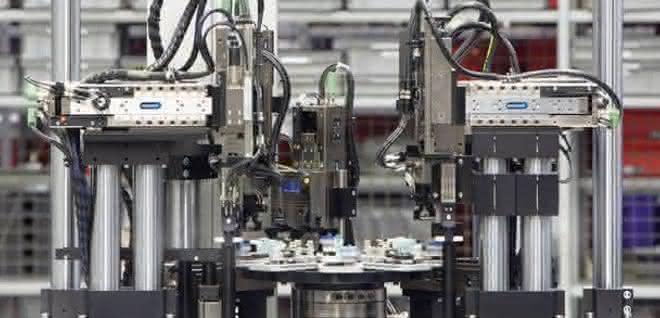
The ELP linear axis is one of the components in handling technology that cause aha effects for designers, emphasizes the manufacturer Schunk. Instead of setting throttles, as is the case with pneumatic modules, or installing new travel blocks, as is the case with electrically controlled modules, the linear direct-drive ELP only requires the end position to be defined mechanically and the extension or retraction speed to be regulated using two rotary coding switches. The auto-learn function takes care of everything else. Two to five strokes are enough to complete the programming. During the teach-in process, the maximum possible speed with the current payload is calculated. The travel profile itself is designed as a ramp - the unit accelerates and brakes automatically depending on the total stroke. Shocks and vibrations as well as uncontrolled travel at the maximum speed of the module are therefore ruled out. If the part weight changes during the process, the axis automatically adjusts its movement profile within a few strokes without the need for operator intervention. As it is controlled via digital I/O, the ELP series is compatible with all control systems and can replace pneumatic modules. In combination with EGP small parts grippers and EGS gripper swivel modules, this results in a modular system that can be used to implement complete handling solutions based on 24-volt technology.
Increasing demands on assembly systems
According to Schunk, 24-volt technology is poised to become a further pillar in the field of assembly automation, as it has advantages over pneumatics: "A rapidly growing number of variants in many industries, increasingly sensitive parts and increasing requirements in terms of energy efficiency and noise emissions play into the hands of this technology. Nowadays, hardly any systems are developed for a single product. Instead, the aim is usually to produce as many variants as possible in as short a cycle time as possible and also provide ample scope for future design and product range changes. Assembly systems must be designed to be correspondingly flexible. Pneumatic handling reaches its limits here. Despite the sometimes enormous advances in pneumatic networks and components, the strengths of 24-volt technology cannot be fully compensated for in the long term, so that a redistribution of the market towards 24-volt technology is foreseeable. Schunk is therefore consciously and proactively embracing change.
Slimmer systems, smaller energy chains
The ELP module enables extremely dynamic movements and moves smoothly and gently to the end position. As the compact unit does not require hydraulic shock absorbers, commissioning and maintenance costs are reduced. Defective dampers also prevent damage to the system and long downtimes. System construction can also be organized more efficiently, as valve terminals, hoses, maintenance units and pressure boosters are no longer required. Energy chains shrink to half their previous size because only two 24-volt circuits need to be set up for the sensors/logic and actuators. A side effect: the electric axis is around 20 decibels quieter than its pneumatic counterpart.
Interest in rapid program development
The selection of handling components with 24 volts is still limited, but this technology has potential. Users are already using the ELP linear axis and the EGP parallel gripper specifically to reduce vibrations, as actuators or as assembly systems in small systems and robot cells without a compressed air supply. The topic will gain in importance at the latest when the companies active in handling technology also provide 24-volt-based components in the most important sizes, from feeding technology to mobile robots and safety technology. Ideally, all components should be programmable from a central control system. In addition, autonomous functions can minimize the commissioning effort. pb


You might also be interested in
Free online tools from ACE in practice
In many companies, digitalization and the lean management approach are seen as a welcome slimming cure. How digital progress is simplifying design processes is demonstrated above all by solutions designed from the user's perspective. Configuration...
 read more...
ACE small shock absorbers secure wheelchair test bench
The demands on the quality and functional safety of wheelchairs are high. This also applies to the test series carried out by manufacturers during the development or further development of models. As part of their training, three mechanical...
read more...E-scooter with customizable damping
The startup Scuddy has significantly improved the flexibility, performance, customizability and ergonomics of its second-generation foldable e-scooter of the same name - thanks in part to damping technology from ACE.
read more...ACE vibration dampers: protected against vibrations step by step
Autonomous driving - what is still being perfected for road traffic is already part of everyday life when it comes to transporting materials from the warehouse to assembly. In fact, manufacturer-independent special kits for converting commercially...
read more...Key factor: energy efficiency
Sumitomo Drive Technologies, together with Invertek Drives and the Lafert Group, will be presenting its complete drive solutions for automation and Industry 4.0. Visitors to the stand will learn how they can achieve their sustainability goals and...
read more...ACE structural and crash dampers: Safety on the road 7
The seventh axis is used in manufacturing and production systems to make robots more agile and increase their reach. As an additional traversing axis, this linear axis brings robots quickly into the workspace or guides them precisely to parallel...
read more...Mechanical and plant engineering
Incoming orders in November: economic dampener takes effect
In the final months of 2022, the various economic downturns were also reflected in the order books of the mechanical and plant engineering sector.
read more...Safe protection for handling systems
Small shock absorbers protect linear axes in the semiconductor industry.
read more...ACE TUBUS structural dampers protect compact sliders
The requirements in automotive manufacturing in terms of product quality, precision and durability are high. Design engineers at voestalpine Camtec GmbH have therefore opted for structural dampers from ACE to protect compact slides.
read more...