
Assembly assistant
20 percent more productive with Klaus
Digitalization is difficult to master for manual production. Especially in areas where individual production and small parameters are required, automation is often not economically feasible. This is where Smart Klaus can help.
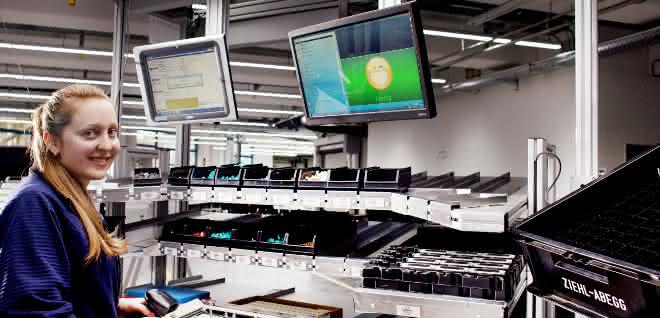
Smart Klaus from Optimum is a good addition for companies in manual production. The system is designed in such a way that each work step is visually explained in detail. The worker is guided through the process step by step. Smart Klaus constantly monitors whether the individual work steps have been carried out correctly. Only when they have been carried out successfully does he give his OK and move on to the next step.
20 percent increase in productivity
Smart Klaus is also used in this function at Ziehl Abegg. He assists with PCB assembly in electronics production and has raised the efficiency of the entire department to a new level. The process is based on a simple three-step procedure:
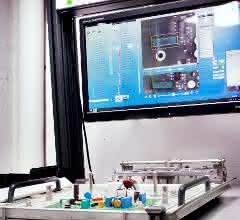
Using the order number, Smart Klaus first accesses data in the company's internal database. Each individual work step was stored here during the installation of the system. A comparison is made in real time. The employee then receives instructions for each work step via a monitor. Smart Klaus guides the worker through the entire process and checks whether the work steps have been carried out correctly. Once a work step has been successfully completed, Smart Klaus confirms the success and moves on to the next step. If something is not right, the digital colleague points it out to the worker, who can then correct it immediately. This makes mistakes a thing of the past.
Ziehl Abegg's aim was to minimize errors in production. "Smart Klaus was like lightning in the brain," recalls Production Manager Hermann Mütsch of the first presentation at Optimum in Karlsruhe. The company equipped six workstations with Smart Klaus. The specifications were met without any problems. The error rate is 0ppm. As a nice side effect, additional safety and the elimination of the need for follow-up checks ensure that productivity has increased by 20 percent.
The digital colleague is also popular because he is extremely flexible. Klaus can be programmed in such a way that either a fixed sequence is specified for the construction process or the parts can be assembled freely. Even a mixture of the two variants can be realized.
All visible features of a workpiece can be identified by prior teach-in. The correct position is displayed and checked during production. For diodes underneath, a second camera can be used for additional support and recognition. Smart Klaus can even visually distinguish between the different poles of a battery.
For many companies, it is crucial that the system is able to correctly identify the number of variants of a workpiece. With the support of the assistance system, production in small batch sizes becomes economically attractive. Individual production in small quantities is no longer a problem.

Working more precisely with a laser
In order to minimize distraction during particularly demanding work steps, Klaus has recently been equipped with a laser. This provides visual support in addition to the screen-based instructions. The laser's light points are able to indicate the points at which a component needs to be added. Position and alignment can also be displayed accordingly. Feedback to the worker is provided by a color change of the laser and indicates correctness or errors.
According to the manufacturer, one of the biggest advantages is that the assistance system enables comprehensive knowledge management. The new colleague is responsible for training employees, teaching them processes and motivating them to work independently. The experience that other employees have gained in production can also be transferred and made available via a central server in all branches of a company.
In more complex production areas, not only is the long training period, which ties up two employees, eliminated, but the number of errors is also minimized, as the system checks continuously. This also increases the speed of work. And the pressure of correctly assembling complex components is taken off the employees. as


You might also be interested in
Plagiarius 2024 negative prize
On January 26, 2024, the Plagiarius campaign awarded its dreaded "Plagiarius" negative prize for the 48th time to manufacturers and retailers of particularly brazen counterfeits and fakes.
 read more...
Ivalua honors winners of the Generative AI...
AI-supported "add-ons" for buyers within 48 hours
Ivalua, provider of cloud-based spend management solutions, announced the winners and innovations of the first Generative AI Innovation Cup. The competition took place in December 2023. It was open to all Ivalua partners and employees - more than...
read more...Efaflex celebrates 50 years of high-speed...
The emphasis is on "fast"
Since day one, Efaflex has wanted to use new technologies as early as possible and drive progress in the industry. This year, the family business is celebrating its 50th anniversary under the motto "Fast Forward".
read more...Security of supply even during power outages
In the winter of 2022, Germany was worried about energy shortages. The drugstore retailer dm did not paint any horror scenarios, but nevertheless saw the possibility of controlled, temporary, regional power cuts (brownouts).
read more...Safety technology in mechanical engineering
Modules with new functions
Euchner's product highlights at EMO 2023 include the communication-capable solenoid interlocks.
read more...Transforming the paper industry towards climate neutrality
Together with partners from industry and research, Voith is developing a project for the optimization of energy and material flows in paper production. The aim of the research project is to develop a digital framework that enables effective process...
read more...Up to 95 percent less flue gas thanks to direct extraction
The requirements for occupational safety measures and safety technology are also constantly increasing in welding technology. The Technical Rules for Hazardous Substances (TRGS) stipulate that welding fumes and harmful substances must be extracted...
read more...Competitive advantages with large machines
Whether 3D-printed components for machines and systems, prototypes or aids for design: additive manufacturing is almost indispensable for modern companies in mechanical and plant engineering and automation if they want to play in the premier league.
read more...Transport technology from the modular system
Many transport tasks can be realized with the help of linear technology. Pre-configured solutions are available to simplify the interaction between the linear unit, motor, gearbox and controller. This minimizes the effort required for research and...
read more...