
3D straightening system
Goodbye to manual post-processing
Fully automated measurement of structural parts. The self-learning, fully automatic 3D straightening system from Gtech measures die-cast structural components and aligns them in three dimensions within the specified tolerance fields.
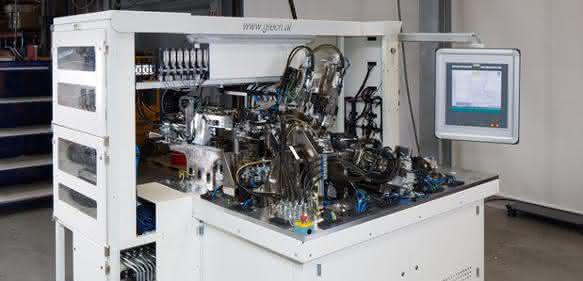
Due to the lightweight construction trend among car manufacturers, aluminium die casting is gaining in importance because it allows complex contours to be realized and components can be recycled. The disadvantage of aluminum die-cast parts is that the structural parts do not lie within the specified tolerance ranges after heat treatment (the die-casting process) and therefore require manual post-processing in the form of measuring and aligning these parts.
GTech's aim was to develop a self-learning system in which structural parts are measured fully automatically and simultaneously aligned in the three-dimensional range based on the measured values obtained. Another objective was to create a database in order to be able to compare the results of a measuring master with the real measured values and thus draw conclusions about the measuring master model. In addition, the system was to be set up in as small an area as possible. In addition, the system was developed on a modular basis. Each system is designed specifically for the customer and their requirements. The newly developed 3D straightening tool is modified and adapted accordingly at the positions in contact with the workpiece. The basic system remains 95 percent untouched and a 100 percent degree of automation is possible.
In the future, the system can therefore be supplemented by fully automated loading and unloading systems and thus perform its work in a production line equipped with upstream or downstream process steps without human intervention. GTech has already been established for several years in the field of measuring and manual straightening of structural parts (aluminum/magnesium die-cast parts such as strut domes or side members) in the automotive industry. In contrast to manual straightening, in which the structural part is clamped, measured and then straightened by the machine operator with straightening tools to the required tolerances, these individual process steps are performed entirely by the system. In addition, the system not only straightens individual reference points, but also ensures that the parts are straightened across the entire contour in the three-dimensional range. Customers benefit from an increase in productivity, a simultaneous reduction in rejects, shorter cycle times, higher process reliability with greater process stability and fewer quality defects.
Based on the positive patent search carried out in advance, an application for an Austrian patent was filed in the first instance, which was granted. In order to protect this development in our main markets, the patent was extended to the entire EU area. as


You might also be interested in
The AKIMI Research Project at WZL
Agent-Based AI Aims to Simplify Robotics for Small and Medium-Sized Businesses
The AKIMI research project is developing an agent-based AI designed to significantly simplify the setup, programming, and reconfiguration of robotic systems for small and medium-sized enterprises. The goal is to make robotics more flexible and...
 read more...
BS Rollen Strengthens Its Presence in North Rhine-Westphalia
With the groundbreaking ceremony, BS Rollen is launching the construction of a new company facility in Hückeswagen. The new building will house administrative offices, an assembly line, and a high-bay warehouse, and is intended to facilitate further...
read more...Intelligent brownfield networking
Many industrial companies are struggling with established plant structures and proprietary interfaces. Stefan Klaus' presentation will show in a practical way how brownfield environments can be efficiently networked with open technologies and made...
read more...Factory-X in practice
How can set-up processes in highly variant production be automated efficiently? Markus Benndorff from soffico shows how Factory-X, industrial data rooms and modular architectures create new possibilities for flexible production concepts.
read more...Mechanical engineering | Case study
Cordless in brush production
The machine manufacturer Wöhler Bohemia is integrating wireless HMI panels from Keba into its brush production systems. The background to this is the need for flexibility, robotics integration and new market strategies.
read more...International product approvals as a strategic competitive advantage in the global market
Which certificates are valid worldwide? Christian Latte, Head of Technical Compliance and Approval Officer at Hummel AG, explains this in an interview. He provides insights into product approvals and explains why early approval strategies shorten...
read more...Foundry modernizes plant park with continuous wire belt shot blasting system
The Spanish foundry Funosa is modernizing its equipment fleet with an RDGE 1250 wire belt continuous shot blasting machine from Rösler. Focus: sand removal from heavy iron castings, energy efficiency, ease of maintenance and ESG strategy.
read more...How bridging steps, stairs and catwalks are changing processes in production and logistics
At Logimat 2026, Munk Günzburger Steigtechnik will be showcasing modular bridging steps, stairs, platform and walkway systems for production, warehousing and logistics. With online configurators, distances can be efficiently shortened, processes...
read more...Drilling cycles optimized
A new replaceable head drill from Walter can reduce machining time in series production thanks to its patented interface and screwless design.
read more...