

Interview with André Pöppe
"The assembly of the future needs assistance systems"
"Many people still associate the term Industry 4.0 with the idea of production without people," says André Pöppe, Product Manager at Desoutter. In this interview, he explains why the opposite is the case.

Mr. Pöppe, Desoutter offers a worker assistance system for assembly workstations. What problems can you solve for your customers with your Pivotware assistance system?
Pöppe: At the top of the list are the issues of quality and efficiency: in a high-wage country like Germany, these have to be right, because very few people can afford rejects. The industry has to be economical with the materials it uses, especially in terms of value-adding time. Worker assistance systems can provide very good support here. Some companies also come to us with a specific quality problem. This could be forgotten screw connections or swapped components, for example O-rings. Sometimes individual components are not fastened correctly or are attached at the wrong angle. Or entire assembly sections are simply not completed. Modern assistance systems help to avoid these errors. Safeguarding with traditional means simply has its limits.
Are you talking about assembly templates, color markings or training courses?
Exactly. Some people also try bonuses, but these approaches don't help in the long term. After all, people are always a source of error, at least potentially. Especially as assembly is becoming increasingly complex. If many variants are produced or complex components are manufactured, mix-ups occur more quickly. We have customers with 20,000 or more variants per product. Nobody can remember them anymore - and color coding doesn't help. In addition, product life cycles are getting shorter in all sectors of industry. And there is a trend towards individualization everywhere, keyword "batch size 1". However, such diversity and complexity must first be mapped in production. With a worker assistance system like our Pivotware, this can be done very quickly and easily.
Can you give an example of how worker assistance can help in such cases?
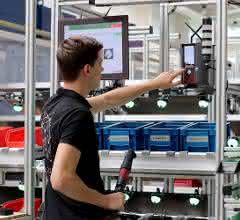
For example, you can integrate pick-by-light boxes or provide the component variants with different codes. The worker scans the variant before assembly and a light signal shows him the material box with the right screws. The software registers whether he is using the correct screw and only then releases the screwdriver for assembly. Incidentally, with Pivotware, our customer decides how much worker assistance is used. The system has a modular structure. Almost any number of features can be added to the basic configuration - depending on how complex the requirements are.
Are there other reasons for using worker assistance besides quality assurance and mastering complexity?
Yes. Some customers simply want to increase efficiency, facilitate training or implement a digital process for traceability. For example, one of our customers who pre-assembles automotive components has to maintain and verify a defect rate of less than 2 ppm. This is easily possible with our pivotware. Faulty screws or components are detected in good time before defective components leave the company and later lead to quality problems in the end product. Or before an unnecessary amount of added value is invested in a part that later has to be dismantled or discarded. Other customers, on the other hand, have to comply with legal requirements or simply have a good reputation to lose if errors occur.
How do employees perceive the new technology? And how do they cope with it?
Generally very well. Another reason for using worker assistance is to relieve employees mentally and physically, for example from manual tasks that are not ergonomic. Or to relieve them of responsibility for faulty screw connections. This reduces the workload and the sickness rate generally falls. In some companies, there are even internal application lists for assembly jobs with worker assistance. This means that employees perceive these jobs as modern and innovative. Digitalization must be seen as an investment in the future of the workplace. It makes an employer attractive to applicants - and that is particularly important in the suburbs of large business cities, where many companies are competing for rare skilled workers.
But increasing automation will not make workers redundant?
No. The degree of automation in assembly will increase more and more in the future. But most processes are far too complex to be completely automated. They require an insight that only a person can provide. The approach is rather that know-how and jobs should be retained at the site. Companies must therefore ensure that they avoid errors, are efficient, train people quickly and constantly improve. With a worker assistance system like PivotWare, they can ensure that production in Germany is still worthwhile. And efficiency plays a major role in this.
On the subject of "efficiency" - what can a worker assistance system achieve in this context?
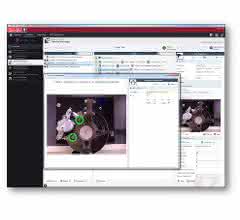
I become more efficient with an assistance system like Pivotware because many manual steps - and therefore potential sources of error - are eliminated. For example, entering data or searching for information. I use it to bring a computer to a workstation that communicates with devices, sensors, actuators and tools. The worker may have to look something up in the traditional work instructions - Pivotware displays it to him in a targeted manner without delay. In theory, he doesn't even have to scan the component because I can integrate MES or ERP systems into my solution. I also avoid so-called media discontinuities, which not only cost time but are also the cause of numerous errors. One example: I use a dial gauge to measure the length or concentricity of components and transfer the values to a sheet of paper. Someone else then enters these into a computer. With a worker assistance system, this break is eliminated because I can simply integrate digital measuring devices into the process. And I can configure the process so that measurements have to be taken - or the process doesn't continue.
PivotWare therefore masters complex or lengthy processes and multi-variant production. Where else does the software provide support?
Such a system can also help with simple processes. For example, when it comes to verifying the correctness of a single screw connection. Our assistance solution can be used to assemble the simplest products as well as extremely complex components, such as huge vehicle or ship components. With a worker assistance system, I can not only verify the quality of the assembly, but also optimize my processes myself by analyzing the records.
How exactly does this self-optimization work?
With Pivotware, I can document my entire process and have the option of creating birth certificates at component level. I can therefore prove which components have been installed in a product and that I have manufactured according to the specifications. But I can also quantify the production of entire periods and draw conclusions from my processes: Where does it take me a particularly long time, where should I rethink the process or where do I need to support the worker even better? I can cast all this into figures without anyone sitting next to me with a stopwatch. This data is collected "en passant" during production. as


You might also be interested in
Intelligent sensor technology for the packaging industry
At Interpack 2026, Sick will be showcasing its portfolio of sensor, automation and AI-supported solutions for secure and digitally networked packaging processes in the consumer goods, healthcare and pharmaceutical industries.
 read more...
Sales growth in a turbulent market environment
Thanks to innovations and a focus on strategic industrial markets, Sick was able to moderately increase its sales in the 2025 financial year. In a turbulent market environment, the company was able to maintain its position and gain market share with...
read more...Photonic microchips with 3D connector
How a 3D system makes photonic chips industrially viable
A research team from Heidelberg is developing a 3D-printed "connector" for photonic microchips. The solution promises a low-loss, standardized coupling of glass fibre and chip - and could fundamentally simplify the production of photonic integrated...
read more...Advanced material retrieval system
Steute shows nexy wireless network with extended connectivity
Steute's Leantec division is presenting an enhanced version of the nexy wireless network with improved connectivity and additional cybersecurity functions. The background to the further development is the increasing use of automated guided vehicles...
read more...Detecting air bubbles in liquids
EBE is launching a capacitive bubble sensor on the market that reliably detects air bubbles and liquid breakages, regardless of the liquid and the condition of the hose.
read more...Miniature acceleration sensors
Structural tests on printed circuit boards
The Z22198 family consists of very small triaxial accelerometers from Kistler that measure vibrations in three orthogonal axes.
read more...Positive development in sensor and measurement technology
In the first quarter of 2025, the sensor and measurement technology industry recorded sales growth of three percent compared to the previous quarter - according to the results of the quarterly member survey conducted by the AMA Association for...
read more...Sick extends contract with CEO
The Supervisory Board of Sick has extended the contract of CEO Dr. Mats Gökstorp by 5 years. The company also announced that Feng Jiao has resigned from his position as Chief Sales Officer at his own request. Markus Scaglioso has been appointed to...
read more...Kistler and Keller Pressure deepen partnership in China
The Kistler Group is intensifying its cooperation with Keller Pressure. By signing the agreement, the two companies are reaffirming their commitment to strengthening synergies and developing the Chinese market in a targeted manner.
read more...