
Integrating additive production
The agile supply chain
In order to reduce dependence on supply chains, many manufacturing companies are considering switching parts of their production to additive manufacturing or using it as a supplementary technology if problems arise in conventional supply.
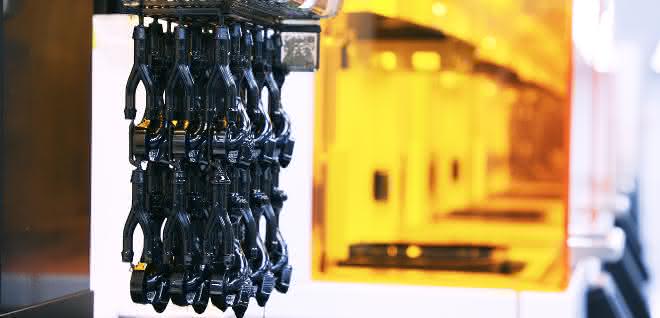
In recent years, manufacturers have evolved their global supply chain to prepare for uncertainty. But the pandemic has put even the most resilient supply chains to the test. At the beginning of the coronavirus crisis, healthcare workers increasingly needed personal protective equipment to treat patients. At the same time, demand for ventilators rose sharply and production lines came to a standstill due to a lack of raw materials.
The impact of the pandemic on supply chains became clear. At the same time, it became clear that the necessary equipment could be produced quickly with the help of additive manufacturing. Regardless of the industry, manufacturers around the globe were using it to close the gap between supply and demand for urgently needed items. Additive manufacturing does not require tooling and allows for almost instantaneous design and production. In addition, new complex and customer-specific geometries can be created and existing parts can be reconstructed using reverse engineering. As a result, additive manufacturing promotes multi-site production compared to a centralized supply chain with a single supplier, complex logistics and long lead times.
The basis for additive manufacturing
The role of additive manufacturing has evolved over the years. From a 3D printing technology for prototyping developed by Chuck Hull, co-founder and CTO of 3D Systems, to a solution that enables end-to-end manufacturing processes and can deliver production-quality parts. The quality of parts, printing speed, material properties and overall cost of the system have improved to such an extent that direct production is now possible with additive manufacturing. This makes it a strategy to reduce the consequences of global supply problems. Direct production enables a new, decentralized manufacturing model where manufacturing resources can be used locally to meet local requirements.

If a manufacturer wants to rely on agile production, it must take three important aspects into account. Firstly, dependencies on existing procedures must be reduced. This includes conventional production methods and product development cycles as well as supplier relationships and inventory management. Secondly, in today's fast-moving environment, they need to continuously develop their processes. As manufacturers rethink and refine their processes, they must also ensure production quality, repeatability and traceability - regardless of the technology they use. However, this should not be at the expense of the quality of their products. And finally, these solutions need to be optimized and equipped with the right software solutions to be productive and flexible at the same time. Currently, software in manufacturing is often used for individual functions or steps. Leading manufacturers are now starting to integrate software into their entire production process, which acts as a digital thread to combine the individual steps into a comprehensive overall process.
The path to agility
When integrating additive manufacturing into their current environment, manufacturers generally follow one of two paths. The first is to be fundamentally prepared for additive manufacturing. Here, additive manufacturing is only planned as a production alternative if necessary. In this case, it is most efficient to work with a service provider who can balance capacity if necessary. The second option is to integrate additive manufacturing into the production processes on site. Regardless of whether the company opts for outsourcing or in-house provision, the testing and verification of additive manufacturing materials and processes for the respective application is part of the process in both cases. Manufacturers should follow these steps when introducing additive manufacturing:
- How will additive manufacturing be used in the manufacturing environment? Will it only be used temporarily or will it help to diversify products?
- Which applications should additive manufacturing support? Additive manufacturing is not the best solution for every application. Therefore, it is important to know what the finished part should do in order to select the best materials and suitable manufacturing processes.
- It is better to start with indirect manufacturing processes, especially if a manufacturer has no experience with additive manufacturing. The production of jigs and fixtures is a good test that also drives the further development of production lines. Only after additive manufacturing has proven its value should the transition to full production applications take place.
- By integrating the right manufacturing technologies and software solutions, the entire workflow can be improved. In addition to 3D printing technology and materials, software also plays a very important role.
- Manufacturers should consider outsourcing additive manufacturing first if they have no experience with additive manufacturing or are not sure if they want to make the investment. By working with a service provider, they can also react to fluctuations in demand or capacity bottlenecks at short notice. The same partner is also likely to be of great help once the manufacturer decides to fully integrate additive manufacturing into their own workflow.
The economy has undoubtedly changed in 2020. Companies that are open to change - and can change themselves - are the ones that will continue to grow. Integrating additive manufacturing into the supply chain is a strategy to respond faster and more effectively to future disruptions and emerging production demands. Agility is the key to economic stability in the future.
Ferdie Bruijnen, VP, Supply Chain Operations & On Demand Manufacturing, 3D Systems


You might also be interested in
Robotics and autonomous order picking
Locus Robotics acquires Nexera Robotics and expands autonomous warehouse logistics
Locus Robotics takes over Nexera Robotics and may have taken a decisive step towards truly universal warehouse automation. A new gripping technology should now make possible what was previously considered difficult to automate.
 read more...
How bridging steps, stairs and catwalks are changing processes in production and logistics
At Logimat 2026, Munk Günzburger Steigtechnik will be showcasing modular bridging steps, stairs, platform and walkway systems for production, warehousing and logistics. With online configurators, distances can be efficiently shortened, processes...
read more...Highly automated warehouse for...
SSI Schaefer implements highly automated warehouse for CERP in France
SSI Schaefer and CERP are building a highly automated logistics center for pharmaceutical logistics in Wissous with shuttle storage, A-Frame, robotics and WAMAS software.
read more...Start of construction for new production hall
Mayr Antriebstechnik invests in its home base and internationally
Mayr Antriebstechnik strengthens location and international logistics: Construction of a new hall in Mauerstetten - parallel expansion of the plant in Poland as a logistics hub.
read more...Conveyor systems that adapt
Modern conveyor systems must reliably transport different product sizes, shapes and materials. The new modular product system from Kipp offers flexible, modular solutions for this: Adjustable side guides ensure precise alignment and gentle...
read more...Focus on sustainability and AI at the trade fair
With more than 120,000 square meters of exhibition space, LogiMAT 2025 will once again occupy all ten halls of the Stuttgart exhibition grounds. From March 11 to 13, global players, medium-sized companies and start-ups will provide an overview of...
read more...Workstation system for shipping and logistics
With Sintro Packing, Karl is launching a workstation system that is designed to meet the specific requirements of shipping and logistics. It is characterized by modular adaptability and ergonomic efficiency.
read more...Deutsche Messe announces Robotics Award
On the occasion of Hannover Messe 2025, Deutsche Messe is once again presenting the Robotics Award after a break of several years. Prizes will be awarded for robot-supported automation and logistics solutions. Companies and institutions from Germany...
read more...Micro motors as the driving force behind intralogistics
Suitable transport structures in intralogistics are a prerequisite in all industries in order to withstand competitive pressure in the future. The basis for this is comprehensive automation, which would be inconceivable without an armada of powerful...
read more...