
New Center for Circular Economy
Resource efficiency through additive manufacturing
Making process chains in additive manufacturing more resource-efficient - that is the goal of the new CZS Center for Circular Economy and Resource Efficiency using Additive Manufacturing Technologies (Center KRAFt).
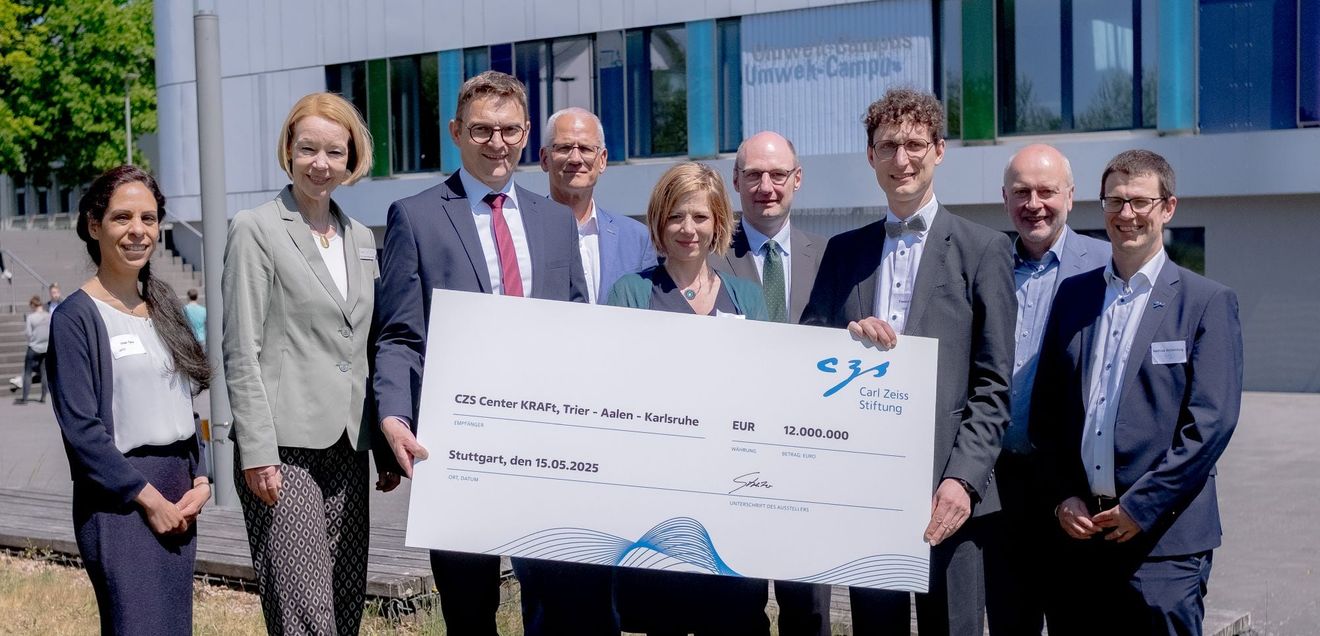
The Birkenfeld Environmental Campus of Trier University of Applied Sciences, Aalen University of Applied Sciences and the Karlsruhe Institute of Technology (KIT) are involved in this project. The Carl Zeiss Foundation is funding the project with 12 million euros. The opening ceremony with symbolic handover of the check took place today, May 15, 2025, at the Birkenfeld Environmental Campus of Trier University of Applied Sciences.
The newly founded research network addresses the careful use of limited resources such as raw materials and energy, one of the most pressing challenges of our time. The researchers are using the potential of additive manufacturing for this purpose. It makes it possible to develop new types of components with high functionality and to use recycled secondary materials in additive plastic and metal processes for resource-efficient production. This allows resources to be saved during product manufacture, but also during the production process. Within the Center, ten interdisciplinary working groups cover the entire additive manufacturing process chain for plastics, metals and technical ceramics - from precise material characterization and the analysis of material and energy data to the development of improved manufacturing processes and optimized products.
"A more efficient use of resources is essential for the sustainable growth of the economy and society. As an interdisciplinary research network, the CZS Center KRAFt pools expertise across locations and looks at the entire additive manufacturing process from different perspectives. In this way, we hope to find new solutions for the circular economy," explains Dr. Felix Streiter, Managing Director of the Carl Zeiss Foundation.
"In view of the limited availability of resources, we urgently need to rethink and use them more sensibly, also with a view to future generations," says Professor Thomas Hirth, Vice President Transfer and International Affairs at KIT. "Only with sustainable innovations and resource-efficient technologies can we guarantee a future worth living for everyone. With the new center, we are contributing to exactly that."
"We can meet the challenges of scarce resources with sustainable production methods. In addition to innovative ideas, this requires open, interdisciplinary and trusting cooperation," emphasizes Professor Joachim Knebel, Head of Department III - Mechanical and Electrical Engineering at KIT. "We can achieve this by bringing together the innovative power of young people and entrusting them with responsibility as well as allowing them freedom of design."
Development of resource-saving process chains
The aim of the center is to obtain high-quality primary materials and to design the entire process chain in additive manufacturing in a resource-efficient manner. In addition to optimizing ecological and economic parameters, the participants also carry out comprehensive life cycle analyses. The aim is to demonstrate and visualize the extent to which the integrated use of secondary materials contributes to reducing the use of primary raw materials. The Center is also pursuing the goal of recording and optimizing energy chains in detail in order to make a sustainable contribution to conserving resources. Collaboration with 24 external cooperation partners, mainly from industry, is also intended to ensure the transferability of the newly developed solutions to a wide range of application areas.
Under the motto "With innovative additive manufacturing technologies, we are laying the foundations for a sustainable and resource-saving future", the project managers officially launched the new center on May 15, 2025. The site manager at KIT is Professor Frederik Zanger from the wbk Institute of Production Engineering at KIT. Together with Professor Christian Greiner from the Institute of Applied Materials - Mechanics of Materials and Interfaces at KIT and Professor Christoph Klahn from the Institute of Micro Process Engineering at KIT, he is working on the goals set for the center.


You might also be interested in
The AKIMI Research Project at WZL
Agent-Based AI Aims to Simplify Robotics for Small and Medium-Sized Businesses
The AKIMI research project is developing an agent-based AI designed to significantly simplify the setup, programming, and reconfiguration of robotic systems for small and medium-sized enterprises. The goal is to make robotics more flexible and...
 read more...
BS Rollen Strengthens Its Presence in North Rhine-Westphalia
With the groundbreaking ceremony, BS Rollen is launching the construction of a new company facility in Hückeswagen. The new building will house administrative offices, an assembly line, and a high-bay warehouse, and is intended to facilitate further...
read more...Intelligent brownfield networking
Many industrial companies are struggling with established plant structures and proprietary interfaces. Stefan Klaus' presentation will show in a practical way how brownfield environments can be efficiently networked with open technologies and made...
read more...Factory-X in practice
How can set-up processes in highly variant production be automated efficiently? Markus Benndorff from soffico shows how Factory-X, industrial data rooms and modular architectures create new possibilities for flexible production concepts.
read more...Mechanical engineering | Case study
Cordless in brush production
The machine manufacturer Wöhler Bohemia is integrating wireless HMI panels from Keba into its brush production systems. The background to this is the need for flexibility, robotics integration and new market strategies.
read more...International product approvals as a strategic competitive advantage in the global market
Which certificates are valid worldwide? Christian Latte, Head of Technical Compliance and Approval Officer at Hummel AG, explains this in an interview. He provides insights into product approvals and explains why early approval strategies shorten...
read more...Foundry modernizes plant park with continuous wire belt shot blasting system
The Spanish foundry Funosa is modernizing its equipment fleet with an RDGE 1250 wire belt continuous shot blasting machine from Rösler. Focus: sand removal from heavy iron castings, energy efficiency, ease of maintenance and ESG strategy.
read more...How bridging steps, stairs and catwalks are changing processes in production and logistics
At Logimat 2026, Munk Günzburger Steigtechnik will be showcasing modular bridging steps, stairs, platform and walkway systems for production, warehousing and logistics. With online configurators, distances can be efficiently shortened, processes...
read more...Drilling cycles optimized
A new replaceable head drill from Walter can reduce machining time in series production thanks to its patented interface and screwless design.
read more...