

Generative design
3D printing in automotive engineering
Additive manufacturing technologies are increasingly being used in automotive production. They can be used to make components lighter and more stable. The example of a 3D-printed seat mount shows how this works.

The demand for electric vehicles is steadily increasing. General Motors, or GM for short, plans to bring at least 20 such vehicles onto the market by 2023 - production is much more expensive and complex compared to traditional cars. Weight plays a particularly important role in these vehicles in order to guarantee range and comfort. At the same time, the development and production of the individual components must not be too time-consuming and complex. For this reason, GM opted for a disruptive approach and a generative design solution. Generative design is a relatively new design approach that uses machine intelligence and cloud computing to quickly generate a wide range of design solutions that meet the specific needs of engineers. Design teams can explore a larger design space, while at the same time aligning with specified manufacturing and performance requirements.
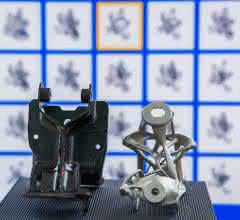
"A vehicle consists of over 30,000 components. Our goal is to reduce this number and thus save weight and reduce complexity," says Kevin Quinn, Director of Additive Design and Manufacturing at GM. "With the help of generative design, we can explore different design solutions for components based on cloud technologies and artificial intelligence and thus find innovative approaches that make us fit for the future - because after electric vehicles, the next challenges are already on the doorstep with autonomous vehicles that need to be mastered. (...) We want to gain a decisive competitive advantage in this area with the help of additive manufacturing and generative design."

New possibilities through generative design
In cooperation with Autodesk, the US automotive group has developed the first 3D-printed and functionally optimized seat mount. The standard component attaches seat belt buckles to seats and seats on the vehicle floor and was the first component to be developed using the generative design technology of the Autodesk Fusion 360 software solution. Engineers defined goals and constraints for the component design, including parameters such as materials, manufacturing process and budget. This information was then entered into the software. The software then uses an algorithm to analyze and evaluate all possible design proposals and recommends an optimal solution based on this.
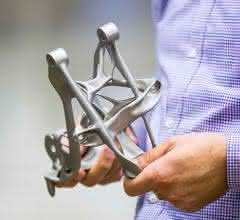
A seat bracket normally consists of eight parts welded together. Using the software, GM engineers were able to generate more than 150 alternative designs and decide on a design consisting of just one stainless steel part. The final product is 40 percent lighter and 20 percent stronger than the company's previous seat mount. Generative design offers engineers the opportunity to experiment. In conjunction with additive manufacturing, infinite design solutions can be implemented with minimal investment. Generative design technology is available today in Fusion 360, Autodesk's cloud-based product development platform. Fusion 360 is a 3D tool for CAD, CAM and CAE that consolidates the entire product development process into a single cloud-based platform, making individual processes on different platforms obsolete.
According to documents from Autodesk / ag


You might also be interested in
ESTIA aims to strengthen Europe's cloud
New tech alliance for EU sovereignty
Twelve companies, including Dassault Systèmes, are founding the European Sovereign Tech Industry Alliance (ESTIA). The initiative aims to strengthen Europe's technological independence and define requirements for sovereign cloud services. The start...
 read more...
Deutsche Telekom and Nvidia launch one of Europe's largest AI factories
With the Industrial AI Cloud in Munich, Deutsche Telekom and NVIDIA are creating one of the largest AI factories in Europe. Companies can train AI models, carry out simulations and access 10,000 GPUs.
read more...Leveraging data potential with AI and streaming
Huge data treasures are still lying dormant in many manufacturing companies. And yet it is high time that these treasures were unlocked. There is often a lack of resources and capacity to make data usable in real time. Streaming production data can...
read more...More awareness of noise
Dematic offers solutions that are tailored to different cloud environments and reduce environmental impact through reduced material consumption and improved energy efficiency.
read more...Generative AI in the automation environment
The mechanical engineering and automation industry is undergoing profound change. This transformation is being driven by more volatile global trade, geopolitical crises and increasing market pressure, which demands greater agility, technological...
read more...Rigid data structures have had their day
The traditional data center is no longer the center of data. A hybrid cloud storage approach enables manufacturing companies to both meet the current requirements of data-intensive processes and future-proof their infrastructure.
read more...Software as a service in three stages
CIM Database Cloud is a new out-of-the-box solution from Contact for end-to-end digital product development.
read more...How production can benefit from AI
Together with AI technology, IIoT networking makes it possible to better control machine parameters and optimize quality with predictive quality. Downtimes and set-up times can also be further minimized. Cloud platforms also make these technologies...
read more...More expertise for digital engineering
Altair, a computational science and artificial intelligence (AI) company, has acquired OmniV, a technology from Michigan, USA-based software company XLDyn.
read more...