
Microscopy
Upgrade makes microscopes digital
Due to the long service life of the optics and mechanics of microscopes, many analog devices are still in use. However, companies do not necessarily have to replace microscopes in order to make their systems fit for a modern digital workflow.
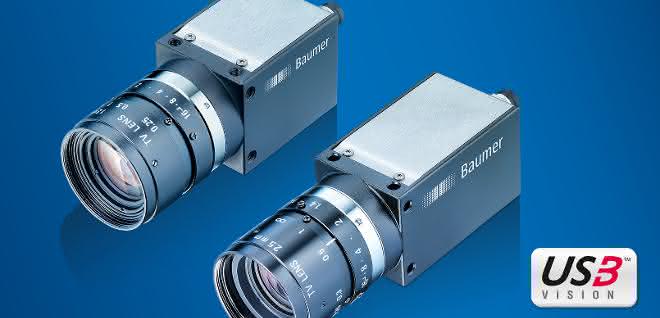
The Autoaim microscope upgrade from Invigon, consisting of a powerful industrial camera from Baumer, the Autoaim microscopy software and the appropriate accessories, brings almost any microscopy system up to the current state of the art.
A digital camera brings tangible benefits for microscopy applications. Instead of looking through an eyepiece, microscopic images can be viewed on a monitor and microscopic areas can be measured on a PC. Subsequent image processing is also possible.
In the age of digitalization, many users who already own a good microscope are therefore looking for a suitable solution. However, to really benefit from a microscope camera, users also need software that controls the camera and provides the necessary functionality for the respective application. A well-coordinated overall solution is therefore required.
This is exactly what Invigon, a software development and industrial image processing company, offers in the form of the Autoaim microscope upgrade package. It contains everything users need to upgrade their existing microscope systems to a modern, digital system. This includes the powerful and intuitive Autoaim microscope software as well as a high-performance 5 megapixel CMOS camera from Baumer's CX series, including all accessories for connection to the PC and calibration. The cameras offer high-resolution and at the same time fluid and fast reacting live images.
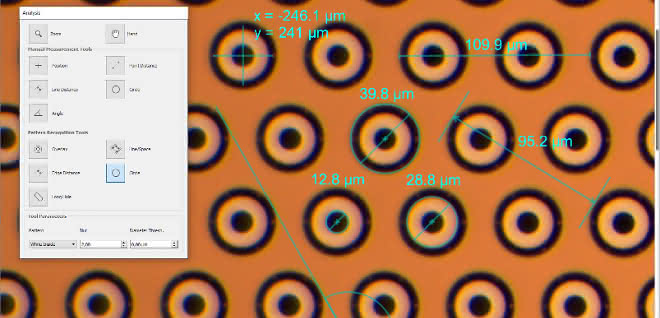
Flexible and modular
With its automatic pattern recognition and simple, reproducible measurement, Autoaim is used by research institutes, medium-sized companies and large corporations. "Our customers praise the intuitive operation and the workflows that can be adapted to their tasks," says Dr. Enrico Seise, Managing Director of Invigon.
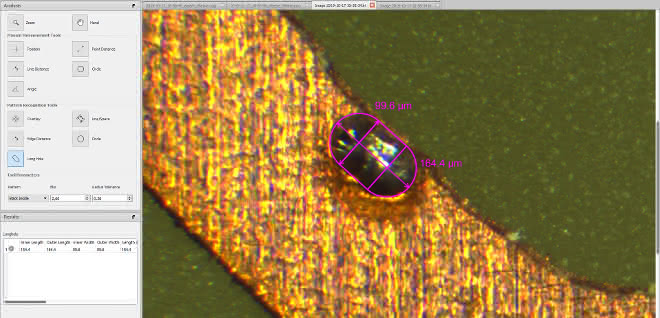
The principle of "recipe-based automation" also allows users without programming knowledge to automate their measurement sequences. To do this, the individual measuring steps are carried out once with a sample in a teach-in process. If only one of several points to be measured was taken into account, the measuring range can be extended afterwards in the software. Once taught, this "recipe" can be carried out on many different samples of the same type. In the event of positional deviations, the integrated pattern recognition automatically recognizes the structures to be measured and measures the relevant points.
A variety of functions, the simple creation of "recipes" and modular hardware compatibility allow a wide range of applications to be implemented, from biology and life sciences to industrial material testing and the inspection of electronic circuit boards. Extensive export options allow comprehensive documentation of all measurement results at all times.
Digital upgrade
"Microscopes with and without cameras have often been an essential part of the work of research institutions and quality inspection in companies for many years. However, due to outdated technology, it is not possible to digitize workflows, or only to an insufficient extent," says Seise, explaining the need to retrofit microscope systems. The upgrade package brings these users up to the latest state of the art. In less than an hour, all components are installed and the software adapted so that digital measurement and documentation can be started quickly and easily.
Even though Autoaim can address a wide range of hardware, Invigon made a conscious decision to deliver the VCXU-51C and VCXU-51M camera models from Baumer as standard in the upgrade package. "It was important to us to have a high-quality camera that works reliably. After all, we want to manufacture our package in industrial quality, and it should also work satisfactorily for the customer." The cameras also impressed on the software side: "As software developers, we naturally pay close attention to the software that comes with the camera, as it becomes part of our software, so to speak," says Seise, adding: "And good documentation and a high level of maturity are important to us, which is what Baumer offers us."
Pixel binning also in color
In terms of hardware, there was also a lot to be said for the models with 5 megapixel resolution. In order to see what is happening to the sample under the microscope, the live image from the camera must be fluid and react quickly to changes. However, high-resolution images, which also transport color information, put older computers in particular to the test of performance due to the amount of data generated.
Invigon has greatly optimized its software to ensure a smooth image even on a ten-year-old PC, which also places demands on the camera. "Baumer cameras reliably deliver more than 30 images/s and can combine several pixels using pixel binning, even if the images are captured in color. Only very few cameras on the market can do this, because other providers cut corners here," explains Seise.
Another plus point is the availability of support for questions. "You can call them late on a Friday afternoon and get an answer. And if we receive a customer inquiry with specific requirements, we can easily borrow a camera to test it. This makes it easier for us to react flexibly and quickly to customer requests," says Seise.
Invigon has been selling the upgrade package since the end of 2019, with consistently positive feedback to date. "In this way, we are contributing to the digitalization of industrial quality assurance and research without having to replace existing microscopes. That's a win-win situation for everyone."
Nicole Marofsky, Marketing Communication at the Baumer Vision Competence Center


You might also be interested in
Basler acquires 76% of Indian image processor
Basler, supplier of image processing components for computer vision solutions, has acquired 76% of the Indian sales partner Alpha TechSys Automation.
 read more...
Process monitoring and fault detection
Cameras ensure quality during laser melting
Powder bed-based laser melting (PBF-LB/M) opens up new possibilities in additive manufacturing. Modern camera systems provide crucial process data to further increase quality and efficiency.
read more...Vision Sensor is three times faster than its predecessor
The 'CS-62' vision sensor from di-soric is around three times faster than its predecessor, the 'CS-60'. In combination with the 'nVision-i 25.1' software, it enables image processing solutions that were previously reserved for smart cameras.
read more...Thermal imaging cameras for quality control
Automated thermal imaging cameras are often suitable for quality control applications where temperature plays a role. However, while there are various solutions on the market for slow processes, it is challenging to select a camera that reliably...
read more...Easy entry into industrial VGA thermography
Reliable temperature measurement is a prerequisite for the success of many industrial processes. Berlin-based manufacturer Optris presents the Xi 640 infrared camera, a new member of its Compact Line, which enables non-contact temperature...
read more...Powder bed-based laser melting optimized
Aconity3D has set itself the goal of optimizing the stability of the manufacturing method of powder bed-based laser melting and thereby promoting its use in a wide range of industries. By using high-speed industrial cameras from SVS-Vistek, the...
read more...INDUSTRIAL Production Products of the year...
2nd place, category handling, assembly and production logistics: SICK
safeVisionary2 is the first 3D time-of-flight camera with Performance Level c safety certification. It enables safe three-dimensional environmental detection and won 2nd place in the competition for Product of the Year 2024 in the handling, assembly...
read more...Nomination Products of the Year 2024
SICK: Camera systems safeVisionary2
safeVisionary2 is the first 3D time-of-flight camera with Performance Level c safety certification. It enables safe three-dimensional environmental detection and has been nominated in the 2024 Product of the Year competition in the handling,...
read more...AI vision brings additional opportunities
The seamless integration of AI into the consumer sector has helped to improve our quality of life and make interactions with technology more efficient. In industry, AI vision with machine learning opens up new possibilities that are not covered by...
read more...