
Quality control
The new dimension of image processing
Automation offers numerous advantages, but at the same time places high demands on integrated image processing. As a result, machine vision solutions often fall short of expectations. The use of 3D light field technology can help to solve demanding tasks quickly and reliably. The combination with modern software helps to use and expand existing know-how in a targeted manner.
It is clear that increasing automation and robotization are making an important contribution to relieving employees of physically strenuous and repetitive tasks. Instead, people are taking over the monitoring, guidance and maintenance of robots and machines. However, these more demanding and appealing tasks are not the only consequence - companies also benefit from the additional time for innovation and further development, in addition to lower production costs, less downtime and increased quality.
Unfortunately, reality often does not yet meet these expectations. In order for robots to work reliably, they not only need a precisely defined task, the right size, power or a suitable gripper, but above all they must also recognize the respective parts - a core task of industrial image processing. In practice, however, the correct identification of the situation regularly presents these systems with immense challenges. Complex lighting and camera setups are therefore often used, individually customized for a specific task. In the past, this always required a great deal of experience and specialist knowledge in this area. And even then, success was not always immediate.
Anyone who has already implemented a few image processing projects knows that sensor and software limitations are difficult to avoid, especially with complex workpieces. As a result, the task is divided into manageable sub-areas for several camera/illumination pairs. This often results in extensive setups. There is no question that these image processing systems are expensive. This is particularly true when it comes to complex objects, such as those with a metallic sheen, which require precisely balanced imaging conditions.
To make matters worse, these extensive designs not only require expert design knowledge, but also need it for implementation and handling in day-to-day business. Simple and intuitive use by workers does not usually exist. The same applies when companies want to adapt their vision systems to new parts or even expand them to include other tasks. Due to the individual design, it is often simply impossible to continue using these systems. This considerably reduces planning reliability. With shrinking batch sizes and more frequent product iterations, this is a serious challenge. Accordingly, those responsible in companies take a critical view of automation solutions based on industrial image processing.
New image capture technology simplifies the process
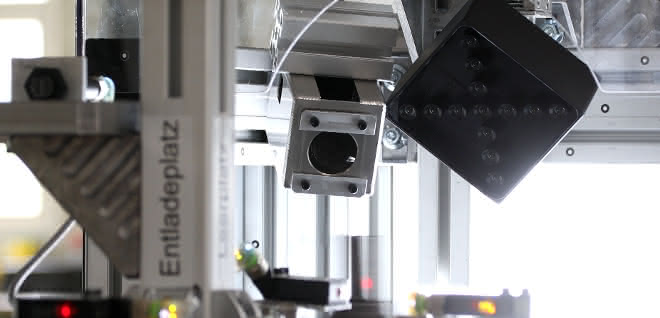
The light field opens up a new dimension in automation here: compact 3D sensors based on a multi-camera array ensure robust image capture thanks to the unique technology. Light field sensors offer a whole range of advantages: less occlusion, reduction of gloss and reflections, for example on metal, plastic and fiber composites, precise and dense point clouds thanks to the multi-camera array, compact and lightweight, fast recording - no multiple exposures necessary.
The light field achieves all of this via the so-called plenoptic function P(θ, ζ, λ, t, Vx, Vy, Vz). In addition to the light beam described by two angles (θ and ζ), the wavelength for color images λ, the time course t, it also contains the corresponding 3D coordinates Vx, Vy and Vzof the camera position. This function can be used to reproduce any view at any time from any position and at any wavelength. The plenoptic function thus forms the basis for all further calculations for the use of light field technology - for example in industrial image processing. With the help of multi-camera arrays for recording and abstracting several image angles, this theory can be used in an industrially suitable manner.
Software must go hand in hand with hardware
In combination with high-performance software, this creates a new generation of machine vision solutions: complex, customized setups with confusing operation are replaced by systems that are quick, easy and intuitive to use. Solid image recognition using a light field makes it possible to solve various tasks with a compact multi-camera array combined into a sensor. Depending on the software configuration, these include bin picking and object handling, 3D scanning and AI quality inspection. These systems are equally easy to adapt and expand. What's more, new workpieces no longer require expert knowledge, but can be implemented in a very short space of time.
In this way, light field-based image processing, together with modern, user-friendly software, makes a valuable contribution to making industrial automation even more successful in the future. The intuitive self-serving approach transforms the role of employees from one of executing to one of planning and monitoring. In no time at all, they become experts for upcoming extensions and adjustments.
Mareike Schindler-Kotscha, Head of Marketing, HD Vision Systems


You might also be interested in
Soft grippers for delicate foods
Irregularly shaped, fragile, and varying in size and weight: products such as potatoes, baked goods, and dairy products push mechanical grippers to their limits.
 read more...
Development Collaboration for Humanoid Robotic Hands Launched
Schunk is entering into a new development partnership with Robert Bosch Robotics. Their shared goal is to develop an industrial-grade robotic hand that can be integrated into various humanoid robot systems.
read more...Robot-controlled packaging of rolls
Koch Robotersysteme, a company specializing in the integration of robotic systems, has developed a complete, automated packaging line for packaging rolls based on Tentoma’s RoRo StretchPack packaging machine.
read more...Robotics and autonomous order picking
Locus Robotics acquires Nexera Robotics and expands autonomous warehouse logistics
Locus Robotics takes over Nexera Robotics and may have taken a decisive step towards truly universal warehouse automation. A new gripping technology should now make possible what was previously considered difficult to automate.
read more...Gentle wheel handling
The newly founded Eisenmann Robotics division develops new robotics concepts to increase the level of automation in modern production facilities.
read more...Gripping systems and vacuum generators
Schmalz is presenting new gripping systems and vacuum generators at Automatica. Exoskeletons, which allow employees to move heavy workpieces effortlessly, will also be on display.
read more...Smart universal gripper for power electronics
The power electronics manufacturer Semikron Danfoss uses the EGU 50 mechatronic parallel gripper from Schunk in a robotic cell. It handles different components and feeds them to a measuring line. With its functionalities, it meets all requirements...
read more...Schmalz takes over finger gripper from Soft Robotics
The vacuum specialist Schmalz is expanding its gripper portfolio and acquiring the mGrip product family from the US company Soft Robotics (SRI), including all finger gripper configurations, patents and the associated know-how.
read more...Soldering with special gripper
In order to make the mini wave soldering of large panels stable and reproducible, Eutect developed a special gripper that prevents the panel from bending, among other things.
read more...