

Container as a service
Machine vision in the cloud
The cloud is becoming increasingly popular in all sectors of industry. A wide range of services and products can be used in a highly scalable, flexible, cost-effective and fail-safe manner. Machine vision applications are also increasingly being offered in the cloud.

Services from the cloud are all the rage. Quite a few companies are transferring comprehensive business processes, software tools and even complete application landscapes such as ERP systems to the cloud. Image processing modules from the production plant are now also being connected to cloud systems across the board. This means that material can be reordered directly via the logistics ERP module, for example. The results from quality assurance can also be collected in the cloud and evaluated transparently. Due to the strong demand, well-known cloud service providers have already responded and are making corresponding offers available specifically for the automation industry. Microsoft Azure and Amazon Web Services (AWS), for example, support the Open Platform Communications Unified Architecture (OPC UA) standard, which enables end-to-end data transfer between different system platforms.
The required resources can be scaled flexibly and additional storage capacity or greater computing power can be added at any time if required. The cloud procurement model is also cost-efficient, as you only have to pay for the services you actually use. There is also the security aspect: cloud service providers generally operate clusters of several mirrored data centers, so they can guarantee highly available and fail-safe systems. Last but not least, the use of the cloud can considerably simplify development processes and the distribution of software.
Reluctance to use the cloud
Due to the many advantages, it makes sense to also offer solutions for industrial image processing (machine vision) in the cloud. However, some industrial users are still reluctant to use such services because they fear for the security of their data. The image information from machine vision applications often contains a lot of internal know-how that needs to be protected. Many users therefore have reservations. They are reluctant to outsource image data to external servers as they do not want to lose control of their systems and want to retain an overview of data access.
These concerns can be allayed if the most suitable cloud usage model is selected: For example, users do not necessarily have to use the public cloud, i.e. server resources from well-known providers such as Microsoft, Amazon or Google. The numerous advantages can also be realized with a private cloud. For example, the data can be stored in an externally shielded data center in your own factory building or in a local partner company. Here too, software, for example, can be distributed much more easily than in traditional on-premise infrastructures. A private cloud also makes it easier to ensure the reliability and scalability of systems centrally within a company or factory. However, if a public cloud is preferred, users should pay attention to the location of the servers. If the cloud provider operates its data centers in Germany, they are subject to the strict requirements of the European General Data Protection Regulation, which ensures a high level of security and protection against unauthorized access.
"Container as a service" model
The common cloud providers today are also flexible enough to offer demanding customers individual contracts, exclusive servers and private network connections.
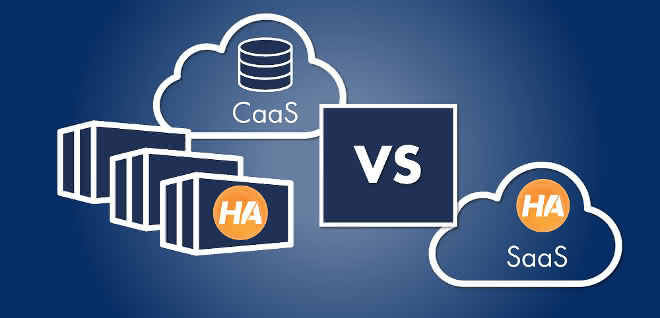
MVTec Software is also bringing its image processing solutions to the cloud to enable users to benefit from the many advantages. For example, the "Container as a Service" (CaaS) model is being used as part of a pilot program.
The library of the standard machine vision software Halcon runs in a Docker software container in a cloud instance and is activated by a license server in the cloud. The number of containers and their hardware resources can be freely scaled. With this model, the customer benefits from maximum flexibility when hosting in a public cloud such as AWS, Azure or Google Cloud, but also in a self-operated private cloud. The only requirements are compatibility with Docker and a connection to the licensing server. In comparison: In the "Software as a Service" (SaaS) model, the cloud provider itself offers individual services and hosts them in its own data centers.
As industrial machine vision applications have very specific requirements, cloud services are not yet as widespread here as in other business applications. Long or variable response times as well as complete connection failures cannot be accepted if real-time applications are to be guaranteed with sufficient performance. In addition, security and data protection concerns limit the use of the cloud, especially when processing sensitive industrial data.
Machine vision in the cloud - three scenarios
In order to identify suitable machine vision applications for the cloud, MVTec has implemented several cloud pilot projects in close cooperation with customers. Three different scenarios come into consideration here: As part of so-called "centralized processing", large volumes of data are processed centrally in a private or public cloud. This can involve, for example, the evaluation of large volumes of image data, the training of deep learning models or automated software tests.
The situation is different with "Vision as a Service": here, the machine vision software is used to provide a web service for industrial image processing. A corresponding service can be provided for applications that do not run in real time. Examples of this include optical character recognition (OCR), barcode reading or services for analyzing, classifying and storing images for use.
The third deployment scenario is the so-called "Deployment at the Edge". Here, the user uses cloud-based Halcon technologies to license machine vision applications and make them available on edge devices. The difference to conventional solutions is that it is not the machine vision software itself that runs in the cloud, but only the licensing service. However, the same Docker technology is used for deployment as for other cloud applications.
Even if there are still some reservations on the part of the industry, the cloud is still a sensible option for the provision of machine vision applications. Users benefit from flexibly scalable, cost-effective and fail-safe services. Depending on their individual requirements, companies can choose between a private and a public cloud.
Christian Eckstein, Business Developer & Partner Manager, MVTec Software / am


You might also be interested in
"We are clearly different from the competition"
The IT company 21unity offers a range of hardware and software services, as well as traditional services. Andreas Mühlbauer spoke to Managing Director Anja I. Gondolf about the company's appearance at the Hannover Messe, its services and future...
 read more...
Think digital, act local
When it comes to industrial damping technology, on-site advice is often very valuable for engineers and designers.
read more...Plagiarius 2024 negative prize
On January 26, 2024, the Plagiarius campaign awarded its dreaded "Plagiarius" negative prize for the 48th time to manufacturers and retailers of particularly brazen counterfeits and fakes.
read more...Spindel Full Service records second-best...
Maintenance as an economic success factor
Spindel Full Service, the spindle repair specialist from Baden-Württemberg, can look back on its second-best financial year in its history - with 15% growth compared to the previous year. And the further forecast also looks good.
read more...Thyssenkrupp and Novelis cooperate
Platform for the circular economy
With a platform for the circular economy in the automotive industry, the two companies Thyssenkrupp Materials Services and Novelis want to set new standards for the recycling of used materials. The open platform will enable access to larger...
read more...How production can benefit from AI
Together with AI technology, IIoT networking makes it possible to better control machine parameters and optimize quality with predictive quality. Downtimes and set-up times can also be further minimized. Cloud platforms also make these technologies...
read more...Marco Ghirardello takes the lead
Fanuc has appointed Marco Ghirardello (48) as the new President and CEO of Fanuc Europe. Ghirardello succeeds Shinichi Tanzawa, who has led the company since 2016 and will take on a new role at Fanuc's headquarters in Japan.
read more...Efficient robot monitoring
Microchips are installed almost everywhere - whether in smartphones, washing machines or cars. With increasing digitalization, the demand for semiconductors has been growing rapidly in all areas of the economy for years.
read more...Everything on one platform
Functional and powerful tools are essential for professional work on the construction site, in the workshop or when carrying out repairs.
read more...