

Dual camera
3D laser profile sensor for maximum precision
Matrox Imaging has introduced AltiZ, a 3D laser profile sensor that uses two integrated cameras to ensure high precision and minimize scan gaps.
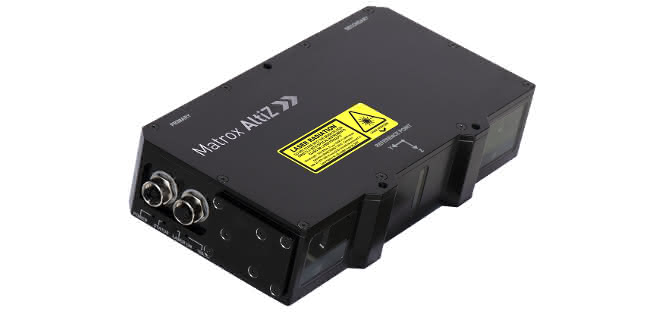
With an optimally coordinated combination of hardware and software for image evaluation, the profile sensor distributed in Germany and Austria by Rauscher opens up new possibilities for 3D image processing.
The market for 3D image processing has been growing significantly for years. The technology, which was initially only used by a few specialists and in very limited fields of application due to its complexity and high demands on computing power and expertise, has now established itself as a permanent tool in the image processing toolbox.
Users have various options from different manufacturers for the realization of 3D image processing systems. The triangulation method is the optimal method when high-resolution and precise three-dimensional image data is required: A laser projects a line onto the object to be examined. A camera calibrated at an angle to the laser captures images of this laser line, which is displayed with different deflections depending on the surface contour of the object. By moving the object relative to the camera, individual images of the laser line can be recorded and combined. Processed with suitable software, a three-dimensional image of the object can be created.
In principle, laser triangulation for recording 3D image data always requires a mechanical movement of the object or sensor in order to capture the scan lines. However, compared to many single-shot technologies such as time-of-flight or stereo vision, the achievable measurement resolution with this method is many times greater.
A disadvantage of conventional 3D profile sensors with a camera and a laser is that, depending on the shape of the object, the laser line cannot be captured continuously by the camera. The result of such optical shadowing is scanning gaps and therefore incomplete data of the object, which cannot be measured at the affected points and checked for the desired quality characteristics.
Two cameras reduce shadowing effects
The Matrox AltiZ 3D laser profile sensor also works according to the principle of laser triangulation, but has a significant advantage over many other systems: Its housing integrates two cameras instead of just one. Simultaneous observation of the laser line with two opposing optical sensors reduces the risk of gaps in the image capture, as object contours that cannot be recognized by one camera due to shadowing are captured by the second sensor.
In addition, the use of two cameras solves a problem that often occurs when inspecting metallic objects: the laser line creates interfering reflections on the surfaces, which make it difficult for a camera to recognize the actual measurement line. Thanks to AltiZ's dual-camera setup, the images taken from two different angles are internally aligned and corrected, allowing reliable and stable extraction of the laser line.
The dual-camera solution leads to another important advantage of AltiZ: the system enables greater precision than sensors with just one camera. Depending on which of the four available AltiZ models is used, surfaces can be captured on the basis of up to 1984 pixels per profile with an accuracy of up to 4 µm. The possible speed of image acquisition is a profile rate of up to 2500 profiles per second. AltiZ also offers the option of operating the sensors alternately, thereby doubling the profile rate, in order to increase image capture even further if required. In cases where no shadowing is to be expected due to the objects or where this is insignificant for quality inspection, the 3D laser profile sensor can therefore also be used economically in fast processes.
Flexible options
In addition to the dual camera setup, AltiZ has a number of other special features that make it easier for the user to use. For example, the conversion of the recorded profile data into the output 3D point cloud and/or the 2.5D depth map takes place entirely within the camera without the use of a PC. All patented algorithms for maximum precision run entirely on the powerful integrated FPGA. To simplify the integration of AltiZ into the respective application, the system is equipped with all common interfaces and I/Os. This makes it easy to synchronize the image acquisition with the object speed, which is usually transmitted to the sensor via encoder signals in conveyor belts, for example. A GigE Vision GenICam/GenDC interface with Power-Over-Ethernet (PoE) is available for data output.
With four AltiZ models and three working ranges from 55 to 310 mm in the X direction and 100 to 545 mm in the Z direction, Matrox Imaging covers a wide range of possible 3D applications. If the detection range of a 3D profile sensor is not sufficient, it is also possible to cascade several AltiZ systems to achieve the required scanning width. There is a model with a red laser for each of the three working areas, which produces a line that is optimally recognizable for the cameras on most materials. A model with blue laser light is also available for inspecting plastic objects.
The developers have also implemented the mechanical requirements for practical use and equipped AltiZ with a compact and robust IP67 housing, which can be easily installed in any application with the help of numerous mounting options. The two cameras of the AltiZ sensors are fully calibrated ex works, so that users do not have to invest any unnecessary time in this area either.
Hardware and software
Matrox Imaging is known for both machine vision hardware, such as frame grabbers and embedded PCs, and machine vision software, such as the Matrox Imaging Library (MIL) and Matrox Design Assistant. For more than 10 years, Matrox has been combining its many years of experience in hardware and software for the Iris GTR series of smart cameras. With AltiZ, the Canadian company has now developed its first complete hardware and software product for 3D image processing. The main advantage is obvious: controlling and supporting a system with hardware and software from a single source is considerably easier for the user and significantly reduces the workload.
Due to the GenDC standard used for 3D image processing, which is becoming increasingly popular and widespread in the market, AltiZ users have the flexibility to use software packages other than the MIL or Matrox Design Assistant.
Possible areas of application for AltiZ include the automotive industry, electronics manufacturing, food and pharmaceutical production and many other industrial sectors in which three-dimensional objects need to be inspected quickly and with high accuracy. Thanks to its performance and pricing, the AltiZ 3D laser profile sensor offers a reliable and economical way of avoiding faulty products in many fields of application, thereby increasing productivity in manufacturing.


You might also be interested in
Basler acquires 76% of Indian image processor
Basler, supplier of image processing components for computer vision solutions, has acquired 76% of the Indian sales partner Alpha TechSys Automation.
 read more...
Process monitoring and fault detection
Cameras ensure quality during laser melting
Powder bed-based laser melting (PBF-LB/M) opens up new possibilities in additive manufacturing. Modern camera systems provide crucial process data to further increase quality and efficiency.
read more...Vision Sensor is three times faster than its predecessor
The 'CS-62' vision sensor from di-soric is around three times faster than its predecessor, the 'CS-60'. In combination with the 'nVision-i 25.1' software, it enables image processing solutions that were previously reserved for smart cameras.
read more...Thermal imaging cameras for quality control
Automated thermal imaging cameras are often suitable for quality control applications where temperature plays a role. However, while there are various solutions on the market for slow processes, it is challenging to select a camera that reliably...
read more...Easy entry into industrial VGA thermography
Reliable temperature measurement is a prerequisite for the success of many industrial processes. Berlin-based manufacturer Optris presents the Xi 640 infrared camera, a new member of its Compact Line, which enables non-contact temperature...
read more...Powder bed-based laser melting optimized
Aconity3D has set itself the goal of optimizing the stability of the manufacturing method of powder bed-based laser melting and thereby promoting its use in a wide range of industries. By using high-speed industrial cameras from SVS-Vistek, the...
read more...INDUSTRIAL Production Products of the year...
2nd place, category handling, assembly and production logistics: SICK
safeVisionary2 is the first 3D time-of-flight camera with Performance Level c safety certification. It enables safe three-dimensional environmental detection and won 2nd place in the competition for Product of the Year 2024 in the handling, assembly...
read more...Nomination Products of the Year 2024
SICK: Camera systems safeVisionary2
safeVisionary2 is the first 3D time-of-flight camera with Performance Level c safety certification. It enables safe three-dimensional environmental detection and has been nominated in the 2024 Product of the Year competition in the handling,...
read more...AI vision brings additional opportunities
The seamless integration of AI into the consumer sector has helped to improve our quality of life and make interactions with technology more efficient. In industry, AI vision with machine learning opens up new possibilities that are not covered by...
read more...